Introduction: The Liquidity Challenge in Global Supply Chains
For United States-based electronics manufacturers and high-tech capital equipment providers, the Indian market represents massive growth potential. However, establishing a localized supply chain has historically presented a severe liquidity challenge. Importing critical components meant paying steep upfront customs duties long before the final product was sold, trapping millions of dollars in working capital.
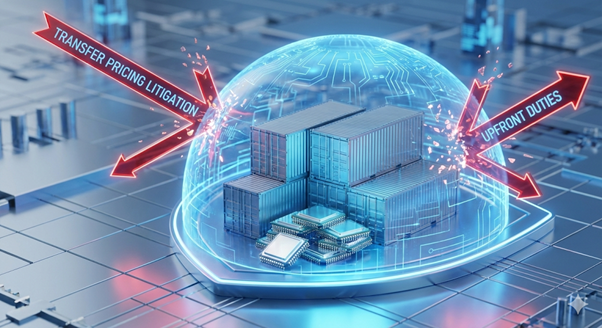
Furthermore, maintaining inventory in India via a foreign entity often triggered Permanent Establishment (PE) risks. This exposed the US parent company to complex and protracted Transfer Pricing litigation with Indian tax authorities. The newly refined 2026 “Component Warehousing” Safe Harbor fundamentally resolves these financial and regulatory bottlenecks.
For a US Chief Financial Officer (CFO), this regulatory update is a game-changer. It allows manufacturers to execute a “just-in-time” delivery model within India while utilizing statutory tax deferments to protect cash flow. Understanding and implementing this safe harbor must be the cornerstone of your operational strategy when planning an expansion into the subcontinent.
Leveraging Bonded Warehousing Without TP Litigation
Historically, if a US electronics firm held inventory in an Indian warehouse to quickly service local clients, the Indian Revenue Service often categorized this as a Permanent Establishment. This classification meant the profits attributed to those sales were subjected to Indian corporate tax, leading to aggressive Transfer Pricing scrutiny regarding the valuation of the imported components.
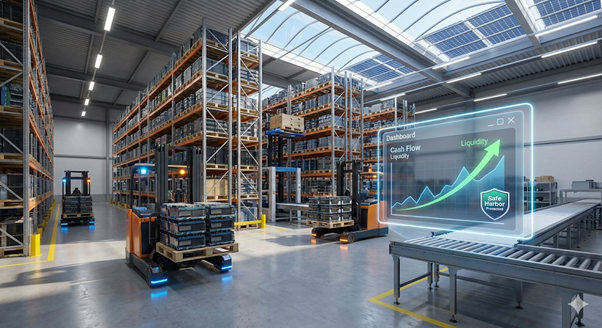
The 2026 Safe Harbor framework provides a distinct legal shield. By utilizing specifically licensed custom-bonded warehouses under schemes like the Manufacturing and Other Operations in Warehouse Regulations (MOOWR), US firms can park inventory securely. Under the safe harbor provisions, merely holding stock in these designated zones for domestic fulfillment or assembly no longer automatically triggers a PE status, provided specific corporate structuring guidelines are strictly followed.
This allows US manufacturers to position critical semiconductor chips, displays, and electronic sub-assemblies locally. You can guarantee rapid fulfillment to your Indian B2B clients without exposing your global profits to local taxation or initiating a decade of transfer pricing litigation in the appellate tribunals.
Custom-Bonded Area Tax Holidays for Capital Equipment
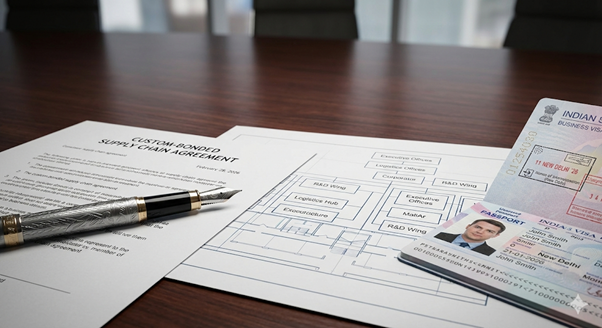
Beyond simple component storage, the safe harbor provisions extend massive benefits to US capital equipment providers. If you are manufacturing high-value testing machinery or automated assembly robotics, you can utilize the custom-bonded areas as active assembly hubs.
Importing the raw materials and sub-components into these bonded facilities incurs zero upfront customs duty and zero Integrated Goods and Services Tax (IGST). The tax holiday remains entirely active while the components sit in the warehouse or undergo assembly.
The duty is only triggered at the exact moment the finished equipment is cleared from the bonded warehouse into the domestic Indian market. If the assembled equipment is subsequently exported to another market in Asia or Europe, the duty is waived entirely. This mechanism completely neutralizes the financial friction of cross-border manufacturing.
Financial Impact: Traditional Import vs. Bonded Warehousing Safe Harbor
| Financial Metric | Traditional Direct Import Model | 2026 Bonded Warehousing Safe Harbor |
| Customs Duty Payment | Paid immediately at the port of entry | Deferred indefinitely until domestic sale |
| Working Capital Impact | High capital lock-in for months | Maximum liquidity preservation |
| Transfer Pricing Risk | High (if maintaining local stock) | Protected under Safe Harbor guidelines |
| Export Tax Burden | Complex drawback claiming process | Zero duty on re-exported goods |
Supply Chain Liquidity and the CFO’s Mandate
For the executive suite, the decision to localize operations is ultimately a mathematical equation. The 2026 safe harbor fundamentally alters the Return on Investment (ROI) calculations for an India Business Setup. By delaying the payment of import duties until the point of revenue generation (the domestic sale), US companies align their tax liabilities directly with their cash inflows.
This optimization of supply chain liquidity frees up millions in working capital. US CFOs can redirect these funds toward aggressive market acquisition, local marketing, or further Research and Development. However, capitalizing on these benefits is not an automatic right; it requires highly deliberate legal and financial architecture.
Navigating the intersection of US corporate tax law, Indian customs regulations, and local corporate compliance requires expert intervention. A standard incorporation process will not capture these advanced supply chain benefits.
Structuring Your Market Entry with KNM India
Executing a highly optimized market entry requires a partner who understands both international finance and local statutory nuances. KNM Management Advisory Services Pvt. Ltd. (KNM India) acts as a premier one-stop business support partner for US multinationals entering the Indian market.
Our specialized Corporate Advisory and Pre-Incorporation teams work directly with your US headquarters. When you are setting up business in india, we design your corporate entity to seamlessly integrate with custom-bonded warehousing schemes. We handle the complex Foreign Direct Investment (FDI) approvals, structure your inter-company agreements to satisfy safe harbor requirements, and provide ongoing Virtual CFO services to monitor your deferred tax liabilities.
Do not allow inefficient supply chain structuring to erode your global margins. By partnering with KNM India, you ensure your corporate foundation is engineered for maximum profitability and absolute regulatory compliance from day one.
[Link to KNM Corporate Advisory Services] [Link to KNM Pre-Incorporation and FDI Services] [External Link to Central Board of Indirect Taxes and Customs (CBIC) – MOOWR Guidelines]
Key Takeaways
- Cash Flow Optimization: The 2026 Component Warehousing Safe Harbor allows US manufacturers to defer upfront customs duties, drastically improving supply chain liquidity and working capital.
- Litigation Shield: By utilizing designated bonded warehousing structures, foreign entities can maintain inventory in India without triggering Permanent Establishment (PE) or aggressive Transfer Pricing (TP) audits.
- Capital Equipment Advantages: US capital equipment providers can utilize custom-bonded area tax holidays to store and assemble high-value machinery tax-free before final domestic sale or re-export.
- Strategic Entry: A successful India Business Setup requires meticulous Pre-Incorporation and FDI advisory to integrate these safe harbor provisions into the corporate legal structure from day one.
Frequently Asked Questions (FAQs)
Q1: What qualifies an electronics manufacturer for the 2026 Component Warehousing Safe Harbor? Qualification depends on strict adherence to the operational guidelines of custom-bonded warehouses and ensuring that the inter-company agreements between the US parent and the Indian logistics or operating entity meet the specific safe harbor definitions to avoid Permanent Establishment.
Q2: Can we assemble products inside the bonded warehouse without losing the tax deferment? Yes. Under schemes like MOOWR, companies are permitted to undertake manufacturing and other operations inside the bonded warehouse. The customs duty on the imported components remains deferred throughout the entire assembly process.
Q3: How does this impact our overall India Business Setup strategy? It shifts the strategy from a “direct sales” model to a “localized fulfillment” model. By incorporating an Indian subsidiary that utilizes bonded warehousing, you can offer faster delivery times to Indian clients while maintaining the financial efficiency of an offshore entity.
Q4: What happens if the components stored in India become obsolete and are never sold? If components stored in the bonded warehouse become obsolete, they can be re-exported back to the United States or destroyed under customs supervision without ever triggering the payment of Indian customs duties or IGST.
Q5: How can KNM India assist US companies in setting up business in india under this framework? KNM India manages the entire lifecycle. We assist with the initial feasibility studies, execute the corporate incorporation, secure the necessary warehouse licensing, and establish the robust accounting frameworks required to track deferred duties and satisfy statutory auditors.
🌐 Website: https://knmindia.com
📞 Telephone and Contact Information:
Tokyo: +81-3-6869-0850
India: +91-124-4295170, +91-99105-04170
📧 Email: services@knmindia.com
📩 Contact: The contact page on knmindia.com allows you to contact our experts.