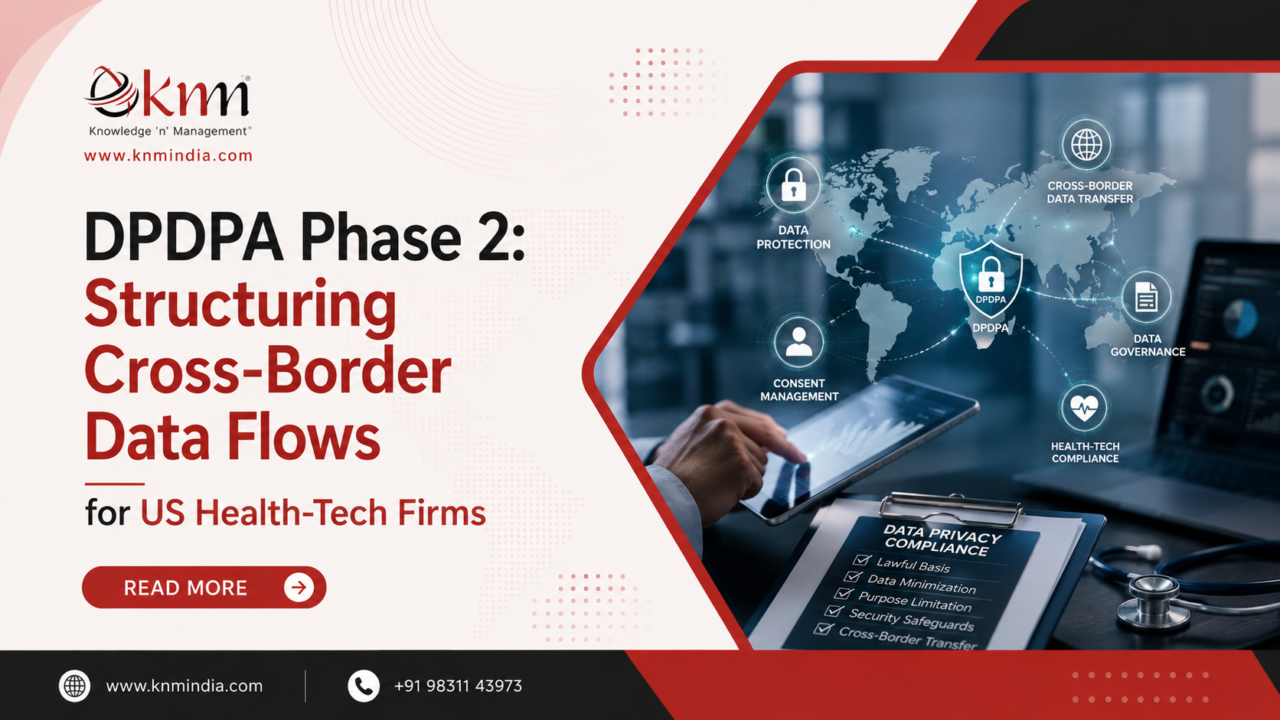
Are you navigating the strict cross-border transfer rules under the DPDP Act? Discover how US health-tech entities can achieve compliance as a massive competitive B2B sales advantage in India.
The Indian digital health ecosystem is expanding at an unprecedented rate, offering a highly lucrative market for US-based health-tech firms. From AI-driven diagnostics to telemedicine infrastructure, American software-as-a-service (SaaS) and medical technology providers are scaling rapidly across the subcontinent. However, entering and operating in this market during 2026 comes with a profound new operational reality: Phase 2 of the Digital Personal Data Protection Act (DPDPA).
As the(Meity) rolls out the operational infrastructure for the DPDPA—including the highly anticipated Consent Manager frameworks by mid-2026 and full enforcement by May 2027—US health-tech firms face intense scrutiny. Health data is inherently sensitive, and the rules governing how this data moves across borders are becoming stringent.
Rather than viewing the DPDPA as a regulatory roadblock, forward-thinking US firms are utilizing Compliance Outsourcing to turn data privacy into a strategic B2B sales advantage. Here is how US health-tech entities can structure their cross-border data flows, mitigate multi-million-dollar penalties, and dominate the Indian enterprise healthcare market.
Key Takeaways
- The “Negative List” Paradigm: India’s DPDPA permits cross-border data transfers by default, except to specific countries restricted by the Central Government. US firms must continuously monitor this dynamic blacklist.
- Significant Data Fiduciary (SDF) Triggers: Health-tech platforms processing sensitive patient data or utilizing AI for healthcare profiling are highly likely to be classified as SDFs, triggering mandatory external audits and the appointment of an India-based Data Protection Officer (DPO).
- B2B Competitive Advantage: Indian hospitals and enterprise healthcare networks will not procure non-compliant US software. Strict DPDPA compliance accelerates the enterprise sales cycle and builds institutional trust.
- The Role of Outsourcing: Managing the complexities of local data laws requires specialized local expertise. Compliance Outsourcing allows US firms to maintain continuous compliance without inflating internal headcount.
The DPDPA Phase 2 Reality: Cross-Border Data Transfers
For US health-tech companies, the core of their operational model often relies on global infrastructure. Data collected from patients in Mumbai or Delhi is frequently routed to cloud servers in Virginia, analyzed by offshore teams, or utilized to train global AI health models.
Under the previous regulatory regime, cross-border data transfer rules were ambiguous. The 2026 DPDPA Phase 2 rollout provides explicit legal guardrails. The Act shifts away from a restrictive “whitelist” (where data can only go to pre-approved countries) to a permissive “negative list” or “blacklist” approach. Personal data may be transferred outside India unless the destination country is specifically prohibited by the Indian government.
However, this permissive approach is heavily caveated. US firms must ensure that their cross-border transfers are fortified by:
- Purpose Limitation and Notice: Data Principals (Indian patients or users) must be given an itemized, clear notice in multiple languages explicitly detailing what data is being transferred, why it is being transferred, and who will have access to it.
- Transfer Impact Assessments (TIAs): Even if the US is not on the negative list, health-tech firms must conduct rigorous TIAs. If your platform utilizes third-party sub-processors (like AWS, Azure, or global analytics firms), you are legally responsible for their data hygiene.
- Data Erasure Mechanisms: If an Indian user revokes their consent, the US health-tech firm must have the technical capability to locate and erase that specific patient’s data across all global servers and third-party sub-processors immediately.
Compliance as a B2B Sales Accelerator
In the B2B health-tech sector, your clients are Indian hospitals, pharmaceutical companies, and clinical research organizations. Under the DPDPA, these Indian enterprises are the primary “Data Fiduciaries,” while the US SaaS provider acts as a “Data Processor.”
If a US firm experiences a data breach or mismanages cross-border transfers, the Indian hospital utilizing the software faces direct statutory penalties—which under the DPDPA can reach an astronomical ₹250 crore (approximately $30 million USD).
Because of this immense shared risk, Indian healthcare enterprises have completely overhauled their procurement and vendor due diligence processes. They are actively rejecting foreign software that cannot prove absolute DPDPA compliance.
Conversely, US health-tech firms that arrive at the negotiation table with a fully localized, audited DPDPA framework bypass these procurement bottlenecks. By demonstrating robust data governance, encryption, and local grievance redressal mechanisms, compliant US firms drastically reduce the legal risk for Indian buyers, transforming privacy compliance into a definitive competitive advantage over non-compliant global peers.
Comparing Cross-Border Operations: Pre-DPDPA vs. Phase 2 (2026-2027)
| Operational Metric | Pre-DPDPA Era | DPDPA Phase 2 Era (2026-2027) |
| Data Transfer Legality | Ambiguous; reliant on basic contractual clauses. | Permitted, subject to the Central Government’s “Negative List” restrictions. |
| User Consent | Bundled in lengthy, complex Terms of Service. | Must be granular, itemized, accessible in multiple languages, and easily revocable via Consent Managers. |
| Breach Notification | Vague timelines; often delayed reporting. | Mandatory, rapid notification to the Data Protection Board of India and affected users. |
| Vendor Liability | Limited liability for offshore data processors. | Primary fiduciaries hold strict liability; US health-tech firms must offer indemnification and audit rights. |
| Governance Structure | Global DPO managed all global privacy queries. | High-risk platforms must appoint a resident, India-based DPO reporting to the board. |
The Strategic Imperative of Compliance Outsourcing
For a US health-tech firm expanding into India, attempting to navigate the DPDPA internally is a highly inefficient deployment of capital and legal resources. The Indian regulatory ecosystem is notoriously dynamic; rules change frequently, and localized interpretations of the law require on-the-ground expertise.
This is driving a massive surge in Compliance Outsourcing. By partnering with established Indian advisory firms, US enterprises can seamlessly integrate legal, technical, and operational safeguards into their software without distracting their core engineering or US legal teams.
Effective global compliance management of India operations involves delegating critical DPDPA tasks to specialized external partners. These tasks include drafting India-specific privacy notices, establishing local grievance redressal offices, and maintaining continuous Transfer Impact Assessments for cross-border data flows. Furthermore, these privacy mandates are deeply intertwined with corporate structuring. Excellent post incorporation services now go beyond basic tax filings; they encompass the deployment of localized IT policies, employment data contracts, and mandatory Data Protection Impact Assessments (DPIAs).
How KNM India Architects Your Digital Expansion
At KNM India, we understand that for US health-tech firms, speed to market is just as critical as regulatory security. Our specialized Compliance Outsourcing service line acts as your dedicated Indian regulatory fortress.
We provide end-to-end global compliance management for US corporations. From the moment you decide to enter the Indian market, our experts handle the intricate details of DPDPA Phase 2. We audit your cross-border data flows, draft compliant vendor and sub-processor agreements, and provide the specialized post incorporation services required to set up your India-based Data Protection Officer and grievance mechanisms.
By outsourcing your compliance architecture to KNM India, you ensure that your health-tech platform is not only legally insulated against ₹250 crore penalties but also perfectly positioned to win high-value B2B contracts with India’s largest healthcare enterprises.
Conclusion
As the 2026-2027 DPDPA Phase 2 enforcement deadlines approach, the window for voluntary compliance is rapidly closing. For US health-tech firms, cross-border data transfers are the lifeblood of their AI, analytics, and operational models. Navigating the strict “negative list” policies, mandatory consent architectures, and enterprise due diligence demands requires flawless strategic execution.
By embracing Compliance Outsourcing, US health-tech organizations can eliminate regulatory friction, safeguard their intellectual property, and transform data privacy from a legal burden into a highly lucrative B2B sales differentiator in the booming Indian healthcare market.
Frequently Asked Questions (FAQs)
- Does the DPDPA require US health-tech firms to store all data locally in India?
No, the DPDPA does not impose a blanket data localization mandate. It utilizes a “negative list” approach, allowing personal data to be transferred across borders to the US and other countries, provided the destination country has not been explicitly restricted by the Indian Central Government and proper consent has been acquired.
- What happens if a US firm violates the cross-border data transfer rules under DPDPA?
Non-compliance can result in severe financial penalties levied by the Data Protection Board of India. Fines can reach up to ₹250 crore (approx. $30 million USD) for failing to implement reasonable security safeguards, and cross-border data flows may be suspended, crippling the software’s functionality.
- Why is Compliance Outsourcing recommended for US tech firms in India?
India’s digital and corporate laws are highly specialized and subject to rapid updates. Compliance Outsourcing provides US firms with immediate access to credentialed local experts, ensuring continuous, real-time regulatory adherence without the immense cost and delay of building an in-house legal team in India.
- How does DPDPA compliance impact B2B sales for US software companies?
Indian enterprises (hospitals, banks, corporations) are strictly liable for the software vendors they use. A US firm that is fully DPDPA compliant significantly reduces the legal risk for the Indian buyer, allowing the software to pass strict enterprise procurement audits and vastly accelerating the B2B sales cycle.
Is your health-tech platform ready to pass the rigorous DPDPA audits demanded by Indian healthcare enterprises? Do not let regulatory blind spots derail your global expansion.
👇 Comment “DPDPA” below to connect with KNM India’s experts and secure your cross-border data compliance roadmap today.
🌐 Website: https://knmindia.com
📞 Telephone and Contact Information:
Tokyo: +81-3-6869-0850
India: +91-124-4295170, +91-99105-04170
📧 Email: services@knmindia.com
📩 Contact: The contact page on knmindia.com allows you to contact our experts.