
Introduction: The Infrastructure Gold Rush
As India accelerates toward its century of independence in 2047, the government is heavily incentivizing the digital backbone required to support a multi-trillion-dollar digital economy. For United States-based cloud providers, hyperscalers, and AI developers, this presents a generational expansion opportunity. The regulatory environment has evolved to classify data centers as critical infrastructure, unlocking significant financial benefits.
However, capturing these benefits requires a flawless India Entry Strategy. Entering the market with a standard wholly owned subsidiary often exposes the US parent company to severe tax inefficiencies and permanent establishment (PE) risks. To truly capitalize on the long-term infrastructure incentives—often referred to in the industry as the 2047 data center tax holiday—MNCs must architect their legal entities with extreme precision before a single server is installed.
The complexity lies in balancing massive capital expenditure (CapEx) with strict data localization laws and optimized global tax repatriation. This article deconstructs the structural models US tech giants must deploy to secure their foothold in the Indian cloud market safely and profitably.
Deconstructing the Long-Term Tax Benefits
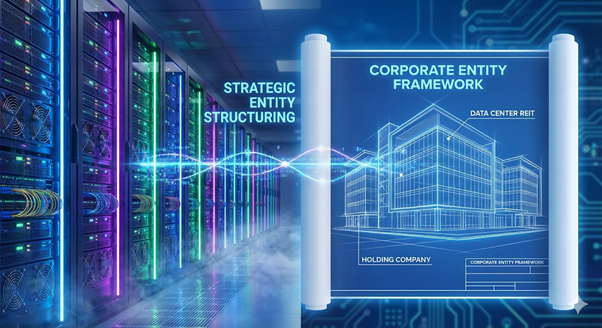
The Indian government’s infrastructure status for data centers allows operators to access long-term, low-cost funding and specific tax exemptions, particularly when located within Special Economic Zones (SEZs) or designated tech parks. These benefits create a predictable financial runway extending decades into the future.
To maximize these incentives, the corporate structure must clearly isolate the capital-intensive data center operations from standard software sales. Mixing these revenue streams in a single entity dilutes the tax benefits and complicates compliance. The goal is to ring-fence the infrastructure assets to ensure they qualify for the maximum allowable deductions and state-level subsidies over the 21-year operational horizon.
Tax Structure Comparison for Data Centers
| Parameter | Standard Corporate Structure | Optimized Infrastructure Structure |
| Base Corporate Tax | 25% to 30% (depending on turnover) | Highly subsidized under SEZ/Infrastructure policies |
| Import Duties (Servers) | Standard customs duty applicable | Duty-free imports (if in SEZ/Free Trade Warehousing) |
| Power Subsidies | Standard commercial grid rates | Exemptions from electricity duty and cross-subsidy charges |
| Transfer Pricing Risk | High (due to mixed revenue streams) | Low (clear distinction between asset and service) |
The “Dual-Entity” Requirement
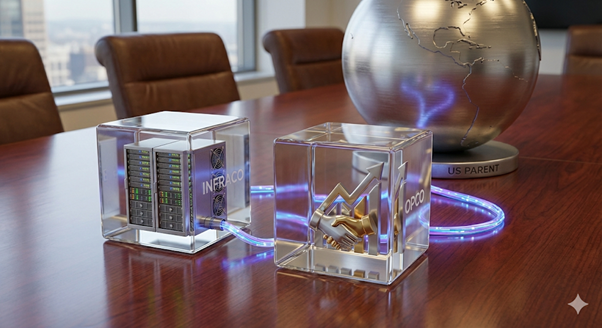
The most effective India Entry Strategy for US cloud MNCs is the “Dual-Entity” model. In this framework, the US parent establishes two distinct Indian companies. Entity A (The Infrastructure Company/InfraCo) owns the real estate, cooling systems, and servers. Entity B (The Operating Company/OpCo) handles domestic sales, marketing, and customer billing.
This separation is critical for regulatory and commercial reasons. InfraCo operates exclusively in the B2B space, leasing computing power to OpCo. OpCo, in turn, acts as the local reseller to Indian enterprises. This structure allows the US firm to invoice Indian clients in local currency (INR) while utilizing domestic Data Process Outsourcing frameworks to manage local customer support and compliance without burdening the InfraCo.
Furthermore, this dual structure protects the US parent from permanent establishment risks. If a single entity handles both the physical servers and the direct software sales, the Indian tax authorities may categorize the entire global revenue stream generated from those servers as taxable in India.
IP and Toll Manufacturing for Global AI
For US hyperscalers driving the artificial intelligence boom, compute power is only half the equation; the other half is algorithmic intellectual property (IP). A primary concern during an india market entry is ensuring that AI models trained on Indian servers do not accidentally transfer IP ownership to the Indian subsidiary.
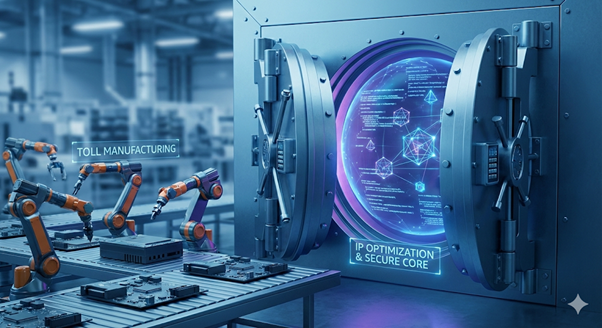
To solve this, US firms utilize a “Toll Manufacturing” or contract R&D model. The Indian InfraCo provides raw compute power and processing services to the US parent for a fixed markup (cost-plus model). The US parent retains absolute ownership of the software, algorithms, and training data.
The Indian entity never owns the intangible assets; it merely performs high-level processing services. This ensures that the massive value generated by the AI models remains domiciled in the US, while the Indian entity remains perfectly compliant with domestic transfer pricing regulations.
KNM India: Architecting Your Cloud Expansion
Executing a dual-entity data center strategy requires deep expertise in cross-border taxation, FDI regulations, and local corporate law. KNM Management Advisory Services Pvt. Ltd. (KNM India) serves as the premier partner for US technology firms executing complex expansions into the subcontinent.
Our specialized Pre-Incorporation and Corporate Advisory teams work directly with your US-based CFOs and legal counsel to design entity structures that maximize infrastructure tax holidays while ring-fencing your intellectual property. We provide an end-to-end advisory experience that bridges the gap between US corporate expectations and Indian statutory realities.
If your organization is planning its next hyperscale deployment, engaging expert corporate advisory early is not optional—it is a financial imperative. We ensure your corporate architecture is as robust and scalable as the data centers you are building.
[Link to KNM Pre-Incorporation & FDI Services] [Link to KNM Corporate Advisory Services] [External Link to Ministry of Electronics and Information Technology (MeitY) Data Center Policies]
Key Takeaways
- Long-Term Horizon: The push toward India’s 2047 vision offers unprecedented infrastructure and tax incentives for hyperscale data centers, functioning as a de facto long-term tax holiday.
- Dual-Entity Necessity: A successful India Entry Strategy for US cloud providers requires separating the infrastructure asset company from the domestic reseller and service entity.
- IP Protection: Global AI players can utilize toll manufacturing models to process data in India while strictly keeping intellectual property and algorithmic ownership in the US.
- Strategic Advisory: Structuring these complex, multi-layered FDI setups requires precise Pre-Incorporation and Corporate Advisory support from specialized firms like KNM India.
Frequently Asked Questions (FAQs)
Q1: What defines a “Dual-Entity” structure in the context of Indian data centers? A dual-entity structure involves incorporating two separate companies: one that purely holds and operates the physical data center infrastructure (InfraCo) and another that handles domestic customer sales, software licensing, and marketing (OpCo).
Q2: Why is Data Process Outsourcing relevant to a cloud infrastructure strategy? By isolating customer support, billing, and domestic data management into a separate OpCo, the US parent can utilize efficient Data Process Outsourcing models. This keeps the headcount and operational complexity of the heavily capitalized InfraCo to an absolute minimum.
Q3: Does the Toll Manufacturing model protect our US-registered patents? Yes. Under a strictly drafted toll manufacturing or contract processing agreement, the Indian entity is legally defined as a captive service provider. It processes data on hardware it owns, but all resulting IP and algorithmic improvements automatically vest with the US parent company.
Q4: Can we transition a standard subsidiary into a dual-entity structure later? While corporate restructuring is possible, it is highly complex and attracts significant capital gains taxes and stamp duties when transferring assets (like servers and land) between entities. It is vastly superior to execute this structure during the initial market entry.
Q5: How does KNM India assist with this specific structural setup? KNM India handles the entire lifecycle. We draft the customized Articles of Association, secure necessary FDI approvals from the Reserve Bank of India, establish the transfer pricing agreements between the entities, and manage the ongoing statutory audits to ensure compliance.
🌐 Website: https://knmindia.com
📞 Telephone and Contact Information:
Tokyo: +81-3-6869-0850
India: +91-124-4295170, +91-99105-04170
📧 Email: services@knmindia.com
📩 Contact: The contact page on knmindia.com allows you to contact our experts.