

Foreign nationals can establish businesses in India in 2026, supported by a legal framework designed for foreign investment and operations. India’s economic growth and government initiatives make it an opportune time for foreign market entry or expansion.
Factual Validation: India’s Evolving Investment Landscape (2025-2026)
- Policy Relaxations: In Q4 2025, the DPIIT issued a press note detailing further relaxations in sector-specific FDI caps, indicating continued government support for foreign investment.
- Streamlined Processes: In Q3 2025, the Ministry of Corporate Affairs (MCA) enhanced its digital filing processes and expedited processing times for Director Identification Numbers (DINs) and company name approvals, simplifying initial incorporation.
- FDI Surge: Economic Times reported a substantial surge in India’s FDI inflows during FY2025, with manufacturing, renewable energy, and digital services being key sectors.
- Single Window Clearance: Livemint covered government discussions regarding a potential “Single Window Clearance” mechanism for foreign businesses, with pilot programs anticipated in early 2026.
- Industry Campaigns:
- PwC India launched its “India’s Investment Outlook 2026” campaign, focusing on economic trends, regulatory stability, and strategic market entry.
- EY India initiated its “India’s FDI Advantage” campaign, highlighting sector-specific opportunities and emphasizing comprehensive legal and tax planning.
These regional data points validate India’s commitment to attracting foreign investment through policy improvements, streamlined processes, and sector-specific opportunities.
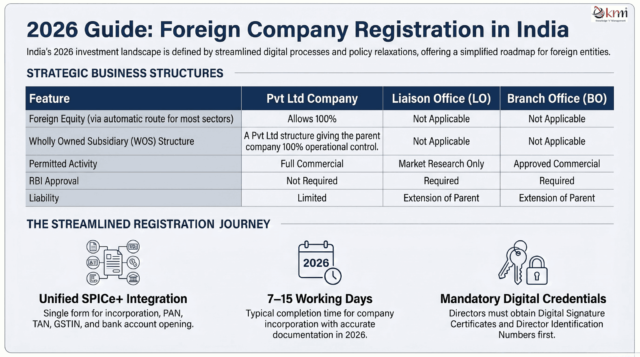
Key Legal Structures for Foreign Businesses in India (Updated for 2026)
Foreign investors have several options for establishing a business presence in India:
- Private Limited Company (Pvt Ltd):
- Foreign Equity: Allows up to 100% foreign equity under the automatic route in most sectors.
- Directors: Requires a minimum of two directors, with at least one being an Indian resident.
- Shareholders: Requires a minimum of two shareholders.
- Capital: No statutory minimum capital requirement.
- Compliance: Subject to annual filings with the Registrar of Companies (ROC) and audited financials.
- Limited Liability Partnership (LLP):
- Foreign Investment: Generally permitted under the automatic route, subject to specific sectoral restrictions and conditions under FDI policy.
- Designated Partners: Requires a minimum of two designated partners, with at least one being an Indian resident.
- Capital: No statutory minimum capital requirement.
- Compliance: Annual ROC filings; often perceived as having simpler compliance than a Pvt Ltd Company.
- Wholly Owned Subsidiary (WOS):
- Structure: A specific form of Private Limited Company where a foreign parent company holds 100% of the equity.
- Purpose: Provides the foreign parent full control over Indian operations.
- Liaison Office (LO):
- Purpose: Engages in non-profit activities such as market research, brand promotion, or acting as a communication channel for the parent company.
- Regulation: Requires specific approval from the Reserve Bank of India (RBI); strictly prohibited from undertaking commercial or trading activities.
- Branch Office (BO):
- Purpose: Permitted to carry out specific commercial activities as approved by the RBI, such as export/import trading, consultancy services, and IT services.
- Regulation: Requires RBI approval; profits generated are repatriable to the parent company.
- Project Office (PO):
- Purpose: Established for executing specific projects in India, particularly in infrastructure or manufacturing sectors.
- Regulation: RBI approval is typically required, though certain projects funded by international agencies or meeting specific criteria may qualify for an automatic approval route.
Comparison Table: Choosing the Right Business Structure for Foreigners
| Feature | Private Limited Company (Pvt Ltd) | Limited Liability Partnership (LLP) | Liaison Office (LO) | Branch Office (BO) | Project Office (PO) |
| Liability | Limited | Limited | N/A (Extension of Parent) | N/A (Extension of Parent) | N/A (Extension of Parent) |
| Control | Board of Directors | Designated Partners | Parent Company | Parent Company | Parent Company |
| Capital | No statutory minimum | No statutory minimum | Funded by Parent | Funded by Parent | Funded by Parent |
| Permitted Activities | Full Commercial Activities | Full Commercial Activities | Market Research, Liaison | Approved Commercial Activities | Project Execution |
| Compliance Burden | Higher | Moderate | Lower | Moderate | Moderate |
| RBI Approval | Generally Not Required | Generally Not Required | Required | Required | Typically Required |
| FDI Policy Link | DPIIT FDI Policy | DPIIT FDI Policy | RBI Guidelines | RBI Guidelines | RBI Guidelines |
| MCA Link | MCA Website | MCA Website | N/A | N/A | N/A |
Example: A foreign tech company establishing a software development center would find a Private Limited Company or Wholly Owned Subsidiary appropriate for full commercial activities and control. For market research only, a Liaison Office would suffice.
The Business Registration Process for Foreigners in 2026: A Step-by-Step Guide
The registration process has been streamlined by digital reforms:
- Obtaining Digital Signature Certificate (DSC) & Director Identification Number (DIN): Directors must obtain these through a mandatory digital application process.
- Name Approval (RUN Form): Apply online for name approval, ensuring compliance with updated name availability rules.
- Company Incorporation (SPICe+ Form Part B): Use the integrated SPICe+ form for company incorporation, PAN, TAN, EPFO, ESIC, GSTIN, and bank account opening.
- Post-Incorporation Compliances: Ensure immediate regulatory filings and basic adherence requirements post-incorporation.
The MCA’s SPICe+ form consolidates multiple registrations, significantly reducing incorporation time. Feedback from Q3 2025 MCA updates suggests further reductions in average company registration time for compliant applications.
Foreign Direct Investment (FDI) Policy in India: 2026 Overview
India’s FDI policy outlines the routes for foreign investment:
- Automatic Route: Investment allowed without prior RBI or government approval.
- Government Approval Route: Investment requires prior approval from the relevant government ministry or department.
Key sectors for FDI and permitted caps include manufacturing, renewable energy, and digital services, which have seen recent policy changes or increased investor interest.
Taxation & Compliance for Foreign Businesses
- Corporate Income Tax: Applicable rates and potential incentives.
- Goods and Services Tax (GST): Understanding the indirect tax regime.
- Double Taxation Avoidance Agreements (DTAA): How DTAAs can benefit foreign businesses.
- Annual Filings and Regulatory Adherence: Ongoing statutory and regulatory compliances.
Challenges & Considerations for Foreign Investors
Potential hurdles include navigating the regulatory landscape, cultural integration, and industry-specific challenges. Government initiatives like the “Single Window Clearance” (reported by Livemint in late 2025) aim to simplify regulatory complexities.
FAQs: Foreign Business in India
- Can a single foreigner start a business in India? While a Private Limited Company typically requires at least two directors (one Indian resident), individual entrepreneur options may exist under specific conditions requiring careful legal structuring.
- Minimum Capital Requirements (2026): Generally, no statutory minimum capital requirements exist for Private Limited Companies and LLPs.
- Physical Office Requirement: A registered office address in India is mandatory for company incorporation.
- Typical Registration Time (2026): Company incorporation can often be completed within 7-15 working days with accurate documentation.
- Profit Repatriation: Profits can generally be repatriated subject to FEMA regulations, applicable taxation laws, and sector-specific policies.
Conclusion: Seizing Opportunities in India’s Dynamic Market
India offers significant potential as a global business hub. Successful and compliant market entry requires expert legal and financial guidance. India’s substantial FDI inflows in FY2025 reflect its attractiveness to foreign investors across diverse growth sectors.
Connect With Us Today
📞 Call: 01244295170
✉️ Email: services@knmindia.com
🌐 Visit: www.knmindia.com