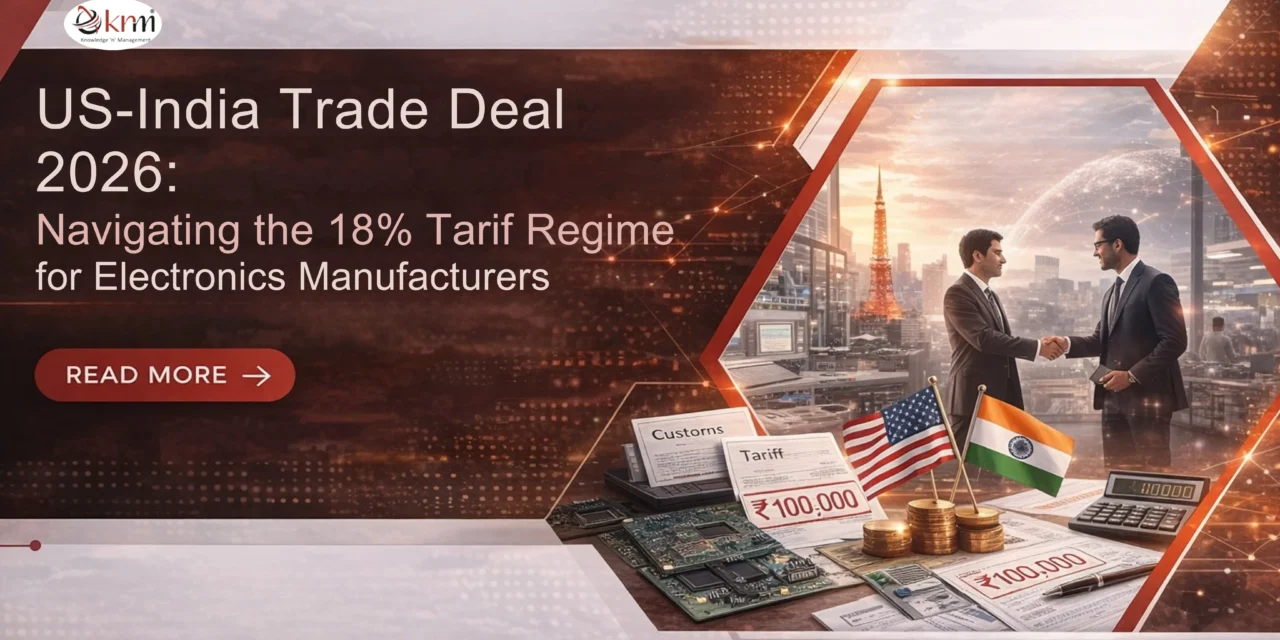
Introduction: The Shifting Center of Global Manufacturing
For United States electronics manufacturers, the search for a resilient, cost-effective alternative to traditional East Asian manufacturing hubs has been a decade-long boardroom priority. The “China Plus One” strategy was often hindered by complex export duties and unpredictable tariff structures. The ratification of the US-India Trade Deal in 2026 fundamentally alters this dynamic.
The centerpiece of this bilateral agreement is the aggressive reduction of tariffs on specific electronics and component exports originating from India and bound for the United States. By slashing the tariff ceiling from a prohibitive 50% down to a highly competitive 18%, the economic calculus for global supply chain leaders has changed overnight.
This is no longer a speculative opportunity; it is a definitive financial mandate. For US Chief Executive Officers and trade teams, the question is no longer whether to manufacture in India, but how rapidly the transition can be executed. However, realizing these newly unlocked margins requires far more than finding a local factory; it demands a highly engineered corporate architecture.
Margin Visibility on US-Bound Exports
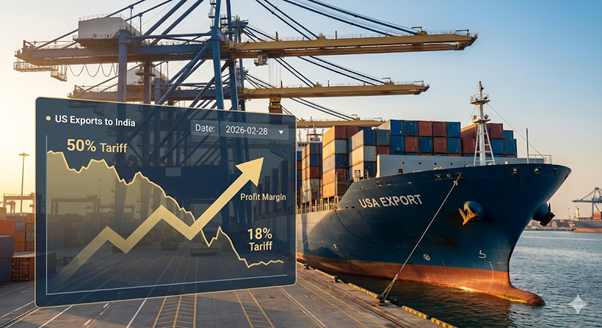
The most significant hurdle for US manufacturers operating overseas has historically been margin compression caused by fluctuating trade policies. The 2026 trade deal establishes a stabilized 18% tariff corridor for electronics, providing unprecedented forward visibility.
When you are planning the relocation of high-volume assembly lines, predictability is just as valuable as profitability. This stabilized rate allows US companies to confidently forecast their landed costs in North America. Furthermore, it provides the financial justification required by global investors and boards of directors to authorize massive capital expenditures in the subcontinent.
To fully realize these gains, the financial controllers in the US must ensure that their Indian subsidiary is impeccably structured. Leakage through inefficient local taxation or poorly managed transfer pricing can quickly erode the 32% margin advantage granted by the new trade deal.
Financial Impact: Pre-2026 vs. Post-2026 Tariff Regime
| Export Metric (Electronics) | Pre-2026 Tariff Environment | Post-2026 Trade Deal (18% Regime) |
| Average Export Tariff | Up to 50% | Capped at 18% |
| Margin Predictability | Highly Volatile | Highly Stable |
| Investor Confidence | Moderate (High Risk) | Strong (Clear ROI pathway) |
| Supply Chain Role | Backup / Secondary Hub | Primary Global Export Hub |
Architecting Your Indian Market Entry
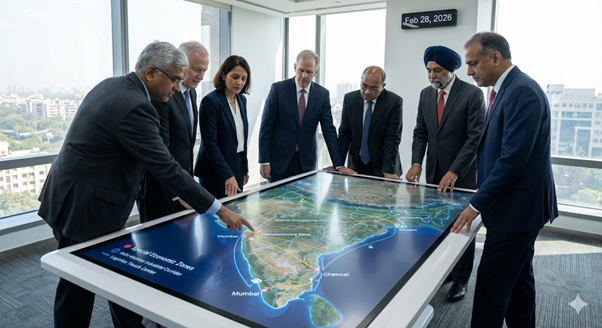
Capitalizing on the 18% tariff regime requires precision from day one. An optimized Indian market entry is not merely about incorporating a private limited company. It involves selecting the correct regulatory framework to maximize both domestic subsidies and international trade benefits.
For instance, companies must evaluate whether to establish their manufacturing units within Special Economic Zones (SEZs) or under the Export Oriented Unit (EOU) scheme. Each classification carries distinct rules regarding local sales, raw material imports, and corporate tax rates. Choosing the wrong classification during the initial setup can permanently handicap the facility’s profitability.
When starting a business in india, US firms must also navigate the Foreign Direct Investment (FDI) guidelines specific to the electronics sector. Ensuring that capital injections from the US parent company are compliant with Reserve Bank of India (RBI) regulations is critical to preventing stranded capital and facilitating smooth future dividend repatriations.

Accelerating Production with Transaction Advisory
Given the urgency to capture market share under the new tariff rules, many US firms cannot afford the 18 to 24-month timeline typical of a greenfield factory build. The strategic alternative is to acquire existing operational facilities or form joint ventures with established Indian manufacturers.
This route requires sophisticated Transaction Advisory Services. Buying an Indian company introduces complex risks regarding legacy compliance, environmental clearances, and undisclosed liabilities. A rigorous financial and legal due diligence process is non-negotiable before any acquisition is finalized.
Expert transaction advisors bridge the gap between US corporate acquisition standards and Indian market realities. They ensure that the target company’s valuations are accurate, the deal structure is tax-efficient across borders, and the integration plan secures the immediate capacity needed to leverage the 18% export tariff.
KNM India: Your Bridge to the Factory Floor
At KNM Management Advisory Services Pvt. Ltd., we serve as the strategic bridge between US boardrooms and Indian manufacturing realities. Our specialized teams understand that the 2026 trade deal represents a generational shift in global manufacturing, and we are positioned to help you capitalize on it.
Our Pre-Incorporation and FDI advisory teams design the optimal corporate structures to house your manufacturing assets. Simultaneously, our Transaction Advisory teams identify, vet, and secure the joint ventures or acquisitions necessary to fast-track your production capabilities.
We act as your local guardian, ensuring that your transition to the Indian market is aggressive, compliant, and highly profitable. Do not let regulatory friction dilute your competitive advantage. Partner with KNM India to seamlessly integrate your operations into the new US-India trade corridor.
[Link to KNM Pre-Incorporation & FDI Services] [Link to KNM Transaction Advisory Services] [External Link to US Trade Representative (USTR) Official Updates]
Key Takeaways
- Margin Expansion: The unprecedented reduction of US-bound export tariffs from 50% to 18% completely reshapes the financial viability of manufacturing electronics in India.
- Predictable Modeling: The 2026 bilateral agreement provides long-term tariff visibility, allowing US Chief Financial Officers to build accurate, decade-long CapEx and OpEx financial models.
- Strategic Structuring: Successfully capturing these margins requires a flawless Indian market entry strategy, ensuring the corporate structure is optimized for export incentives and local tax holidays.
- Accelerated Timelines: Utilizing Transaction Advisory Services for brownfield acquisitions or joint ventures can help US firms bypass the standard greenfield setup delays and immediately access the new tariff regime.
Frequently Asked Questions (FAQs)
Q1: Does the 18% tariff apply to all manufacturing sectors under the 2026 deal? No. The 18% tariff cap is specifically targeted at the electronics manufacturing sector, including specific sub-assemblies, semiconductors, and consumer electronics. Other sectors have different negotiated rate structures.
Q2: What is the fastest way for a US company to start exporting from India? Instead of a greenfield setup, engaging Transaction Advisory Services to acquire a brownfield facility or executing a joint venture with an existing, compliant Indian manufacturer is the fastest route to market.
Q3: How does Indian market entry differ for an export-focused company? Export-focused companies must carefully evaluate setting up in Special Economic Zones (SEZs) or customs-bonded warehouses. These structures offer duty-free import of raw materials, which is critical for maintaining margins before the final product is exported.
Q4: Can we repatriate profits to the US without heavy taxation? Yes, but it requires careful upfront structuring. Utilizing the correct FDI routes, establishing proper transfer pricing agreements, and understanding the Double Taxation Avoidance Agreement (DTAA) between the US and India are essential steps when starting a business in india.
Q5: How can KNM India assist with the initial stages of this transition? KNM India provides end-to-end support, beginning with a feasibility study to confirm your specific HS codes qualify for the 18% rate. We then manage the complete entity incorporation, FDI reporting, and initial regulatory licensing required to commence operations.
🌐 Website: https://knmindia.com
📞 Telephone and Contact Information:
Tokyo: +81-3-6869-0850
India: +91-124-4295170, +91-99105-04170
📧 Email: services@knmindia.com
📩 Contact: The contact page on knmindia.com allows you to contact our experts.