Choosing how to operate in India is not a location decision it’s a structural one. Whether you set up a GCC India entity, contract an outsourcing partner, or use a Build-Operate-Transfer (BOT) model determines your cost structure, your control over IP and talent, and how easily you can exit or scale the arrangement later. This blog compares all three models directly, by cost, control, risk, IP ownership, governance, and exit options, so you can choose based on facts rather than whichever vendor pitched you first.
What Is a GCC Company?
A GCC (Global Capability Center) is a wholly owned offshore or nearshore unit that a company sets up to run core business functions engineering, R&D, analytics, finance, or customer operations directly under its own management and IP ownership.
Unlike outsourcing, a global capability center in India is not a vendor relationship; it’s an extension of the parent company’s own organization, staffed by employees who report into the same functional structure as headquarters. This is why GCC companies in India have shifted over the past decade from basic back-office support to running product engineering, AI/ML development, and strategic finance functions. The parent company owns the entity, the IP generated within it, and the governance structure end to end.
What Is Backoffice Outsourcing?
Backoffice outsourcing means contracting a third-party vendor to perform defined business functions on your behalf, under a service agreement rather than direct employment.
In this model, you don’t own the entity or employ the staff you pay for back office support services delivered against an SLA, with the vendor managing hiring, infrastructure, and day-to-day operations. It’s the fastest way to get functions like transaction processing, IT helpdesk, or accounting support running in India, but you’re renting capacity rather than building an asset. IP generated during outsourced work typically defaults to vendor ownership unless the contract explicitly assigns it back to you a clause many companies discover too late.
What Is a BOT (Build-Operate-Transfer) Model?
A BOT model is a phased arrangement where a third-party partner builds and operates an India center on your behalf for a defined period, then transfers full ownership including staff, infrastructure, and IP to you at a pre-agreed point.
This model exists specifically to solve the tradeoff between GCC and outsourcing: you get a vendor’s speed and market knowledge upfront, without permanently giving up ownership. Companies typically use BOT when they want the eventual control of a GCC but aren’t ready to navigate Indian entity setup, hiring, and compliance from day one.
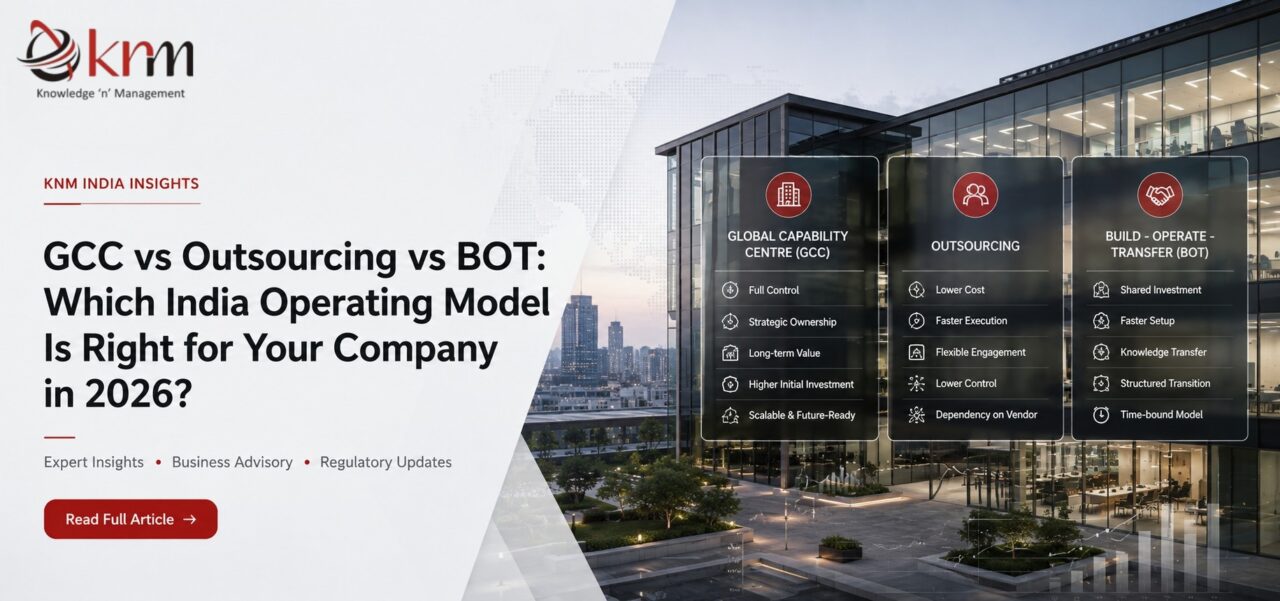
| Model | Best For | Control | Setup Speed |
| GCC | Long-term India operations | High | Slow |
| Outsourcing | Fast execution | Low | Fast |
| BOT | Future GCC ownership | Medium to High | Medium |
GCC vs Outsourcing vs BOT Side-by-Side Comparison
The right model depends on which variable matters most to you: cost predictability, IP control, or setup speed since no single model wins on all three simultaneously.
| Parameter | GCC | Outsourcing | BOT |
| Cost Structure | High upfront, lower long-term per-unit cost | Low upfront, ongoing per-service fee | Moderate upfront, cost shifts to you at transfer |
| Control | Full operational and strategic control | Limited governed by SLA only | Vendor-led initially, full control post-transfer |
| IP Ownership | Retained by parent company | Typically vendor-owned unless contracted otherwise | Vendor-owned during build phase, transferred at exit |
| Governance | Direct reporting into parent org structure | Vendor governance, client oversight only | Vendor governance transitioning to client governance |
| Setup Time | Longest (entity incorporation, hiring, compliance) | Fastest (contract signing only) | Moderate (vendor mobilizes faster than a fresh GCC) |
| Risk Exposure | Higher initial risk, lower long-term risk | Lower initial risk, higher long-term dependency risk | Shared risk, concentrated around the transfer event |
This is where most GCC companies evaluating India get the decision wrong they compare setup speed alone and miss that outsourcing’s low entry cost often comes with the highest long-term dependency risk.
Which Model Is Cheapest Upfront vs. Long-Term?
Outsourcing is the cheapest model upfront, but a GCC typically becomes the lowest-cost option over a 3–5 year horizon once you account for vendor margins baked into every outsourcing invoice.
| Cost Factor | GCC | Outsourcing | BOT |
| Year 1 Cost | Highest (entity setup, compliance, hiring) | Lowest (service fee only) | Moderate (vendor mobilization fee) |
| Ongoing Vendor Margin | None | 20–35% typically embedded in fees | Present during build phase only |
| Cost at Scale (100+ FTEs) | Most efficient per-FTE cost | Margin compounds with headcount | Becomes GCC-equivalent post-transfer |
| Hidden Costs | Compliance, RBI/FEMA filings, HR setup | Contract renegotiation, vendor lock-in | Transfer valuation, transition management |
A backoffice outsourcing arrangement makes sense when you need capacity now and can’t justify entity setup costs for an unproven function but as headcount scales, the embedded vendor margin usually erases the upfront savings within two to three years.
Who Should Choose Each Model?
The right fit depends less on company size and more on how sensitive the function is to IP ownership and long-term control.
- Choose GCC if: the function involves proprietary IP, product engineering, or strategic decision-making you don’t want a vendor holding leverage over, and you’re committed to India as a multi-year location.
- Choose Outsourcing if: the function is standardized, non-differentiating (payroll processing, basic IT support), and speed of deployment matters more than long-term cost efficiency.
- Choose BOT if: you want eventual GCC-level control and IP ownership, but need a vendor’s local expertise to get operational quickly without navigating entity setup alone.
Setting up any of these as a genuine Global Capability Center requires the same regulatory groundwork entity structuring, tax registration, and compliance regardless of which path gets you there.
IP Ownership, Governance, and Exit Options Compared
IP ownership is the single clearest differentiator across all three models: a GCC retains it by default, outsourcing typically forfeits it unless contractually reversed, and BOT holds it in vendor custody until the transfer date.
Governance follows the same pattern. A GCC reports directly into the parent’s organizational structure, meaning strategic decisions are made by the same leadership that runs headquarters. Outsourcing is governed purely through SLAs and contract terms you have oversight, not authority. BOT sits in between: governance is vendor-led during the build phase, with a structured handover of decision-making rights built into the transfer agreement.
Exit paths vary just as much:
- GCC exit: There typically isn’t one you already own the entity, so “exit” means winding down or divesting the subsidiary itself, a more involved regulatory process.
- Outsourcing exit: Governed by contract termination clauses; straightforward but often includes transition-out fees and knowledge-transfer timelines.
- BOT exit: Structured around the transfer trigger a pre-negotiated valuation and handover date after which the vendor relationship ends and full ownership passes to you.
Common Mistakes When Choosing an India Operating Model
Most companies get this decision wrong not because they pick the “bad” model, but because they pick the right model with the wrong contract terms.
- Outsourcing IP-sensitive work: Assuming standard vendor contracts protect your intellectual property, when most default to vendor ownership unless explicitly negotiated.
- Underestimating GCC governance overhead: Treating a GCC as a cost center rather than budgeting for the compliance, RBI/FEMA reporting, and HR infrastructure it actually requires.
- Vague BOT transfer clauses: Leaving the transfer valuation, timeline, or trigger conditions undefined at signing, which turns a clean handover into a prolonged negotiation later.
How KNM India Helps You Choose and Structure the Right Model
Choosing between a GCC, outsourcing, and BOT isn’t just a strategic decision it’s a structuring, compliance, and tax decision that needs to be right from day one. KNM Group has advised international companies on India entry since 1999, helping them structure the right entity, manage RBI/FEMA compliance, and build tax-efficient operations whether that means incorporating a full GCC India subsidiary, structuring a BOT transition, or advising on the contractual protections an outsourcing arrangement needs. Our Virtual CFO and secretarial support continue well past the setup phase, so the model you choose stays compliant and cost-efficient as it scales.
Not Sure Which India Model Fits Your Business?
GCC, outsourcing, and BOT each offer different trade-offs in cost, control, IP ownership, speed, and long-term flexibility.
Talk to KNM India to evaluate the right India operating model for your business – Contact Us
FAQs
What is the difference between a GCC and outsourcing in India?
A GCC is a wholly owned entity where the parent company directly employs staff and retains IP, while outsourcing is a vendor relationship governed by a service contract, with IP typically defaulting to the vendor.
What is a GCC company?
A GCC (Global Capability Center) is an offshore unit fully owned and operated by a parent company to run core business functions like engineering, finance, or analytics under its own governance and IP ownership.
Is a GCC more expensive than outsourcing?
Yes, upfront a GCC requires entity setup, hiring, and compliance costs that outsourcing avoids, but a GCC typically becomes more cost-efficient than outsourcing once operations scale past 100+ employees.
What does BOT mean in India market entry?
BOT stands for Build-Operate-Transfer, a model where a vendor builds and runs an India operation on your behalf for a defined period before transferring full ownership to you.
Do companies own their IP in a GCC model?
Yes, IP generated within a GCC is retained by the parent company by default, unlike outsourcing, where IP ownership typically stays with the vendor unless the contract states otherwise.
Which model is best for a mid-size company entering India?
A BOT model often suits mid-size companies best, since it provides a vendor’s speed and local expertise upfront while still leading to full ownership and IP control once the transfer is complete.