
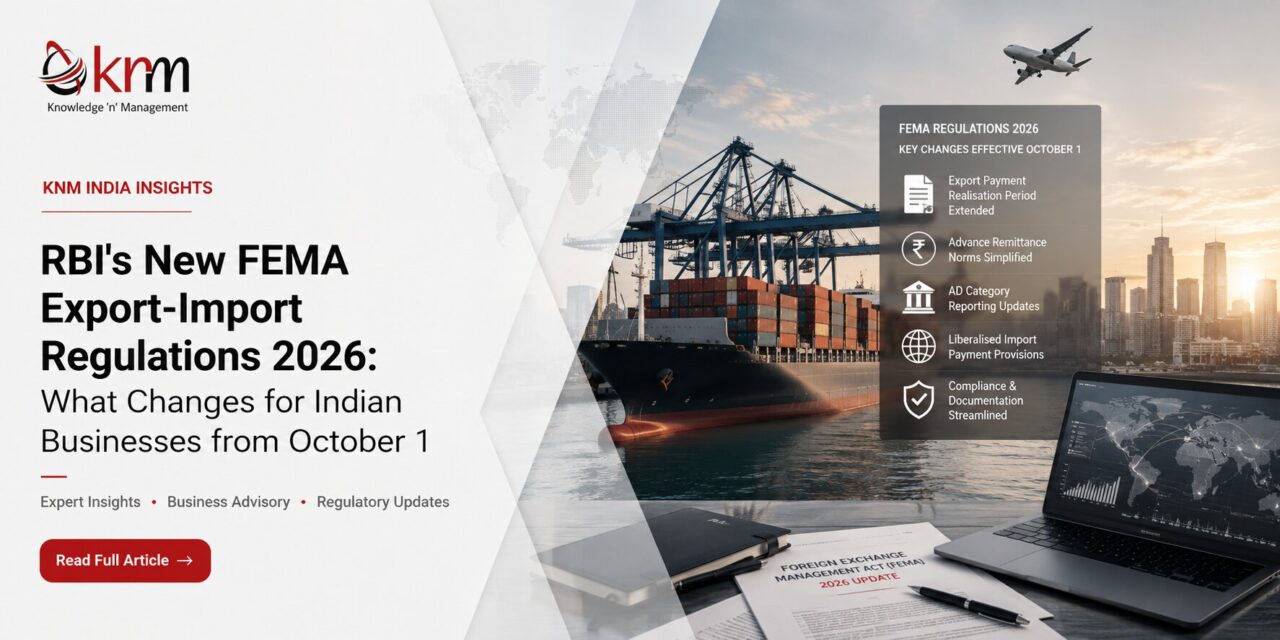
The Reserve Bank of India has consolidated 167 separate circulars into a single rulebook the FEMA export import regulations 2026 and every business that earns foreign exchange from exports needs to know what changes on October 1. Notified as FEMA 23(R)/2026-RB on January 13, 2026, the new regulations replace the older 2015 framework entirely, not just amend it. This is one of the most significant updates to FEMA regulations India has seen in over a decade, and it applies equally to goods exporters, services exporters, and software/IT companies for the first time.
At a glance, here’s what’s changing:
- One unified Export Declaration Form (EDF) replaces separate goods and SOFTEX filings
- The realization/repatriation timeline shifts but not in the way most summaries suggest (more below)
- Services and software exports are now formally brought into the same rulebook as goods
- A simplified, self-declaration path for small shipments up to ₹10 lakh
- Authorised Dealer (AD) banks get more autonomy to approve and extend timelines without RBI referral
What’s Changing Under the FEMA Export Import Regulations 2026
The Foreign Exchange Management (Export and Import of Goods and Services) Regulations, 2026 is a single consolidated instrument issued under Sections 7, 8, 10(6), and 47(2) of the Foreign Exchange Management Act 2026 framework, superseding the FEMA (Export of Goods & Services) Regulations, 2015 along with 167 associated circulars. Regulations 2026 are principle-based rather than prescriptive, meaning AD banks now interpret and apply many provisions directly instead of routing every exception through RBI.
| Area | Old (2015 framework) | New (2026 Regulations, effective Oct 1) |
| Declaration | Separate EDF (goods) + SOFTEX (software) | Single EDF covers goods, services, software |
| Certification | STPI mandatory for software exports | AD banks recognized as “Specified Authority,” STPI optional |
| Realization period | 9 months (as of the current interim rule) | 15 months (18 for INR-invoiced trade) |
| Small shipments | Full documentary justification for write-off | Self-declaration write-off up to ₹10 lakh |
| AD bank powers | Limited; frequent RBI referral | Broader autonomy on extensions and approvals |
A quotable summary: the 2026 Regulations are the first time India has governed goods, services, and software exports under one document instead of three separate frameworks.
The Realization/Repatriation Timeline Why “15 Months” Isn’t the Whole Story
The realization period right now, for any export made before October 1, 2026, is 9 months not 15. This surprises a lot of businesses because the “15 months” figure has been circulating since late 2025, but the timeline has actually moved twice within a single year.
Here’s the actual sequence:
| Shipment/invoice date | Applicable realization period | Governing rule |
| Before Nov 13, 2025 | 9 months | Original Regulation 9, 2015 Regulations |
| Nov 13, 2025 – June 4, 2026 | 15 months | Second Amendment 2025 (temporary relaxation) |
| June 5, 2026 – Sept 30, 2026 | 9 months | First Amendment 2026 (reversal, still in force today) |
| Oct 1, 2026 onward | 15 months (18 for INR-invoiced) | FEMA Export Import Regulations 2026, Regulation 5 |
Worked example: A services company invoices a US client on August 20, 2026. Because that invoice date falls in the June 5–September 30 window, the proceeds must be realized and repatriated within 9 months by roughly May 20, 2027 not 15 months. Had the same invoice been dated October 5, 2026 instead, the deadline would extend to around January 5, 2028. Six weeks either side of October 1 changes the deadline by six months, which is a real cash-flow planning variable, not a technicality.
*Verified as of August 26, 2026, based on RBI notifications FEMA 23(R)/(7)/2025-RB, FEMA 23(R)/(8)/2026-RB, and FEMA 23(R)/2026-RB. Confirm the applicable notification on rbi.org.in before relying on this for contract or compliance decisions, since further interim amendments remain possible before October 1.
One Export Declaration Form (EDF) for Goods, Services, and Software
The Export Declaration Form is the single document under which exporters of goods, services, and software will now declare export value, replacing the earlier requirement of a goods-EDF plus a separate SOFTEX form for software. An export declaration form India filing under the new regime also carries a monthly rhythm for services: exporters must submit the EDF through their AD bank within 30 days of the month-end in which the invoice was raised, and a single EDF can cover multiple overseas clients billed in that period.
This is a structural simplification more than a compliance-burden reduction the reporting obligation doesn’t disappear, but the paperwork consolidates into one form and one filing cycle instead of parallel systems.
What’s New for Service and Software Exporters
Services and software exports are now governed by the same Regulations as goods exports for the first time, rather than being addressed through separate directions and STPI-linked procedures. The clearest sign of this shift: STPI certification for software exports is no longer mandatory, because AD banks are now recognized as a “Specified Authority” on par with STPI, meaning businesses can get software exports certified through their bank instead.
This matters most for IT, ITeS, and services companies including those structured as a global capability center serving a foreign parent, since GCC service exports fall squarely within the unified EDF requirement rather than a separate software-export track.
Relief for Small Exporters the ₹10 Lakh Threshold
For shipping bills or invoices up to ₹10 lakh, AD banks can allow a reduction or write-off of unrealized export value based on the exporter’s own self-declaration, without requiring the fuller documentary justification the current process demands. This formalizes, as a standing rule under the new Regulations, a relief that had already been operating on a circular basis since October 2025 it now becomes permanent policy from October 1.
For a small exporter with several sub-₹10-lakh invoices sitting unrealized due to a foreign buyer dispute or a minor shortfall, this removes what was previously a documentation-heavy write-off process and replaces it with a declaration-based one.
Before October 1 Compliance Checklist
Getting ready for October 1 mostly comes down to reviewing what’s currently open and updating internal workflows before the switch, rather than any dramatic operational overhaul:
- Review open entries in EDPMS/IDPMS and clear or reconcile anything overdue under the current 9-month rule
- Update invoicing and internal reporting workflows to align with monthly EDF filing for services
- Brief finance and accounts teams on the new realization timelines so contracts and payment terms reflect the correct clock
- Reconcile banking arrangements and confirm your AD bank’s process for EDF submission post-October 1
- Where a provision is still evolving or draft-stage, don’t treat it as settled confirm directly with your AD bank or RBI FEMA compliance advisor before changing internal policy
Many businesses handle this transition period through Compliance Outsourcing rather than building it in-house, particularly where EDPMS/IDPMS reconciliation and monthly EDF filing add up to more recurring work than a small finance team can absorb alongside everything else.
How KNM Is Already Helping Businesses Prepare
We’ve seen clients fall into two broad situations as October 1 approaches. A mid-sized goods exporter came to us with a backlog of open EDPMS entries built up over several quarters, some sitting well past the current 9-month window and needed a structured reconciliation before the new realization clock and reporting format take over. Working through open entries with the AD bank first, before the transition, avoided carrying ambiguity into the new framework.
Separately, a services and IT-enabled business that had relied on SOFTEX filings for years needed help re-mapping its export reporting onto the unified EDF process ahead of the monthly filing requirement, essentially rebuilding a reporting habit that had been unchanged for a decade.
This is the kind of transition work that sits naturally alongside our broader Corporate Advisory Services in India and Virtual CFO services reviewing banking and payment cycles, aligning internal reporting with the new timelines, and making sure nothing falls into a compliance gap during the changeover.
Talk to KNM Before October 1
If your business exports goods, services, or software, the FEMA export import regulations 2026 change how you declare, when your realization clock starts, and who certifies your filings. Getting ahead of October 1 rather than reacting after is the difference between a smooth transition and a scramble.
Reach out to KNM India to review where your current processes stand.
FAQs
What are the key changes in the RBI export regulations 2026?
The RBI has consolidated export and import rules for goods, services, and software into one Regulation, replacing separate EDF and SOFTEX filings with a single EDF, extending the standard realization period to 15 months (18 for INR-invoiced trade) from October 1, and giving AD banks more autonomy over approvals and extensions.
What are the latest FEMA updates for 2026?
The most recent update is the June 5, 2026 amendment that temporarily reverted the realization period back to 9 months; this interim rule stays in force until October 1, 2026, when the newly notified FEMA Export and Import Regulations, 2026 take over with a 15-month (18-month for INR trade) standard.
What are the new RBI rules for 2026 regarding timelines?
Export proceeds made before October 1, 2026 must be realized and repatriated within 9 months under the current interim rule; exports made on or after October 1, 2026 get 15 months (18 months if invoiced or settled in Indian Rupees) under the new Regulations.
What are the latest FEMA trade regulations for services?
Service and software exporters are now covered by the same unified EDF used for goods, must file it monthly through their AD bank within 30 days of month-end, and no longer need mandatory STPI certification since AD banks can certify software exports directly.