
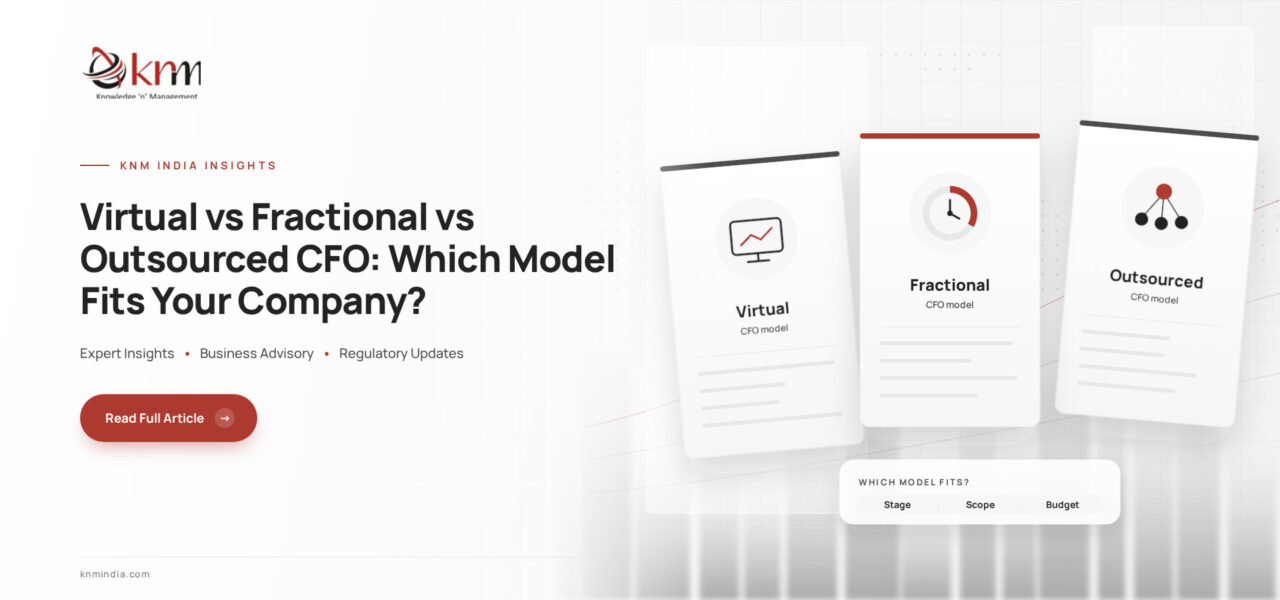
Quick Answer: The three labels describe different things: “virtual” is where the work happens, “fractional” is how much of a CFO’s time you get, and “outsourced” is who delivers it.
- A fractional CFO is one senior person working part-time, usually focused on strategy, the board, and funding.
- A virtual CFO works remotely on a fixed cadence, usually focused on MIS, cash flow, and reporting.
- An outsourced CFO is a firm’s team that can also cover bookkeeping, compliance, and back-office work.
Running an Indian entity from overseas and not sure which model fits? See how KNM combines CFO-level reporting with the accounting and compliance work underneath it. See KNM’s virtual CFO service
A US or other foreign parent sets up an Indian subsidiary, hires a small team, and soon finds that headquarters wants monthly numbers it can trust, while the Indian entity has filings, audits, and cash to manage locally. A full-time CFO feels too early. A local accountant feels too narrow. This is usually when companies start looking at part-time CFO models and broader management advisory services.
A part-time CFO is a senior finance professional who gives a company CFO-level reporting, planning, and advice without a full-time employment contract. Virtual, fractional and outsourced CFOs are all versions of that idea, and the names are often used loosely. This guide compares the four models side by side, including the full-time CFO, then gives you one decision table to pick the right fit.
What Are the Key Differences Between a Fractional CFO and a Virtual CFO?
A fractional CFO is defined by time, and a virtual CFO is defined by location. The two can overlap: a fractional CFO may work remotely, and a virtual CFO is almost always part-time.
- Fractional: you get a share of one experienced person’s working month. The emphasis is usually strategy, board meetings, investor conversations, and major decisions.
- Virtual: the work is delivered remotely through shared books, dashboards and scheduled calls. The emphasis is usually reporting, cash flow and financial control.
- Outsourced: the work is delivered by a firm, not an individual. The firm assigns a team, which can include accountants and compliance staff alongside the CFO-level lead.
The practical lesson: none of these labels tells you how senior the person is. A Virtual CFO could be a seasoned finance leader or a junior analyst sending templates. Ask who does the work, not what the service is called.
The Four CFO Models Compared
| Dimension | Full-time CFO | Fractional CFO | Virtual CFO | Outsourced CFO |
|---|---|---|---|---|
| Main focus | Whole finance function and leadership | Strategy, board, funding, major decisions | MIS, cash flow, budgets, reporting | Finance function delivered as a package |
| Time | Full-time | Part-time, a set share of a month | Part-time, on a fixed cadence | Depends on the scope agreed |
| Presence | On site | Remote or hybrid | Remote | Remote team, visits as agreed |
| Who delivers | Your employee | One individual | An individual or a small team | A firm’s team |
| Control | Highest, direct line management | High, through one senior person | Medium, through agreed deliverables | Through the engagement letter and the firm’s lead |
| Cost structure | Salary and benefits | Retainer or hourly | Monthly retainer | Retainer for a bundled scope |
| Continuity if someone leaves | You rehire | You replace the person | Depends on the provider | The firm reassigns within its team |
Read the table by your biggest gap. If you lack strategic judgment, look at the fractional column. If you lack reliable numbers, look at the virtual and outsourced columns.
Model 1: Full-Time CFO
A full-time CFO makes sense when finance decisions are frequent, large, and need someone inside the company every day. Typical triggers are a listing plan, several entities with complex intercompany flows, a large finance team that needs a leader, or regular negotiations with lenders and investors.
Some companies have no choice. Under Section 203 of the Companies Act, 2013, every listed company and every other public company with paid-up share capital of ₹10 crore or more must appoint whole-time key managerial personnel, including a CFO. Most private subsidiaries of foreign companies are not covered by this rule, which is why part-time models are common for them.
Model 2: Fractional CFO, and Is It Worth It?
A fractional CFO is worth it when your problem is judgment, not bookkeeping. You get an experienced person in the room for funding rounds, pricing decisions, board meetings and restructuring, without a full-time salary.
- Good fit: a growing company preparing to raise funds, enter a new market or reset its cost base.
- What it does not fix: late or unreliable books. A fractional CFO still needs an accounting team underneath.
- What to agree: the hours or days per month, which meetings they attend, and what decisions they own.
Model 3: Virtual CFO, and Why “Virtual” Says Nothing About Seniority
A Virtual CFO fits companies that need steady financial visibility more than boardroom presence. The usual output is a monthly pack: MIS, cash flow, budget against actuals, and a short commentary on what changed.
- Good fit: startups and smaller subsidiaries whose books are in the cloud and whose owners or parent company sit elsewhere.
- What it does not fix: a missing bookkeeping or compliance team, unless the provider includes one.
- What to agree: the list of reports, the working day each arrives, and who reviews them.
KNM’s guide on virtual CFO services for Indian SMEs covers how to outsource this role without losing control of decisions.
Model 4: Outsourced CFO, a Team That Includes the Back Office
An outsourced CFO is a firm that takes over a defined part of your finance function, from bookkeeping up to CFO-level reporting. This is the model most foreign parents end up with in India, because one engagement covers the work a small subsidiary cannot staff on its own.
- Accounting layer: Bookkeeping Outsourcing, reconciliations and monthly closing. KNM’s comparison of onshore and offshore bookkeeping explains the trade-offs.
- Operations layer: back office support services such as payables, receivables, and payroll processing, described in KNM’s article on backoffice outsourcing in India.
- Data layer: Data Process Outsourcing for invoice capture, records, and reporting inputs. See KNM’s guide to data process outsourcing.
- Leadership layer: a CFO-level lead who turns those numbers into reports and decisions.
The trade-off is less direct control over one individual, in exchange for continuity: if your lead is away, the firm covers the work.
What an Indian Subsidiary Needs That a Domestic Company Does Not
A foreign-owned Indian company has two audiences for its numbers: Indian regulators and the parent company. Whichever CFO model you choose should cover both.
- Two sets of reporting: statutory accounts under Indian accounting standards, plus a reporting pack in the format the parent uses for consolidation.
- FEMA reporting: filings with the RBI when shares are issued to the foreign parent, and the annual return on foreign liabilities and assets.
- Transfer pricing: documentation and an accountant’s report on transactions with the parent and other group companies.
- Two audits: the Indian statutory audit, and queries from the parent’s auditors during group consolidation.
- Time zones and approvals: documents signed by directors abroad, and decisions that need sign-off from headquarters.
A fractional CFO alone rarely covers this list. Most subsidiaries need an outsourced team or a virtual CFO supported by accounting and compliance staff, plus corporate advisory services in India for structuring and regulatory questions.
How the Cost of Each Model Is Structured
Fees vary widely by provider, so compare structure before price. A full-time CFO is a fixed salary plus benefits and hiring cost. A fractional CFO is usually a monthly retainer for a set amount of time, or an hourly rate. A virtual CFO is usually a monthly retainer for a list of deliverables. An outsourced CFO is a retainer for a bundled scope, which can look higher but often replaces several separate vendors.
The main cost drivers in every model are transaction volume, the number of entities, how much accounting and compliance sits inside the scope, and how much senior time you need each month.
How KNM Supports Foreign-Owned Companies Across CFO Models
Foreign parents often begin with the basics in India: books, payroll, and statutory filings. As the subsidiary grows, headquarters asks for better reporting, then for someone who can explain the numbers and plan ahead. KNM India’s management advisory services are built for that progression. KNM covers accounting and back-office support services, compliance, a Virtual CFO service, and corporate advisory services in India, so a company can move from one model to the next without changing teams.
For companies still setting up, KNM’s secretarial services handle the Companies Act side, so finance, filings, and advice sit with one firm. If you are deciding between models, KNM’s guide on outsourcing finance and accounting in India is a useful next read.
Decision Table: Which CFO Model Fits You?
Start with your biggest problem today, not the title you want on the org chart.
| If your main problem is | Choose | Why |
|---|---|---|
| Books are late, messy, or do not reconcile | Outsourced CFO team, starting with bookkeeping | Reporting and strategy depend on reliable books |
| Headquarters wants trusted monthly numbers from India | Virtual CFO with an accounting team underneath | Fixed reports on a fixed date, delivered remotely |
| You are raising funds or facing a major decision | Fractional CFO | Senior judgment in the room, for a limited time |
| A small Indian subsidiary with no local finance staff | Outsourced CFO | One firm covers books, filings, payroll and reporting |
| Several entities, a listing plan or a large finance team | Full-time CFO | Daily leadership and, for some companies, a legal requirement |
| You need advice on structure, expansion or regulation | Management advisory services alongside any model | Strategic and regulatory questions go beyond reporting |
Many companies combine models over time: outsourced bookkeeping first, a virtual CFO once the numbers are reliable, and a fractional or full-time CFO when the decisions get bigger. If you choose the outsourced or virtual route, KNM’s checklist on how to choose a virtual CFO firm in India lists the 12 questions to ask before you sign.
Frequently Asked Questions
What is the difference between a CFO and a fractional CFO?
A CFO is a full-time employee who leads the whole finance function. A fractional CFO does similar senior work, such as planning, funding, and board reporting, but only for part of each month and usually for several companies. The fractional model costs less than a full-time hire, but the person is less available and still needs an accounting team to rely on.
What is an outsourced CFO called?
An outsourced CFO is also called a part-time CFO, CFO as a service, or, when delivered remotely, a virtual CFO. A fractional CFO is a related term that describes the time commitment. An interim CFO is different: it is a temporary, often full-time, appointment to cover a gap, such as a CFO who has left.
Is a fractional CFO worth it?
A fractional CFO is worth it when your company faces decisions that need senior finance judgment, such as raising funds, entering a market, or restructuring costs, but does not need that judgment every day. It is not worth it if your main problem is unreliable books, because a fractional CFO cannot plan on numbers nobody trusts.
What are the four roles of a CFO?
One widely used way to describe the CFO’s job splits it into four roles: steward, which protects the company’s assets and controls; operator, which runs an efficient finance function; strategist, which shapes the company’s direction; and catalyst, which drives change across the business. Part-time CFO models usually focus on two or three of these roles, depending on the scope agreed.
Can a virtual CFO handle reporting to a US parent company?
Yes, if it is part of the agreed scope. A virtual CFO can prepare the monthly reporting pack in the parent’s format alongside the Indian statutory accounts. Agree the format, the reporting calendar, and who answers the parent auditors’ questions in the engagement letter, so headquarters and the Indian team work from the same numbers.
Can we start with bookkeeping and add a CFO later?
Yes, and many companies should. Reliable books are the foundation for every CFO model. Start with Bookkeeping Outsourcing and compliance, then add a virtual CFO for monthly reporting once the numbers close on time. Choosing a firm that offers both avoids a handover between providers when you move up.
Pick the Model That Fixes Today’s Problem
The right CFO model is the one that solves your biggest finance gap now and can grow with the business. If you run an Indian entity, or plan to, and want one team for accounting, compliance, CFO-level reporting, and management advisory services, talk to KNM about where to start. Contact KNM India