
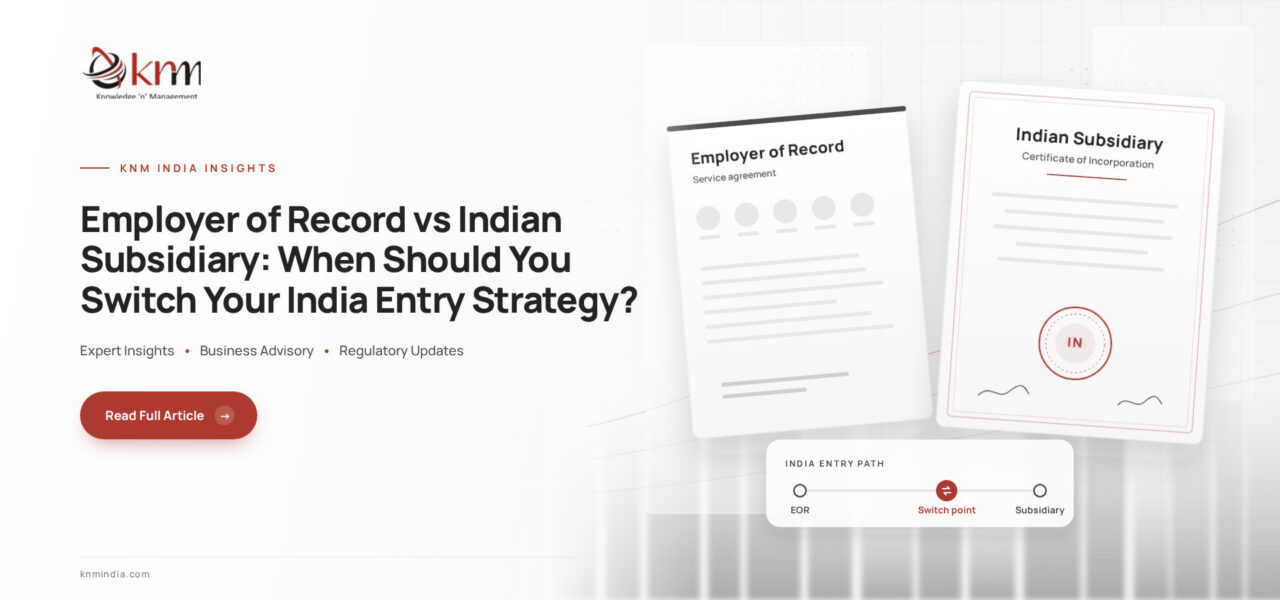
Quick Answer: An Employer of Record suits fast, small-scale hiring when you do not sell in India. Switch to your own Indian subsidiary when you need to sell, sign local contracts, hold IP in India or run a permanent team.
- With an EOR, the EOR is the legal employer, so you get speed but limited control, and no local entity to sell or contract through.
- A subsidiary is your own Indian company: more setup and compliance, but full control over contracts, IP, benefits, and brand.
- The usual triggers to switch are local revenue, core IP work, a permanent or growing team, and rising permanent establishment risk.
Outgrowing your EOR, or deciding how to enter India in the first place? See how KNM plans market entry and entity setup for foreign companies, from structure to first filings. See KNM’s India entry strategy services
Many US companies hire their first people in India without setting up a company. It is quick, it keeps legal work light, and it lets the business test the market. A year later, the same company has a growing team, an Indian customer asking for a local invoice, and a product being built in Bengaluru or Pune. At that point, the original India entry strategy needs a second look.
An Employer of Record (EOR) is a third-party company that legally employs staff in India on your behalf, running their contracts, payroll, and statutory deductions, while you direct their work. An Indian subsidiary is your own company incorporated in India, usually wholly owned by the foreign parent. This guide compares the two for Indian market entry and lists the seven signs that it is time to switch.
What Is an Employer of Record in India?
An Employer of Record in India is the legal employer of people who work for you. The EOR signs the employment contracts, runs payroll, deducts tax and statutory contributions, and handles employment compliance through its own Indian entity. You decide what the employees work on and how they perform.
- What you get: the ability to hire in India without incorporating a company, usually much faster than setting one up.
- What you do not get: a legal presence of your own. The EOR employs people; it does not sell your products, sign your customer contracts, or hold your assets in India.
- Who uses it: companies testing the market, hiring a handful of specialists, or bridging the gap while their own entity is being set up.
EOR vs Indian Subsidiary: Side-by-Side Comparison
| Dimension | Employer of Record | Indian subsidiary |
|---|---|---|
| Legal employer | The EOR’s Indian entity | Your own Indian company |
| Speed to first hire | Fast, no entity needed | Slower, the company must be incorporated and registered first |
| Upfront effort | Low: a service agreement and onboarding | Higher: incorporation, bank account, tax and other registrations |
| Ongoing compliance | Employment compliance handled by the EOR | Your responsibility: accounts, audit, ROC filings, tax, FEMA reporting |
| Selling and invoicing in India | Not possible through the EOR | Yes, in your own name |
| Local contracts, leases, bank accounts | Not in your name | Yes |
| IP created in India | Depends on assignment clauses through the EOR | Owned by your company under your own contracts |
| Permanent establishment exposure | Can arise for the parent if staff do core or revenue-generating work | Activity sits in an Indian company that is taxed in India |
Neither route is better in general. An EOR buys speed and simplicity; a subsidiary buys control and a legal base for growth.
7 Signs It Is Time to Switch From an EOR to Your Own Entity
1. You want to sell to customers in India
An EOR cannot invoice Indian customers for you, collect revenue on your behalf or register for GST in your name. If Indian sales are part of the plan, you need an Indian entity, and selling from overseas while staff in India support those sales can raise tax questions of its own.
2. You need to sign local contracts, leases, or vendor agreements
Office leases, Indian vendor contracts, local bank accounts, and government registrations all need an Indian legal person. With an EOR, either the parent signs from abroad, or the arrangement does not work at all. A subsidiary can sign in its own name.
3. Your India team is building core IP
When the legal employer is the EOR, ownership of what your team creates depends on a chain of assignment clauses between the employees, the EOR, and your company. That can work, but it adds a link that buyers, investors, and auditors will check. With a subsidiary, your own company employs the team, and the chain is shorter and easier to prove.
4. The India team is becoming permanent
An EOR is often a bridge. When India stops being an experiment and becomes a function, such as engineering, operations, or a Global Capability Centre, most companies want their own entity, their own managers, and their own employer brand. Global Capability Centres in India are usually set up as an Indian company for this reason.
5. EOR fees exceed what your own entity would cost
EOR fees are usually charged per employee, so they grow with every hire. A subsidiary has a different cost shape: setup costs and fixed annual costs for accounting, audit, filings and advisers, which do not rise much with each new hire. Once the per-employee fees for your team are higher than the running cost of your own entity, the numbers favour switching. Use the worksheet further down to compare your own figures.
6. You want your own benefits, ESOPs and employer brand
With an EOR, employees sign the EOR’s contract and usually get its standard benefits. If you want your name on the offer letter, your own leave and benefits policy, or an equity plan designed around your Indian team, your own company gives you that control.
7. Your permanent establishment risk is rising
The more your India team does core or revenue-generating work for the parent, the more important it becomes to check whether the parent itself has a taxable presence in India. Moving that activity into an Indian subsidiary puts it inside a company that is taxed in India on its own income. The next section explains why.
Permanent Establishment Risk, Explained Simply
A permanent establishment (PE) is a taxable presence of a foreign company in another country. Under India’s tax treaties, including the treaty with the United States, a foreign company can be treated as having a PE in India if it has a fixed place of business there, or people in India who habitually conclude contracts for it, among other tests.
An EOR arrangement does not create a PE by itself, but it does not rule one out either. The risk depends on what the people in India actually do: staff who negotiate or close sales, or who run the parent’s core business from India, raise more questions than staff doing support work. Because the outcome depends on the treaty and the facts, get tax advice on your specific set-up rather than relying on the EOR model alone.
Can a Foreigner Start a Business in India? What a Subsidiary Needs
Yes. A foreign company or foreign individual can own a private limited company in India, and in most sectors 100% foreign ownership is allowed under the automatic route, without prior government approval. Some sectors have caps or need approval, so check your sector before setting up business in India.
- Structure: most foreign companies use a private limited company wholly owned by the parent. See KNM’s guide to a wholly owned subsidiary or joint venture in India.
- Directors: at least two, and at least one must be resident in India as defined in Section 149(3) of the Companies Act, 2013.
- Shareholders: at least two. A parent usually holds the shares, with one share held by a nominee or a group company.
- Incorporation: through the SPICe+ form on the MCA portal, which also issues the company’s PAN and TAN.
- Foreign investment reporting: when shares are issued to the parent, Form FC-GPR is filed within 30 days of allotment.
So the answer to “can a foreigner start a business in India” is yes, provided the sector rules, director rules, and FEMA reporting are followed from day one.
How to Move From an EOR to Your Own Entity
The switch works best when it is planned as a project, not a single event. A typical sequence:
- Review your EOR agreement for notice periods, transfer terms, and any restrictions on hiring the employees directly.
- Decide the structure, sector route, and shareholding, and prepare documents with pre-incorporation services such as name approval, director identification and parent company documents. See KNM’s pre-incorporation services.
- Incorporate the company, open the bank account, bring in share capital, and file FC-GPR within 30 days of allotting shares to the parent.
- Complete the registrations your business needs, such as GST, and set up payroll, provident fund, and other employment registrations.
- Issue new employment contracts from your company and agree with each employee how their past service and benefits will be treated.
- Run first-year compliance: hold the first board meeting within 30 days of incorporation, have the board appoint the first auditor within 30 days, and file Form INC-20A (declaration of commencement of business) within 180 days. Keep statutory registers from day one. KNM’s post-incorporation services cover this stage.
- End the EOR arrangement once everyone is on your payroll.
Cost Worksheet: EOR vs Subsidiary
Costs vary by provider, city, and team, so compare your own numbers rather than general ranges. Fill in the third column for your situation.
| Cost line | EOR or subsidiary? | Your figure |
|---|---|---|
| Per-employee service fee | EOR | |
| Salaries and statutory contributions | Both | |
| Incorporation and registrations | Subsidiary, one-time | |
| Accounting, audit and ROC filings | Subsidiary, yearly | |
| Tax, transfer pricing and FEMA compliance | Subsidiary, yearly | |
| Payroll processing and employment compliance | Included in EOR fee; subsidiary pays separately | |
| Exit or transfer costs under the EOR agreement | EOR, at switch |
Compare the yearly totals at your current headcount and at the headcount you plan for next year. The point where the lines cross is your cost trigger.
How KNM Helps Companies Move From an EOR to Their Own Indian Entity
Companies leaving an EOR usually need two things at once: an Indian company set up correctly, and a plan for running it from abroad. KNM India works on both. Its India entry strategy team helps choose the structure, and its pre-incorporation services and post-incorporation teams handle incorporation, registrations, FEMA reporting, and first-year compliance.
Once the entity is running, KNM’s secretarial services and virtual CFO service keep filings and reporting to the parent on track. For companies building a larger team, KNM also advises on Global Capability Centres. Japanese companies can work with KNM’s Japan Desk, which has an office in Tokyo; see KNM’s Japanese site.
Which India Entry Strategy Fits Now? Decision Table
| Your situation | Best fit |
|---|---|
| Testing the market with a few hires, no Indian customers yet | Stay on an EOR |
| Team growing and expected to stay, no local sales yet | Plan the switch now, keep the EOR until the entity is ready |
| Indian customers, contracts or a local office on the horizon | Set up a subsidiary |
| Core product or IP being built in India | Set up a subsidiary |
| India team doing sales or core work for the parent | Take tax advice on PE risk and plan the switch |
| Building a Global Capability Centre | Set up a subsidiary from the start |
Many companies use both in sequence: an EOR for the first hires, then a subsidiary once the business case for Indian market entry is proven.
Frequently Asked Questions
Is the subsidiary of a foreign company an Indian company?
Yes. A subsidiary incorporated in India under the Companies Act, 2013 is an Indian company, even if a foreign parent owns all of its shares. It is taxed as a domestic company on its income, files with the Registrar of Companies, and follows Indian law. Because its shares are held by a foreign parent, it also has FEMA reporting obligations, such as FC-GPR when shares are issued.
How much does it cost to hire through an EOR in India?
EOR costs have two parts: the employee’s salary and statutory contributions, which you pay either way, and the EOR’s service fee, usually charged per employee per month. Fees vary by provider and by the services included. Compare quotes on the same basis, and check the notice period and any transfer or exit charges before you sign.
Can a foreigner start a business in India?
Yes. Foreign companies and individuals can set up a private limited company in India, with 100% foreign ownership allowed in most sectors under the automatic route. The company needs at least two directors, one of them resident in India, and at least two shareholders. Some sectors have caps or need government approval, so check the sector rules first.
Can employees keep their service history when they move from the EOR?
It depends on what you agree. When employees move from the EOR to your subsidiary, they sign new contracts with your company. Whether earlier service counts, for example for leave or benefits linked to years of service, should be settled in the transfer terms with the EOR and with each employee. Agree this in writing before the move.
Can we sell to Indian customers through an EOR?
No. An EOR employs people for you; it does not sell your products or invoice your customers. To sell in India in your own name, register for GST and sign customer contracts locally, you need an Indian entity, most often a subsidiary. Selling from abroad while India-based staff close the deals can also raise permanent establishment questions.
Do we need a subsidiary to set up a GCC in India?
In practice, most Global Capability Centres are set up as an Indian subsidiary, because a GCC needs to employ a large team, lease offices, own equipment and contract with vendors in its own name. An EOR can bridge the first few hires while the entity is set up, but it is rarely the long-term structure for a GCC.
Plan the Switch Before You Need It
The best time to plan your entity is before the EOR stops fitting: before the first Indian customer, the office lease, or the next round of hiring. If you are reviewing your India entry strategy or setting up business in India for the first time, talk to KNM about the right structure and timeline. Contact KNM India