
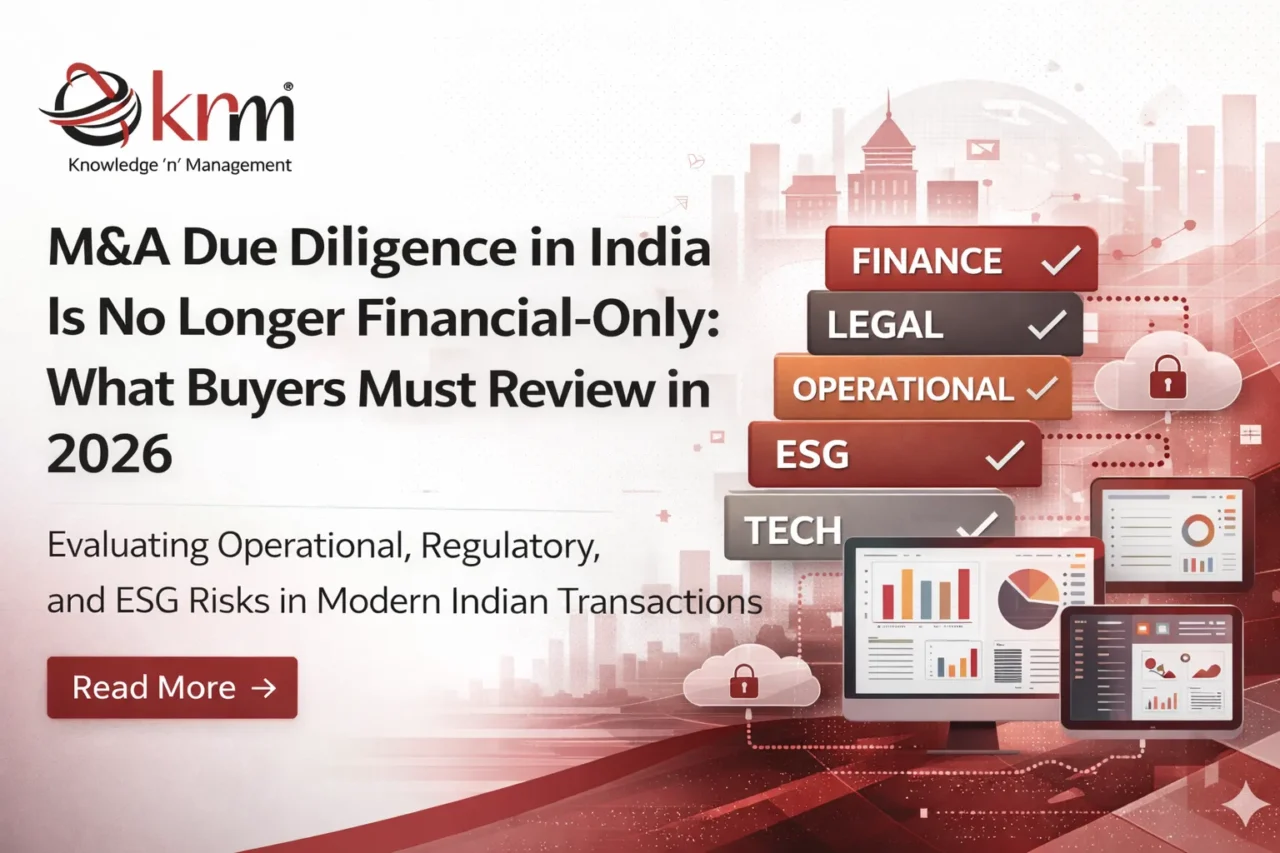
Introduction
The Changing Landscape of M&A Due Diligence in India
M&A due diligence in India is evolving. Buyers no longer focus only on financials. The process now covers many new areas. This shift is changing how deals are evaluated and structured. M&A advisory teams and due diligence services must keep up with these changes. Buyers want full visibility into every aspect of the target company. In 2026, expecting only a financial review is not enough.
Several factors drive this transformation. Regulatory changes and compliance requirements are rising. Environmental, social, and governance (ESG) standards are gaining importance. Technology risks and data privacy are part of the checklist now. Buyers must review tax, legal, HR, and operational matters. The goal is to spot risks and find value beyond the balance sheet.
Expanding Scope Beyond Financials
Traditionally, due diligence looked at finances and legal risks. Today, M&A due diligence in India covers many new areas. Due diligence services now dive into intellectual property, environmental issues, and digital assets. M&A advisory firms, including KNM India, also analyze supply chains and customer contracts. These new focus areas help identify hidden liabilities and integration challenges.
Key Elements Included in Modern Due Diligence
| Area | Focus |
| Regulatory | Compliance and licenses |
| ESG | ESG practices and impact |
| Technology | IT infrastructure and data security |
| Tax | Tax exposure and compliance |
| Human Resources | Labor laws and HR policies |
This broader approach gives buyers a clearer picture of opportunities and risks. M&A deals can fail if buyers miss non-financial issues. Due diligence services must use experts from several fields. This ensures all angles are covered before the deal closes.
The Role of Professional M&A Advisory Services
Professional M&A advisory firms are adapting their offerings. They provide specialized due diligence services for every stage of the deal. These services use teams with legal, tax, technical, and operational expertise. The advisory team helps buyers create a detailed checklist. This covers not just finances, but business operations, compliance, and people-related issues.
In 2026, buyers expect end-to-end support from their M&A advisory partners. The advisory firms must anticipate new risks in the Indian market. They offer guidance on best practices and risk mitigation. Firms such as KNM India support buyers navigating this fast-changing regulatory and business environment.
Evolving Landscape of M&A Due Diligence
Shift from Financial-Only Focus
Traditionally, M&A Due Diligence in India centered on financial review. Buyers focused on validating reported numbers, liabilities, and cash flows. Today, financial analysis remains vital but is no longer the only focus. Due diligence services now encompass a broader range of issues. Firms offering M&A advisory emphasize this shift.
Non-financial risks can impact deal value. Compliance, technology, and operational checks now play a key role. Buyers expect detailed insights beyond the balance sheet. This evolution reflects global best practices coming to India.
Expanded Scope of Due Diligence Services
M&A Due Diligence now covers diverse areas. Legal, regulatory, and environmental compliance get close scrutiny. Intellectual property and cybersecurity risks are reviewed thoroughly. Buyers also assess human resources and cultural alignment.
| Area | Focus Points |
| Legal | Licenses, litigation, contracts |
| Regulatory | Sectoral laws, approvals |
| Technology | Data privacy, IT systems |
| ESG & Environment | Waste, energy, compliance |
| Human Resources | Key talent, policies, disputes |
M&A advisory firms integrate these checks into their process. They help buyers identify hidden risks and growth opportunities.
Integration of Digital Tools and Analytics
Digital transformation has changed M&A Due Diligence practices. Data analytics and AI help process large data sets. Buyers can spot patterns, anomalies, and red flags faster. Virtual data rooms allow secure, remote access to documents.
Due diligence services now offer dashboards for real-time monitoring. Automated compliance checks can flag issues early. M&A advisory teams use these tools to increase efficiency and coverage. This trend will continue to grow by 2026, shaping how buyers approach deals in India.
Key Components of Modern Due Diligence Services
Expanding the Scope: Beyond Financial Checks
Modern M&A Due Diligence in India is no longer limited to balance sheets and cash flow. Buyers now expect due diligence services to cover commercial, operational, and strategic aspects. A deeper review of supply chains, customer contracts, and vendor arrangements is standard. The goal is to identify risks that may hide beyond financial statements. M&A advisory teams also focus on verifying market share and mapping competitor landscapes.
A buyer must assess compliance with industry standards and government regulations. This approach helps capture hidden liabilities. M&A Due Diligence teams look for red flags in permits, licenses, and ongoing litigation. The aim is to prevent surprises after the deal closes.
Technology, Data, and IP: Core to the Process
Technology assets now sit at the center of many deals, so due diligence services dig into IT infrastructure and cybersecurity. Buyers want assurance that business data is secure. They check if the company safeguards sensitive information and complies with data privacy laws. Identifying outdated systems or cyber vulnerabilities is essential for post-merger integration.
Intellectual property (IP) is another focus for modern M&A advisory. Teams verify the ownership and protection of patents, trademarks, and copyrights. They examine licensing agreements and ongoing disputes. The value of the target often depends on the strength and scope of its IP portfolio.
Human Resources, ESG, and Cultural Fit
Human capital is a critical component of M&A Due Diligence today. Teams review employment contracts, retention plans, and key talent dependencies. Labor law compliance, pending disputes, and compensation structures are analyzed in detail. This helps buyers avoid post-merger disruptions related to staffing.
Environmental, social, and governance (ESG) factors are a growing area in due diligence services. Buyers examine pollution controls, diversity initiatives, and ethical sourcing practices. ESG reviews can impact access to financing and public perception. Cultural compatibility between merging entities is assessed to reduce integration risks. M&A advisory teams work to spot potential clashes early, ensuring deal success.
Challenges Faced by Buyers
Expanding Scope of M&A Due Diligence
Buyers now face a broader range of issues during M&A Due Diligence. The days when financial review was the main focus are over. Companies must now assess legal, tax, operational, and regulatory risks as part of their due diligence services. This expansion increases both complexity and resource needs. M&A advisory firms help, but buyers must manage many moving parts.
Another challenge is adapting to frequent regulatory updates. Indian regulators often update compliance norms, especially in data privacy and environmental matters. Buyers must stay alert to these changes. Missing a recent requirement can expose them post-closing.
Integration of Non-Financial Risks
Non-financial risks now demand equal attention during M&A Due Diligence. Buyers need to review environmental, social, and governance (ESG) risks. Compliance issues can carry heavy penalties or damage reputation. These reviews require specialized knowledge and more time.
Cultural alignment is another complex area. Buyers must judge whether teams, management styles, and company values can fit. This is especially important in Indian M&A, where local practices matter.
Data Quality and Access Challenges
Accessing reliable information remains a key obstacle. Private Indian companies may not disclose all records during due diligence. Data might be incomplete, outdated, or inconsistent. Buyers must cross-verify facts from multiple sources.
Digitalization complicates the process further. Large volumes of electronic records can overwhelm due diligence teams. M&A Due Diligence providers now use advanced analytics tools, but buyers must confirm accuracy.
Key Takeaways
- M&A due diligence in India is expanding beyond financial review
- Buyers now assess regulatory, ESG, technology, HR, and operational risks
- Professional M&A advisory services support multidisciplinary due diligence
- Digital tools and analytics are reshaping due diligence practices
- Comprehensive review strengthens deal value and reduces post-deal risk
Conclusion
Expanding the Horizons of M&A Due Diligence
M&A Due Diligence in India now extends far beyond financial investigation. Buyers must evaluate operational, legal, tax, HR, and regulatory domains. Due diligence services now offer tailored frameworks for each transaction. M&A advisory teams, including KNM India, guide clients through these complex workflows.
New Expectations for Buyers in 2026
Buyers are expected to adopt robust diligence protocols. M&A Due Diligence now requires technology-driven tools for data analysis. Due diligence services deploy specialized checklists for sector-specific needs. M&A advisory firms coordinate multidisciplinary teams to address emerging risks.
Building Stronger Transactions Through Comprehensive Review
Comprehensive M&A Due Diligence empowers buyers to make better decisions. Buyers who partner with experienced due diligence services gain a strategic edge. M&A advisory firms tailor review processes according to deal size and sector. This holistic diligence approach is now critical for any successful M&A in India.
Looking to modernize your bookkeeping outsourcing model with continuous assurance and real-time financial visibility?
FAQ
- What is changing in M&A due diligence practices in India?
M&A due diligence in India is evolving from focusing solely on financials to including regulatory, environmental, social, governance (ESG), technology, data privacy, tax, legal, HR, and operational aspects to provide a fuller picture of risks and opportunities. - Why is the scope of due diligence expanding beyond financial review?
Rising regulatory requirements, increased importance of ESG standards, technology risks, and the need to uncover hidden liabilities and integration challenges are driving buyers to evaluate non-financial areas alongside financials. - What new areas are included in modern M&A due diligence in India?
Key new focus areas include regulatory compliance, ESG practices, IT infrastructure and data security, tax exposure, labor laws, intellectual property, cybersecurity, supply chains, customer contracts, and cultural fit. - How do professional M&A advisory firms support the due diligence process?
They provide specialized, multidisciplinary teams with legal, tax, technical, and operational expertise to create detailed checklists, anticipate new risks, guide best practices, and offer end-to-end support throughout the deal.
Partner with KNM India to transform outsourced bookkeeping services into a strategic advantage for your finance function.
🌐 Website: https://knmindia.com
📞 Telephone and Contact Information:
Tokyo: +81-3-6869-0850
India: +91-124-4295170, +91-99105-04170
📧 Email: services@knmindia.com
📩 Contact: The contact page on knmindia.com allows you to contact our experts.