
It was mandated by DGFT that all IEC holders have to ensure that details in their IEC are updated electronically every year during the April-June period (for which no user charges were to be borne by the IEC holder). All IECs which have not been updated after 01.07.2021 shall be de-activated with effect from 01.02.2022.
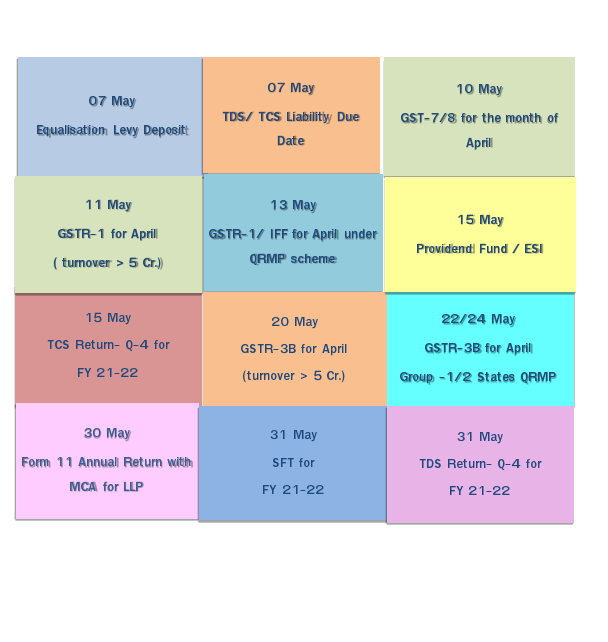
For more details please refer to the update bulletin for January 2022 along with the Monthly compliance calendar for February 2022.

Latest Update:
Ministry of Finance vide Press Release dated 24-11-2021, informed that India & USA agree on a transitional approach on Equalisation Levy 2020. As per the release, India and United States have agreed that the same terms that apply under the October 21 Joint Statement shall apply between the United States and India with respect to India’s charge of 2% equalization levy on e-commerce supply of services and the United States’ trade action regarding the said Equalisation Levy. However, the interim period that will be applicable will be from 1st April 2022 till implementation of Pillar One or 31st March 2024, whichever is earlier

Latest Update:
Ministry of Corporate Affairs(“MCA”) by General Circular No. 17/2021, dated 29th October, 2021 provided the relaxation on levy of Additional fees in filing of e- forms AOC-4, AOC-4(XBRL), AOC-4(CFS), AOC-4(Non- XBRL) and MGT-7/ MGT-7A for the financial year ended on 31.03.2021. Due Date for filing of form AOC-4/AOC-4(XBRL)/AOC-4(CFS) is within 30 days from the date of Annual General Meeting of the Company & the due date of filing of Form MGT-7/ MGT-7A is 60 days from the date of Annual General Meeting. It has been issued that no additional fee shall be levied upto 31.12.2021 for filing of e- forms AOC-4, AOC-4(XBRL), AOC-4(CFS), AOC-4(Non- XBRL) and MGT-7/ MGT-7A in respect of the financial year ended on 31.03.2021.
Hope you find the above useful. Feel free to revert us.
Please also reach to us:
Our website : https://www.knmindia.com/
Facebook page : https://www.facebook.com/knmindia/
Linkedin page : https://www.linkedin.com/company/knm-management-advisory-services-pvt-ltd-/
Instagram : https://www.instagram.com/knmmanagement/
Twitter : https://twitter.com/KnmManagement

No need to carry the physical copy of tax invoice in cases where an e-invoice has been
In order to facilitate the strategic disinvestment, it has been decided that Section 79 of the Income-tax Act, 1961, shall not apply to an erstwhile Public Sector Company which has become so as a result of strategic disinvestment. Accordingly, the loss incurred in any previous year prior to, and including, the previous year of strategic disinvestment shall be carried forward and set off by the erstwhile public sector company. The above relaxation shall cease to apply from the previous year in which the company, that was the ultimate holding company of such erstwhile public sector company immediately after completion of the strategic disinvestment, ceases to hold, directly or through its subsidiary or subsidiaries, fifty-one percent of the voting power of the erstwhile public sector company.
| Particulars | Original Due Date | Due dates extended by previous notifications | New Due Dates (Circular 17/2021) | |||
| Original Income Tax Return (ITR)
– Non-Tax Audit/Non-TP Case – Tax Audit/Non TP-Case -TP Case |
|
31st July 2021 31st October 2021 30th November, 2021
|
|
30th September 2021 30th November 2021 31st December, 2021 |
31st December 2021 15th February 2022 28th February 2022 | |
| Belated/Revised ITR for AY 2021-22 (FY 2020-21) | 31st December, 2021 | 31st January, 2021 | 31st March, 2021 | |||
| Audit Report by CA-
-Tax Audit -TP Certification/Audit u/s 92E |
30th September 2021 31st October 2021 |
31st October 2021 30th November 2021 |
15th January 2022 31st January 2022 | |||
Further, specific provision of place of supply of ‘intermediary services’ under section 13 of the IGST Act shall be invoked only when either the location of supplier of intermediary services or location of the recipient of intermediary services is outside India.
1. Recommendations relating to GST rates on Goods and Services
2. Presentation relating to Compensation Cess using of revenue collections from Compensation Cess in the period beyond June 2022 till April 2026 for repayment of borrowings and debt servicing made to bridge the gap in 2020-21 and 2021-22.
3. Recommendations relating to GST law and procedure
Measures for Trade facilitation:
Other Recommendations has been received as below:
In terms of the power vested under the third proviso to sub-section (1) of Section 96 of the Act, the Registrar of Companies extended the time to hold AGM, other than the first AGM, for the financial year ended on March 31, 2021, for Companies within the jurisdiction of their respective office, which are unable to hold their Annual General Meeting, without requiring extension for such period within the due date of holding the AGM by a period of two months from the due date by which the AGM ought to have been held in accordance with companies to file applications for seeking such extension by filing the prescribed Form No. GNL-1. The RoC clarified that the extension granted under this Order shall also cover the pending applications filed in Form No. GNL-1 for the extension of AGM for the financial year ended on 31.03.2021, which is yet to be approved. Further, the applications filed in Form No. GNL-1 for the extension of AGM for the financial year ended on March 31, 2021, which were rejected, where the approval for the extension of AGM up to 2 months from the due date of the AGM shall be deemed to have been granted without any further action on the part of the Company.
SEBI
Acoordingly, a Stock Exchange may choose to offer a T+1 settlement cycle on any of the scrips subject to the conditions that advance notice of at least one month, regarding the change in the settlement cycle to be given, to all stakeholders, including the public at large, and also disseminate the same on its website. After opting for a T+1 settlement cycle for a scrip, the Stock Exchange shall have to mandatorily continue with the same for a minimum period of 6 months. Thereafter, in case, the Stock Exchange intends to switch back to T+2 settlement cycle, it shall do so by giving 1-month advance notice to the market. Any subsequent switch (from T+1 to T+2 or vice versa) shall be subject to a minimum period and notice period. Further, there shall be no netting between T+1 and T+2 settlements. The settlement option for security shall be applicable to all types of transactions in the security on that Stock Exchange.
The amendment provides that the listed entity shall give prior intimation to the stock exchange of at least two working days in advance, excluding the date of the intimation and the date of the meeting of the board of directors, about the Board meeting in which the Board is going to consider any of the proposals relating to an alteration in the form or nature of non-convertible securities that are listed on the stock exchange or in the rights or privileges of the holders thereof; An alteration in the date of the interest/ dividend/redemption payment of non-convertible securities; Financial results viz. quarterly or annual, as the case may be; Fundraising by way of issuance of non-convertible securities; or(e) any matter affecting the rights or interests of holders of non-convertible securities. Further, the amendment also provides that the annual audited standalone and consolidated financial results for the financial years shall be submitted to the stock exchange(s) within sixty days from the end of the financial year along with the audit report.
RBI
In terms of Section 11A of the Prevention of Money Laundering Act (PMLA), 2002, the government through a notification may permit entities other than banking firms to authenticate client’s Aadhaar number using the e-KYC facility provided by the Unique Identification Authority of India (UIDAI). However, the notification shall be issued only after consulting with the UIDAI and the appropriate regulator. Further, a detailed procedure for processing of applications under the aforementioned section for the use of Aadhaar authentication services by entities other than banking companies have been provided by the Department of Revenue, Ministry of Finance in its earlier notification dated 9th May, 2019. Accordingly, NBFCs, payment system providers, and payment system participants desirous of obtaining Aadhaar Authentication License -KYC User Agency (KUA) License or sub-KUA License (to perform authentication through a KUA), issued by the UIDAI, may submit their application to this Department for onward submission to UIDAI.
National Company Law Tribunal
The list of appointees includes Andhra Pradesh High Court Judge Justice Telaprolu Rajani, Bombay High Court retired Judge Justice Pradeep Narhari Deshmukh, Madras High Court retired Judge Justice S. Ramathilagam, District Court Judge Deep Chandra Joshi, DRT-3 (Delhi) Presiding Officer Dharminder Singh, Punjab and Haryana High Court retired Registrar General Harnam Singh Thakur, Principal District Court, Salem (Tamil Nadu) retired district court judge P. Mohan Raj and advocate Rohit Kapoor are among those appointed as the Judicial Members to the NCLT. The newly-appointed technical members include Principal Commissioner of Income Tax Ajai Das Mehrotra, retired NHPC Chairman and Managing Director Balraj Joshi, retired Ministry of Panchayati Raj Secretary Rahul Prasad Bhatnagar, Retired Principal Director-General of Income Tax Subrata Kumar Dash, retired Department of Consumer Affairs Secretary Avinash K Srivastava and retired SBI Chief General Manager Shree Prakash Singh. Other technical members are chartered accountant Sameer Kakar, retired Director General of Income Tax Manoj Kumar Dubey, Chief Commissioner of Income Tax Kaushalendra Kumar Singh and Principal Chief Commissioner of Income Tax Anuradha Sanjay Bhatia. The Appointments Committee of the Cabinet has approved the appointments to the posts of Judicial Member and Technical Member in the National Company Law Tribunal, in the pay scale of Rs.67,000-79,000/- (pre-revised), for a period of 05 years from the date of assumption of charge of the post, or till attaining the age of 65 years, or until further orders, whichever is the earliest.
IBBI
To amend the Insolvency and Bankruptcy Board of India (Insolvency Resolution Process for Corporate Persons) Regulations, 2016. The amendment regulations enhance the conduct, timeliness, and value maximization in corporate insolvency proceedings. The Code puts in place a creditor-in-control process under the Corporate Insolvency Resolution Process (CIRP). The committee of creditors (COC) has a statutory role and it discharges a sort of public function. The committee and members of the committee shall discharge functions and exercise powers under the Code and these regulations in respect of the CIRP in compliance with the guidelines as may be issued by the Board. In regulation 36A, a new sub–regulation 4A has been inserted to provide any modification in the invitation for expression of interest may be made in the manner as the initial invitation for expression of interest was made and any such modification shall not be made more than once. Further, the committee shall not consider any resolution plan which is received after the time as specified by the committee under regulation 36B or received from a person who does not appear in the final list of prospective resolution applicants or does not comply with the provisions of sub-section (2) of section 30 and sub-regulation (1).
DGFT
Any IEC where an online updation application has been submitted but is pending with the DGFT RA for approval shall be excluded from the de-activation list. It may further be noted that any IEC so de-activated, would have the opportunity for automatic re-activation without any manual intervention or a physical visit to the DGFT RA. For IEC re-activation after 06.10.2021, the said IEC holder may navigate to the DGFT website and update their IEC online. Upon successful updation the given IEC shall be activated again and transmitted accordingly to the Customs system with the updated status. Earlier DGFT mandated all the IEC holders to ensure that details in their IEC are updated electronically every year during the April-June period. However, based on representations received from the IEC holders who had not updated their IECs, the period of updation was extended up to July 31, 2021 and subsequently to August 31, 2021.
FEMA
RBI has notified the Foreign Exchange Management (Export of Goods and Services) (Amendment) Regulations, 2021 which shall come into force from the date of their publication in the Official Gazette 10-09-2021. Through this amendment Regulation 15 which deals with advance payment against exports has been amended. Regulation 15 pertains to Advance payment against exports which reads, where an exporter receives advance payment (with or without interest), from a buyer / third party named in the export declaration made by the exporter, outside India, the exporter shall be under an obligation to ensure that the rate of interest, if any, payable on the advance payment shall not exceed 100 basis points above the London Inter-Bank Offered Rate (LIBOR) or other applicable benchmarks as may be directed by the Reserve Bank, as the case maybe.
MSME
IndiaXports aims to orient MSMEs free of cost, with the objective of focussing on the untapped export potential in existing tariff lines and supporting MSMEs in order to grow the number of exporting MSMEs and increase MSME exports by 50% in 2022. This initiative features an Info Portal which serves as a knowledge base for exports by Indian MSMEs with the required information related to export potential for all the 456 tariff lines along with the potential markets as well as trends in exports, export procedures and lots more. Apart from an export help desk, instructor-led orientation will also be provided to MSMEs through a series of sessions for specific sectors highlighting the opportunities in specific products in international markets. Further, the initiative targets over 1 lakh MSMEs desirous of knowing more about exports and hand holding over 30,000 MSMEs to start exporting, doubling the base of active exporters.
Financial assistance is provided to all eligible/State/ Central Government organizations, registered industries associations and Societies/Trusts involved in the promotion and development of MSME sectors. The IC Scheme has been recently revised and it now has three sub-components namely (i) Market Development Assistance of MSMEs (MDA), (ii) Capacity Building of First time MSE Exporters (FTE) and (iii) Framework for International Market Intelligence Dissemination (IMID). Further proposals are invited from all eligible organizations under the MDA (Market Development Assistance) Sub-Component of the IC Scheme. The proposals can be uploaded on the IC Scheme web portal https://ic.msme.gov.in, which will remain open for submission of proposals from September 14, 2021 to September 30, 2021. It is also informed that all proposals under the IC Scheme will be accepted via online mode only.
IFSCA
Every Director of the recognized MII shall ensure that the recognized MII abides by all the applicable provisions of International Financial Services Centres Authority Act, 2019, MIIs Regulations, Bullion Exchange Regulations, rules and regulations framed thereunder and the circulars, directions issued by the Authority from time to time; Ensure compliance at all levels so that the regulatory system does not suffer any breaches; Ensure that the recognized MII takes steps commensurate to honor the time limit stipulated by Authority for corrective action; Not support any decision in the meeting of the governing board which may adversely affect the interest of investors and shall report forthwith any such decision to the Authority. Further, the Code provides that its objective is to enhance the level of market integrity and investor confidence. It is emphasized that a written code of ethics may not completely guarantee adherence to high ethical standards. This can be accomplished only if Directors and Key Management Personnel of the recognized MIIs commit themselves to the task of enhancing the fairness and integrity of the system in letter and spirit.
KNM India can assist you with a range of complete financial services that range from Corporate advisory to Transaction advisory, Pre-incorporation to Post-incorporation, Insolvency and bankruptcy code to Secretarial services, Assurance to Internal audit services, along with Market entry strategy to Foreign company registration in India. To discuss any of these please book your slot, or call us on +91-99105-04170 – or email us at services@knmindia.com to get a quick response.
Disclaimer: Information in this note is intended to provide only a general update of the subjects covered. It is not intended to be a substitute for detailed research or the exercise of professional judgment. KNM accepts no responsibility for loss arising from any action taken or not taken by anyone using this publication. Updates are for the period 26.08.2021 till 25.09.2021.


| Circular No. 17/2021, Press Release Dated 09th September 2021 | |||
| Particulars | Original Due Date | First Extension (Circular No. 09/2021, Dated 20th May 2021) | Second Extension (Circular No. 17/2021, Dated 09th September 2021) |
| Income Tax Return (ITR)
| |||
| Original ITR
– Non-Tax Audit/Non-TP Case
– Tax Audit/Non-TP Case
– TP Case |
31st July 2021
31st October 2021
30th November, 2021 |
30th September 2021
30th November 2021
31st December, 2021 |
31st December 2021
15th February 2022
28th February 2022 |
| Belated/Revised ITR for AY
2021-22 (FY 2020-21) | 31st December, 2021 | 31st January 2022 | 31st March 2022 |
| Audit Report by CA-
-Tax Audit
-TP Certification/Audit u/s 92E |
30th September 2021
31st October 2021 |
31st October 2021
30th November 2021 |
15th January 2022
31st January 2022 |
Though the due date for filing of Income-tax Return for the Assessment Year 2021-22 has been extended, no relief shall be provided from the interest chargeable under section 234A if the tax liability exceeds Rs. 1 lakh. Thus, if the self-assessment tax liability of a taxpayer exceeds Rs. 1 lakh, the assessee would be liable to pay interest under section 234A from the expiry of original due dates, i.e., 31-07-2021 or 31-10-2021 or 30-11-2021. The interest under section 234A shall not be levied if the self-assessment tax liability of the taxpayer does not exceed Rs. 1 lakh and ITR if filed within the extended due date.
Further, in case of senior citizen having no PGBP Income, all taxes paid upto 31st July will be deemed as Advance Tax.

MCA through its Press Release has stated various disclosures to be made by companies in their financial statements under the Schedule III of the Companies Act, 2013 effective from April 01, 2021, which were amended vide notification dated March 24, 2021
CBDT vide notification dated 82/2021, Dated 27th July 2021 amending the rule 12 (1) & (5), that deals with “Return of income”. Rule 12(1) was amended considering the section 148. Also amends Rule 12(5) which shall now read as “Where a return of income relates to the assessment year commencing on the 1st day of April, 2020 or any earlier assessment year, it shall be furnished in the appropriate form as applicable in that assessment year.
| Particulars | Original Due Date | Due dates extended by previous notifications | New Due Dates (Circular 15/2021) | |||
| Statement of Income paid or credited by Investment fund to its unit holder in Form 64D for the previous year 2020-21 | 15th June 2021 | 30th June 2021 Vide Circular No. 09/2021
15th July 2021 Vide Circular No. 12/2021
| 15th Sept 2021 | |||
| Statement of Income paid or credited by Investment fund to its unit holder in Form 64C for the previous year 2020-21 | 30th June 2021 | 15th July 2021 Vide Circular No. 09/2021
31st July 2021 Vide Circular No. 12/2021
| 30th Sep 2021 | |||
| Furnishing of Equalisation levy Statement in Form No. 1 for FY 2020-21 | 30th June 2021 | 31st July 2021 Vide Circular No. 12/2021 | 31st Aug 2021 | |||
| Quarterly statement in Form No. 15CC to be furnished by authorized dealer in respect of remittances made for the quarter ending on June 2021 | 15th July 2021 | 31st July 2021 Vide Circular No. 12/2021 | 31st Aug 2021 | |||
| Quarterly statement in Form No. 10BB to be furnished by Pension Fund in respect of each investment made in India for the quarter ending on June 2021 (Due to non availability of Utility)
| 31st July 2021
| 30th Sept 2021 | ||||
| Quarterly statement in Form No. II SWF to be furnished by Sovereign Wealth Fund in respect of each investment made in India for the quarter ending on June 2021. (Due to non availability of Utility)
| 31st July 2021
| 30th Sept 2021 |
This is also clarified that above said forms, e-filed, after the expiry of time limits provided as per Circular No.12 of 2021 dated 25.06.2021 or as per the relevant provisions, till date, will stand regularised accordingly.
As per Rule 10RB, MAT payable u/s 115JB by the company will be reduced by the relief calculated by below formula:
(A-B) – (D-C),
where,
A = tax payable by the assessee company under sub-section (1) of section 115JB on the book profit of the previous year including the past income;
B = tax payable by the assessee company under sub-section (1) of section 115JB on the book profit of the previous year after reducing the book profit with the past income;
C = Aggregate of tax payable by the assessee company under sub-section (1) of section 115JB on the book profit of those past year or years to which the past income belongs;
D = Aggregate of tax payable by the assessee company under sub-section (1) of section 115JB on the book profit of past year or years, referred to in item C, after increasing the book profit with the relevant past income of such year or years:
Provided that if the value of (A-B)-(D-C) in the formula is negative, its value shall be deemed to be zero.
For availing relief under the said rule 10RB, CBDT has introduced Form 3CEEA which needs to be uploaded and signed / verified electronically at the IT portal.
The broad framework of CSR has been provided in Section 135 of the Companies Act, 2013, Schedule VII of the Act and Companies (CSR Policy) Rules, 2014. MCA had also issued clarifications including FAQs from time to time on various issues concerning CSR and notified the amendments in Section 135 of the Act as well in the CSR Rules on 22nd January 2021 with an aim to strengthen the CSR ecosystem, by improving disclosures and by simplifying compliances. In response to such amendments, Ministry has received several references and representations from stakeholders seeking clarifications on the various issues related to CSR. Accordingly, in suppression of clarifications and FAQs issued vide General Circular no. 21/2014 (dated 18th June 2014), 36/2014 (dated 17th September 2014), 01/2016 (dated 12th January 2016) ,05/2016 (dated 16th May 2016), the clarification issued vide letter dated 25.01.2018 and General Circular no. 06/2018 (dated 28th May 2018), a set of FAQs along with the response of the Ministry is provided herewith at Annexure for better understanding and facilitating effective implementation of CSR. Through these FAQs, MCA has clarified issues relating to the Applicability of CSR, CSR Framework, CSR Expenditure, CSR Activities, CSR Implementation, Ongoing Project, Treatment of Unspent CSR Amount, CSR Enforcement, Impact Assessment and CSR Reporting & Disclosure.
The amendments are carried out to insert Rule 6 in the Companies (Creation and Maintenance of databank of Independent Directors) Rules, 2019 and the Schedule of Annual Report on Capacity Building of Independent Directors. Accordingly, the institute shall within sixty days from the end of every financial year send an annual report to every individual whose name is included in the data bank and to every company in which such individual is appointed as an independent director in the format provided in the Schedule to these Rules. The schedule consists of various entries namely Director’s Name, DIN Number, IDDB Registration Number, Subscription (1 year or 5 year or Lifetime), Membership Validity, Online Self-Assessment Proficiency Test Status (N.A if exempted), Participation during the Financial Year, and Total Participation.
Both houses of Parliament have approved LLP Amendment Bill, 2021. Finally, the same got the approval of President of India on 13th August 2021 and become LLP Amendment Act, 2021. MCA has introduced the concept of “small, limited liability partnership” in line with the concept of “small company” under the Companies Act, 2013. Certain sections of the Act are amended so as to convert offenses into civil defaults and to convert the nature of punishment provided in the said sections from fines to monetary penalties. A new section 34A has been inserted to empower the Central Government to prescribe the “Accounting Standards” or “Auditing Standards” for a class or classes of limited liability partnerships. Further, powers under Section 39 of the Act relating to “compounding of offenses” is granted to the Regional Director to compound any offense under this Act which is punishable with a fine only. A new section 67A empowering the Central Government to establish or designate as many “Special Courts” as may be necessary for the purpose of providing speedy trial of offenses under the Act, has been inserted.
which shall come into force on the date of their publication in the Official Gazette i.e 19-08-2021. The Amendment provides that an individual shall not be required to pass the online proficiency self-assessment test to be included in independent directors databank when he has served for a total period of not less than three years as on the date of inclusion of his name in the data bank in the pay scale of Director or equivalent or above in any Ministry or Department, of the Central Government or any State Government, and having experience in handling matters relating to commerce, corporate affairs, finance, industry or public enterprises; or the affairs related to Government companies or statutory corporations set up under an Act of Parliament or any State Act and carrying on commercial activities. It is further provided that an individual who are or have been, for at least ten years either as an advocate of a court or in practice as a chartered accountant or in practice as a cost accountant or in practice as a company secretary, shall not be required to pass the online proficiency self-assessment test.
The new disclosures with respect to the virtual currency/cryptocurrency transactions and CSR spending was undertaken by companies during a financial year are to be provided in detail. Where the Company has traded or invested in Cryptocurrency or Virtual Currency during the year, the profit or loss on transactions involving Cryptocurrency or Virtual Currency, amount of currency held as at the reporting date, deposits or advances from any person for the purpose of trading or investing in Crypto Currency/virtual currency is required to be disclosed. Further, where the company covered under section 135 of the Companies Act, disclosures with regard to the amount required to be spent by the company during the year, amount of expenditure incurred, shortfall at the end of the year, a total of previous years shortfall, reason for the shortfall, nature of CSR activities, details of related party transactions, e-contribution to a trust controlled by the company in relation to CSR expenditure as per relevant Accounting Standard, where a provision is made with respect to a liability incurred by entering into a contractual obligation, the movements in the provision during the year should be shown separately.
MCA has exempted the foreign companies and companies incorporated or to be incorporated outside India, whether the company has or has not established, or when formed may or may not establish, a place of business in India, insofar as they relate to the offering for subscription in the securities, requirements related to the prospectus, and all matters incidental thereto in the International Financial Services Centre set up under section 18 of the Special Economic Zones Act, 2005. Further, Section 387 to 392 of the Companies Act, 2013 deals with the dating of prospectus and provisions as to experts’ consent and allotment, the registration of the prospectus, the offer of India depository receipts, and the punishment for contravention.
The regulator has issued guidelines on eligibility criteria for accredited investors (AIs), procedure as well as validation for accreditation, a procedure to avail benefits linked to accreditation and flexibility to investors to withdraw consent. A person will be identified as an accredited investor on the basis of net worth or income. Individuals, HUFs, family trusts, sole proprietorships, partnership firms, trusts and body corporates can get accreditation based on financial parameters specified by the regulator. Under the framework, AIs may avail flexibility in minimum investment amount (lower ticket size) or concessions from specific regulatory requirements applicable to investment products. Further, the subsidiaries of recognized stock exchanges can carry out the accreditation process. This is subject to the condition that the stock exchange should have a minimum of 20 years of presence in the Indian securities market and should have a net worth of at least Rs 200 crore and exchange needs to have nation-wide terminals and should have investor grievance redressal mechanisms in place, including arbitration and presence of Investor Service Centres (ISCs) in at least 20 cities. Further, the investors will have the flexibility to withdraw their consent and discontinue availing benefits of accreditation subject to certain conditions and client agreement will have to provide the modalities for withdrawal of consent and consequences of the investor withdrawing the consent.
SEBI, in consultation with clearing Corporations (CCs), has decided that in the case of repeated defaults by a seller or a buyer, for each instance of repeated default an additional penalty shall be imposed. Which shall be 3 % of the value of the delivery default. Repeated Default shall be defined as an event, wherein a default on delivery obligations takes place 3 times or more during a six-month period on a rolling basis and the penalty levied shall be transferred to the Settlement Guarantee Fund (SGF) of the Clearing Corporation. Earlier in March, SEBI had fixed a penalty of 4 percent of the settlement price plus replacement cost on delivery default in agricultural commodities sellers. While in non-agricultural commodities, the penalty for delivery default by sellers will be at 3 percent of settlement price plus replacement cost. The new framework will be effective after one month from the date of issuance of the circular.
SEBI with an intent of ease of doing has implemented the System Driven Disclosures (SDD) in phases, under PIT Regulations, 2015. It has been confirmed by Stock Exchanges and Depositories that they have implemented the SDD in line with the circular dated September 09, 2020, and the same has gone live from April 01, 2021. SEBI has clarified that for listed companies who have complied with requirements of the circular dated September 09, 2020, the manual filing of disclosures as required under Regulation 7(2)(a) & (b) of PIT Regulations is no longer mandatory. Further, the Stock Exchanges are advised to bring the provisions of this circular to the notice of all listed companies and also disseminate the same on their websites.
The provisions pertaining to preferential issues as specified in the Securities and Exchange Board of India (Issue of Capital and Disclosure Requirements) Regulations, 2018 shall not be applicable in case of a company issuing new shares in pursuance and compliance with these regulations except wherever specifically provided for in these regulations. Under this regulation, a company may implement a scheme either directly or by setting up an irrevocable trust(s), however the same has to be decided upfront at the time of taking approval of the shareholders for setting up the scheme(s). An employee shall be eligible to participate in the schemes of the company as determined by the compensation committee. The compensation committee shall frame suitable policies and procedures to ensure that there is no violation of securities laws including the Securities and Exchange Board of India (Prohibition of Insider Trading) Regulations, 2015 and the Securities and Exchange Board of India (Prohibition of Fraudulent and Unfair Trade Practices Relating to the Securities Market) Regulations, 2003, as amended from time to time, by the trust, the company, and its employees, as may be applicable. Further, the Board of Directors of every such Company shall at each Annual General Meeting place before the shareholders a certificate from the Secretarial Auditors of the company that the scheme(s) has been implemented in accordance with these regulations and in accordance with the resolution of the company in the general meeting.
Regulation 31(4) of LODR mandates that all entities falling under promoter and promoter group be disclosed separately in the shareholding pattern on the website of stock exchanges, in accordance with the format(s) specified by the Board. Currently, the shareholdings of the promoter(s) and promoter group entities are collectively disclosed under table II-Statement showing a shareholding pattern of the promoter and promoter group, which shall now be segregated into promoters and promoter group. Accordingly, in the interest of transparency to the investors, all listed entities shall now provide such shareholding, segregated into promoter(s) and promoter group. Through this circular SEBI has modified the Circular No. CIR/CFD/CMD/13/2015 dated November 30, 2015, and Circular no. SEBI/HO/CFD/CMD1/CIR/P/2018/149 dated December 07, 2018, which prescribed formats for disclosure of shareholding pattern including disclosure of holding of specified securities of promoter and promoter group, public shareholders, and significant beneficial owners, respectively.
The Details of shares marked as a lien in clients’ Demat account shall be provided by respective Depositories to Clearing Corporations (CC). Further, the details in respect of shareholder’ settlement for tender offer process shall be provided to CCs by Issuer /Registrar to an Issue and Share Transfer Agent (RTA) handling the respective tender offer. Under the existing mechanism, the shares tendered by the shareholders are required to be directly transferred to the account maintained by the Clearing Corporation and different tendering processes are being adopted by Depositories. Such transfer involves systematic risk, substantial time, and cost. The revised mechanism shall be applicable to all the tender offers for which Public Announcement is made on or after October 15, 2021.
which shall come into force on the date of their publication in the Official Gazette. Through this amendment, a new Regulation 7D (1A), which specifies the reward payable has been inserted. It provides that if the total reward payable is less than or equal to Rupees One Crore, the Board may grant the said reward upon the issuance of the final order by the Board. Provided that in case the total reward payable is more than Rupees One Crore, the Board may grant an interim reward not exceeding Rupees One Crore upon the issuance of the final order by the Board and the remaining reward amount shall be paid only upon collection or recovery of the monetary sanctions amounting to at least twice the balance reward amount payable. Further, the words ‘one crore’ substituted by ‘ten crores’ in the Proviso of Regulation 7D.
The Regulation merges SEBI (Issue & Listing of Debt Securities) Regulations, 2008 (ILDS Regulations) and SEBI (Issue & Listing of Non-Convertible Redeemable Preference Shares) Regulations, 2013 (NCRPS Regulations). The new Regulations shall be applicable on issuance and listing of debt securities and non-convertible redeemable preference shares by an issuer by way of public issuance; issuance and listing of non-convertible securities by an issuer issued on a private placement basis which are proposed to be listed and listing of commercial paper issued by an issuer in compliance with the guidelines framed by the Reserve Bank of India. In all the above situations, in-principal approval shall be obtained by the issuer, making an application to the stock exchanges for a listing of its non-convertible shares and also to enter into an arrangement with the Depositories for dematerialization of the non-convertible securities in accordance with the Depositories Act, 1996. Further, public issue of debt securities and/or non-convertible redeemable preference shares not to be made unless a draft offer document has been filed with all the stock exchanges on which such securities are proposed to be listed, through the lead manager. The lead manager shall ensure that all comments received on the draft offer document are suitably addressed prior to the filing of the offer document with the Registrar of Companies. The lead manager shall, prior to the filing of the offer document with the Registrar of Companies, furnish to the Board a due diligence certificate in the format as per Schedule III of these regulations.
The Board has approved the merger of SEBI (Issue of Sweat Equity) Regulations, 2002 and SEBI (Share Based Employee Benefits) Regulations, 2014 into a single regulation called the SEBI (Share Based Employee Benefits and Sweat Equity) Regulations, 2021. The Board has granted relaxation in lock-in requirements in certain cases where the promoter shareholding to the extent of minimum promoter contribution (i.e., 20% of post issue capital) shall be for a period of 18 months from the date of allotment in IPO/ FPO instead of existing 3 years and promoter shareholding in excess of minimum promoter contribution shall be locked-in for a period of 6 months instead of existing 1 year. The definition of promoter group shall be rationalized, in a case where the promoter of the issuer company is corporate body, to exclude companies having common financial investors. The disclosure requirements in the offer documents, in respect of Group Companies of the issuer company shall be rationalized to, inter-alia, exclude disclosure of financials of top 5 listed/unlisted group companies. These disclosures will continue to be made available on the website of the group companies. Further, the Board has approved amendments to SEBI (AIF) Regulations, 2012 to provide investment flexibility and streamline regulatory processes.
Through this amendment, the SEBI inserted a new provision which stated that no independent director, who resigns from a listed entity, shall be appointed as an executive / whole-time director on the board of the listed entity, its holding, subsidiary or associate company or on the board of a company belonging to its promoter group, unless a period of one year has elapsed from the date of resignation as an independent director. For every appointment of an independent director, the Nomination and Remuneration Committee shall evaluate the balance of skills, knowledge and experience on the Board and on the basis of such evaluation, prepare a description of the role and capabilities required of an independent director. Further, for the purpose of pecuniary relationship, it is now provided that it shall be construed when the person is holding securities of or interest in the listed entity, its holding, subsidiary or associate company during the three immediately preceding financial years or during the current financial year of face value in excess of fifty lakh rupees or two percent of the paid-up capital of the listed entity, its holding, subsidiary or associate company, respectively, or such higher sum as may be specified.
The amendment provides that the non-resident Indians or overseas citizens of India or resident Indian individuals maybe constituents of an applicant for FPI registration provided they meet the conditions specified by the Board from time to time. It is further provided that resident Indian other than individuals may also be constituents of the applicant, subject to the conditions, that Such resident Indian, other than individuals, is an eligible fund manager of the applicant, as provided under Section 9A(4) of the Income Tax Act, 1961 and the applicant is an eligible investment fund as provided under Section 9A(3) of the Income Tax Act, 1961 which has been granted approval under the Income Tax Rules, 1962.
The amendment substitutes the term “banker to an issue” under the definition which means a scheduled bank, or such other banking company as may be specified by the Board from time to time, carrying on any of the activities, including acceptance of application and application monies; acceptance of allotment or call monies; refund of application monies; payment of dividend or interest warrants. Further, Regulation 22 now amended and specifies the action on inspection or investigation report by the Board which includes such activities as it may deem fit and appropriate including action under Chapter V of the Securities and Exchange Board of India (Intermediaries) Regulations, 2008. Chapter V of SEBI intermediaries’ regulation deals with Action in case of default and manner of suspension or cancellation of the certificate.
In Para 105 of the Master Direction – Non-Banking Financial Company – Housing Finance Company (Reserve Bank) Directions, 2021 wherein certain criteria have been prescribed for notification of HFCs as ‘Financial Institution’ under Section 2(1)(m)(iv) of the SARFAESI Act. In this connection, Government has notified the HFCs registered under Section 29A (5) of the National Housing Bank Act, 1987 and having assets worth ₹100 crores & above, as ‘Financial Institution’ under Section 2(1)(m)(iv) of SARFAESI Act, 2002. In view of the revision of the criteria for notification as ‘Financial Institution’ the criteria prescribed under Para 105 of the aforesaid Master Direction are withdrawn with immediate effect. Accordingly, the Master Direction – Non-Banking Financial Company – Housing Finance Company (Reserve Bank) Directions, 2021 is being modified accordingly.
The RBI has approved seven Credit Rating Agencies (CRAs) – Crisis, ICRA, CARE Ratings, Fitch Ratings India Pvt Ltd, Brickwork Ratings, Acuite Ratings & Research and Infomatics Valuation and Rating – and their respective minimum investment-grade credit rating. Accordingly, HFC’s fixed deposit program needs to have a minimum investment-grade credit rating of ‘FA-’ from Crisis or ‘MA–’ from ICRA or ‘BBB’ from CARE Ratings. Crisis’s ‘FA-’ rating indicates that the degree of safety regarding timely payment of interest and principal is satisfactory. Changes in circumstances can affect such issues more than those in the higher-rated categories. Likewise, CARE Ratings ‘BBB’ rating indicates that instruments with this rating are considered to have a moderate degree of safety regarding timely servicing of financial obligations. Such instruments carry moderate credit risk.
The Insolvency and Bankruptcy Code (Amendment) Bill, 2021 was introduced in Lok Sabha on July 26, 2021. It amends the Insolvency and Bankruptcy Code, 2016. Insolvency is a situation where individuals or companies are unable to repay their outstanding debt. The Bill replaces the Insolvency and Bankruptcy Code (Amendment) Ordinance, 2021, which was promulgated on April 4, 2021. The Code provides a time-bound process for resolving the insolvency of corporate debtors (within 330 days) called the corporate insolvency resolution process (CIRP). The debtor himself or its creditors may apply for initiation of CIRP in the event of a default of at least one lakh rupees. Under CIRP, a committee of creditors is constituted to decide on the insolvency resolution. Application for initiating PIRP may be filed in the event of a default of at least one lakh rupees. The central government may increase the threshold of minimum default up to one crore rupees through a notification. During PIRP, the debtor will be provided with a moratorium under which certain actions against the debtor will be prohibited. These include filing or continuation of suits, execution of court orders, or recovery of property. At any time from the PIRP commencement date but before the approval of the resolution plan, the committee of creditors may decide (with at least 66% of the voting shares) to terminate PIRP and instead initiate CIRP.
Though the scheme for exporters which replaced the ongoing Merchandise Exports from India Scheme (MEIS) came into effect on January 1, 2021, the rates had not been finalized yet. Accordingly, the RoDTEP rates will vary from 0.5-4.3% of export value and will include sectors like marine, agriculture, leather, gems and jewellery, automobile, plastics, electrical, electronics and machinery. However, exporters in sectors like steel, pharmaceutical, chemicals have been kept out of the scheme. Products manufactured or exported at export-oriented units and special economic zones have been excluded from the scheme for the time being. While most animal products including milk and freshwater fish will get a RodTEP rate of 0.5%, agri items such as tomatoes and onions will get benefits at a 4% rate. Textile items such as saree and shirting fabrics will get the highest benefit at 4.3% of export value. RoDTEP has created a mechanism to reimburse such central, state, and local taxes, which are not being refunded under any other scheme. The refund would be credited to an exporter’s ledger account with the customs and will be used to pay basic customs duty on imported goods. The credits can also be transferred to other importers. The rebate will have to be claimed as a percentage of the Freight on Board value of exports. A monitoring and audit mechanism, with an information technology-based risk management system has been put a place in to physically verify the records of the exporters.
All IEC holders must ensure that details in its IEC are updated electronically every year, during the April – June period. However, for the current year only, this period is extended by another month i.e., till August 31, 2021. In cases where there are no changes in IEC details the same also needs to be confirmed online. Further, fee to be charged for modification of IEC done during the month of August 2021 will remain ‘Nil”. Period of modification of IEC is extended for the year 2021-22 only till 31.08.2021, and no fee shall be charged on modifications carried out in IEC during the period up to August 31, 2021.
According to the Foreign Exchange Management (non-debt instruments) (second amendment) Rules, 2021, applications for FDI in private banks having joint ventures or subsidiaries in the insurance sector may be addressed to the Reserve Bank of India for consideration in consultation with the Insurance Regulatory and Development Authority of India to ensure that the limit of foreign investment of 74 percent for the insurance sector is not breached. It is also provided that in an Indian Insurance Company having foreign investment, a majority of its directors, a majority of its Key Management Persons and at least one among the Chairperson of its Board, its Managing Director, and its Chief Executive Officer, shall be Resident Indian Citizens. The rules also require such insurance companies to have 50 percent of their directors as independent directors unless the chairperson of its board is herself or himself one. In that case at least one-third of its board should have independent directors. It is further clarified that an Indian Insurance company having foreign investment shall comply with the provisions under the Indian Insurance Companies (Foreign Investment) Rules, 2015.
The objective of the scheme is to help businesses including MSMEs to meet their operational liabilities and resume business in view of the distress caused by the COVID-19 crisis, by providing Member Lending Institutions (MLIs), 100 percent guarantee against any losses suffered by them due to non-repayment of the ECLGS funding by borrowers. The overall ceiling initially announced for ECLGS was Rs 3 lakh crore which was subsequently enhanced to Rs 4.5 lakh crore. However, ECLGS being a demand-driven scheme, sanctions/ disbursements are made by lending institutions based on an assessment of borrower’s requirement and their eligibility. Further, this scheme offers a one-year moratorium on payment of principal components. In addition to this, the other scheme announced under the Atma Nirbhar Bharat package i.e. ‘Credit Guarantee Scheme for Subordinate Debt’ also has a moratorium clause of 7 years on the payment of principal component with the overall all repayment period of 10 years.
KNM India can assist you with a range of complete financial services that range from Corporate advisory to Transaction advisory, Pre-incorporation to Post-incorporation, Insolvency and bankruptcy code to Secretarial services, Assurance to Internal audit services, along with Market entry strategy to Foreign company registration in India. To discuss any of these please book your slot, or call us on +91-99105-04170 – or email us at services@knmindia.com to get a quick response.

Relief from MAT u/s 115JB with regard to adjustments made to book profit on account of Secondary Adjustment and APAs
Relief Provided
The Finance Act 2021 has introduce new sub-section (2D) of section 115JB to rationalize MAT provisions to consider the below situations in computing MAT liability:
Computation mechanism
CBDT vide Notification No. 92/2021 dated 09/08/2021 has introduced new Rule 10RB giving effect to the above provision.
As per Rule 10RB, MAT payable u/s 115JB by the company will be reduced by the relief calculated by below formula:
(A-B) – (D-C),
where,
A = tax payable by the assessee company under sub-section (1) of section 115JB on the book profit of the previous year including the past income;
B = tax payable by the assessee company under sub-section (1) of section 115JB on the book profit of the previous year after reducing the book profit with the past income;
C = Aggregate of tax payable by the assessee company under sub-section (1) of section 115JB on the book profit of those past year or years to which the past income belongs;
D = Aggregate of tax payable by the assessee company under sub-section (1) of section 115JB on the book profit of past year or years, referred to in item C, after increasing the book profit with the relevant past income of such year or years:
Provided that if the value of (A-B)-(D-C) in the formula is negative, its value shall be deemed to be zero.
Filing Mechanism
For availing relief under the said rule 10RB, CBDT has introduced Form 3CEEA which needs to be uploaded and signed / verified electronically at the IT portal.