

Introduction: The Japan-India Business Corridor
Japan remains one of the largest investors in the Indian ecosystem, with thousands of firms seeing India not just as a manufacturing hub but as a critical growth market. However, for a Japanese CFO or Business Owner sitting in Tokyo, the process of company establishment in India is often viewed with a mix of optimism and caution. The optimism stems from the market potential; the caution arises from India’s reputation for regulatory complexity.
The challenge isn’t just setting up the entity. The real challenge begins day one after incorporation: bridging the gap between the chaotic reality of on-ground Indian compliance and the precision-oriented expectations of a Japanese Headquarters. Without a structured approach, the flow of financial information can become a bottleneck, leading to delays in decision-making and potential non-compliance risks.
By integrating automation into the setup phase, Japanese firms can ensure that their Indian subsidiary operates with the clockwork efficiency required by HQ. This article explores how to establish your presence in India while simultaneously building a robust, automated framework for quarterly compliance.
Navigating Company Establishment in India
The process of company establishment in India has been streamlined significantly by the Ministry of Corporate Affairs (MCA) in recent years, but it still requires meticulous attention to detail, especially for Foreign Direct Investment (FDI). For a Japanese entity, the private limited company structure is often the most viable route, offering limited liability and a clear legal distinction from the parent company.
However, “setup” implies more than just obtaining a Certificate of Incorporation. It involves structuring the capital (FDI), appointing resident directors, and obtaining strictly necessary registrations like GST, PAN, and TAN. Many firms make the mistake of treating incorporation and ongoing compliance as separate silos.
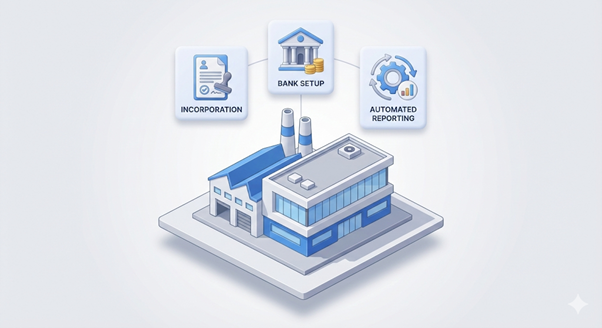
At KNM India, we advise clients to view business setup in India as an integrated lifecycle. The systems you put in place during the registration phase—such as your choice of banking partners, accounting software, and auditor appointments—will directly dictate how easily you can handle the inevitable quarterly compliance burden.

The Challenge of Quarterly Compliance for Japanese Subsidiaries
Japanese corporate culture values precision, timeliness, and transparency (Ren-So-Ketu). In contrast, the Indian fiscal environment is dynamic, with frequent notification updates and rigid statutory deadlines. This mismatch often creates friction when a newly formed Indian subsidiary attempts to report back to Japan.
In India, compliance is not an annual event; it is a continuous cycle.
- Monthly: GST returns, TDS payments, and payroll processing.
- Quarterly: TDS returns (Form 24Q/26Q) and advance tax calculations.
- Annual: ROC filings, Tax Audits, and Transfer Pricing reports.
For a Japanese parent company using a generic “outsourcing” vendor, the quarterly reports often arrive late or in a format that does not match the global ERP systems used in Japan. This lack of synchronization can lead to consolidation errors at the group level. This is where the concept of company formation India must evolve to include “Compliance Architecture” design.
Automating the Compliance Workflow
Automation is the bridge that connects Indian regulatory requirements with Japanese management expectations. By automating the quarterly compliance process, companies remove the dependency on manual spreadsheets and reduce the risk of human error—a critical factor for risk-averse Japanese investors.
Automation in this context does not just mean software; it means a tech-enabled service workflow.
- Real-Time Data Capture: Instead of waiting for the end of the quarter, accounting entries regarding GST and withholding tax are validated in real-time.
- Automated Reconciliation: Tools that automatically match internal ledgers with the government’s GST portal (GSTR-2B) to ensure no tax credit is lost.
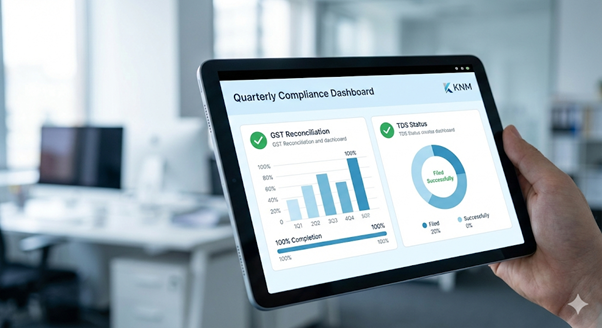
- Dashboarding for HQ: Providing the Japanese CFO with a “View Only” dashboard that translates Indian statutory data into intelligible financial health metrics.
Comparison: Manual vs. Automated Compliance Framework
| Feature | Traditional Manual Approach | KNM Automated Approach |
| Data Entry | Batch processing at month-end | Real-time transaction recording |
| Error Rate | High risk of manual transposition errors | Minimal risk due to API validation |
| HQ Reporting | Delayed by 15-20 days post-quarter | Available within 3-5 days post-quarter |
| Compliance Risk | Reactive (fixing notices when they come) | Proactive (flagging issues before filing) |
| Transparency | Black box (HQ relies on local manager) | Glass box (HQ has direct visibility) |
KNM India: Your Partner for Strategic Entry
At KNM India, we do not simply process forms; we act as the strategic custodians of your Indian operations. Our Corporate Advisory and Virtual CFO teams specialize in supporting foreign entities, particularly from regions like Japan, where reporting standards are exacting.
When we assist with company establishment in India, we simultaneously set up the financial infrastructure required for the future. We implement robust internal controls and automated reporting lines that ensure your quarterly compliances—from TDS to GST—are not just filed, but are analytically useful to your management team in Tokyo.
We understand that for a Japanese firm, “business setup in India” is a long-term commitment. Our goal is to ensure that your compliance rating remains impeccable, protecting your brand reputation and ensuring smooth repatriation of profits in the future.
Key Takeaways
- Strategic Alignment: Company establishment in India is only the first step; aligning Indian operations with Japanese HQ reporting standards is critical for long-term success.
- Compliance Complexity: India’s regulatory environment involves intricate quarterly filings (GST, TDS) that often differ from Japanese compliance calendars.
- Automation Advantage: Implementing compliance automation early in the company formation process reduces human error and ensures real-time visibility for Tokyo-based CFOs.
- KNM’s Role: KNM India integrates Pre-Incorporation advisory with Virtual CFO services to ensure seamless data flow between Indian subsidiaries and Japanese parent companies.
Conclusion
Entering the Indian market offers immense rewards, but the operational friction can be high without local expertise. By prioritizing company establishment in India that focuses on automation and rigorous compliance from day one, Japanese firms can mitigate risks and focus on market capture.
Do not let regulatory nuances slow down your India strategy. Align your Indian subsidiary with the speed and precision of your Japanese Headquarters through smart, automated advisory.
[Link to KNM Pre-Incorporation Services] [Link to KNM Virtual CFO Solutions] [External Link to Invest India: Japan-India Relations]
Frequently Asked Questions (FAQs)
Q1: How long does company establishment in India take for a Japanese firm? Generally, the process takes between 15 to 30 working days, provided all documents (notarized and apostilled in Japan) are in order. However, FDI banking approvals can sometimes extend this timeline.
Q2: Can we automate all compliance filings in India? While the filing on the government portal requires manual authorization via Digital Signature Certificates (DSC), the preparation, calculation, and reconciliation can be 90% automated to ensure accuracy and speed.
Q3: What are the mandatory quarterly compliances for a Private Limited Company? The primary quarterly requirements include TDS (Tax Deducted at Source) returns and the payment of Advance Tax. Additionally, listed companies or those with specific debt structures may have quarterly ROC filings.
Q4: Does KNM India support Japanese language reporting? Yes, KNM India has experience working with international clients and can structure MIS reports and financial summaries in formats that are easily easily integrated into Japanese reporting styles.
Q5: Is a physical office required for company formation in India? Yes, a registered office address is mandatory for incorporation. KNM India can assist in providing virtual office support or registered address services during the initial setup phase.
Collaborate with KNM India to turn the outsourced bookkeeping services into a competitive edge to your finance department.
🌐 Website: https://knmindia.com
📞 Telephone and Contact Information:
Tokyo: +81-3-6869-0850
India: +91-124-4295170, +91-99105-04170
📧 Email: services@knmindia.com
📩 Contact: The contact page on knmindia.com allows you to contact our experts.