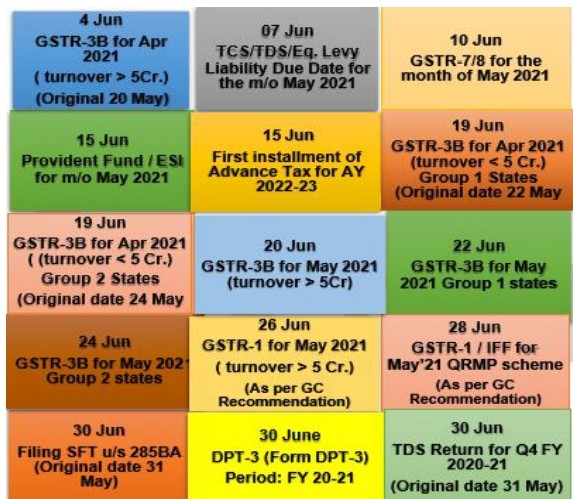
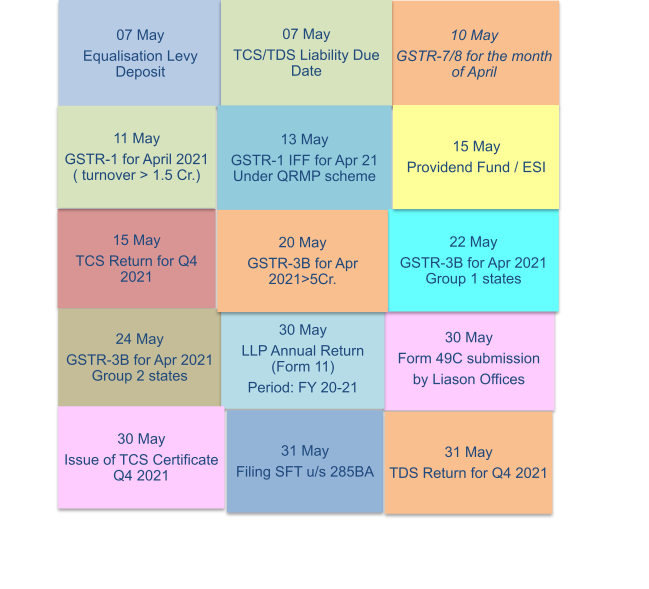
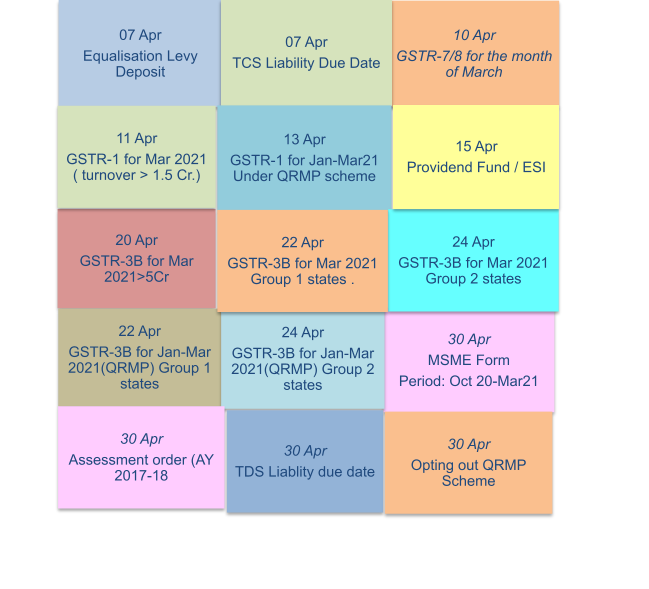
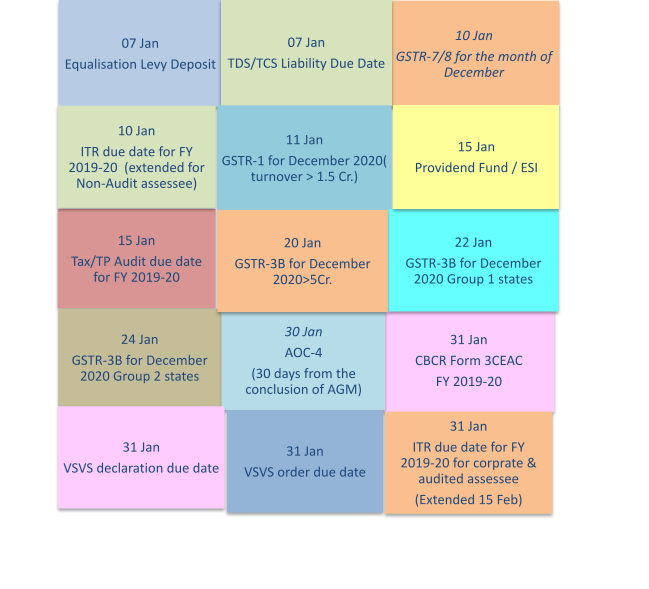
Under section 143(1) of Income Tax Act, 1961, an intimation for adjustment of refund/demand needs to be send within 9 months from the end of the financial year in which the return is made. Earlier this timeline was 12 months from the end of the financial year in which the return is made.
However, due to some technical issues or other reasons, of course not attributed to taxpayers several Income Tax returns up to the AY 2017-18 were not processed and consequently Intimations of the same were not sent to taxpayers. This has led to a situation where the taxpayer is unable to get his legitimate refund in accordance with provisions of the Act, although the delay is not attributable to him.
As per the earlier order dated 10th July 2020, time frame was given till 31st October 2020 to process such returns with refund claims but considering the pending taxpayers’ grievances related to issue of refund and to mitigate genuine hardship being faced by the taxpayers these time limits are further extended till 30th September 2021 through order u/s 119 of IT Act, 1961.
The relaxation accorded above shall not be applicable to the following returns:
(a) returns selected in scrutiny.
(b) returns remain unprocessed, where either demand is shown as payable in the return or is likely to arise after processing it.
(c) returns remain unprocessed for any reason attributable to the assessee.
To ensure adequate safeguards, it has been decided that once administrative approval is accorded by the Pr. CCIT/CCIT, the Pr. CIT/CIT concerned would make a reference to the DGIT(Systems) to provide necessary enablement to the Assessing officer on a case-to-case basis.
Further, we shall be happy to assist in case of any clarifications. For a deeper discussion, feel free to revert us at services@knmindia.com
Disclaimer: Information in this note is intended to provide only a general update of the subjects covered. It is not intended to be a substitute for detailed research or the exercise of professional judgment. KNM accepts no responsibility for loss arising from any action taken or not taken by anyone using this publication.
CBDT has come out with the following amendments as below: –
Launching of New Income Tax Website.
Compliance check Functionality for ease the usance of section 206AB/CCA.
Extension of time limits of certain compliances to provide relief to taxpayers.
Issuance of Cost Inflation Index for FY 2021-22.
GST
CBIC has come out with the following amendments as below: –
GST notifications issued on June 1st 2021 to provide effect of 43rd GST council meeting
GST rates reduced on Goods on specific items prescribed in 44th GST council meeting held on June 12th 2021
Clarification on applicability of Dynamic QR Code
Companies Act 2013/ Other Laws
MCA has come out with the following amendments as below:
MCA has issued the much-awaited clarification for passing general and special resolutions and convening an EGM in unavoidable circumstances and extended the validity of the existing circulars up to December 31, 2021, in light of the current social distancing norms.
All companies are free to discuss and approve the matters related to the approval of the annual financial statements; the approval of the Board’s report; the approval of the prospectus; the Audit Committee Meetings for consideration of financial statement including consolidated financial statement if any;
To know in detail please continue reading…
Income Tax
CBDT vide Press release dated 5th June 2021 informed for launching of new Income tax website incometax.gov.in on 07th June 2021 with an aim to providing better interface, free ITR preparation utility in some cases, new & functionalities and also for quick refunds etc.
CBDTvide Notification No. 71/2021 / No. 370142/19/2021-TPLdated 8th June 2021 amend the rule 31A (4) to comply with clauses amended according to 194A, 196D and 194Q. In addition to Appendix II has been changed in form 26Q to give effect to TDS sections.
CBDT vide Circular F.NO.225/61/2021/ITA-I dated 10th June 2021 has issued parameters for compulsory selection of returns for Complete Scrutiny during Financial Year 2021-22 and conduct of assessment proceedings.
CBDT vide Press release dated 14th June 2021 has informed that until fixation of bugs/error on new Income Tax website taxpayer can prepare 15CA/CB manually. This notification is applicable till 30th June 2021. A facility will be provided on the new e-filing portal to upload these forms at a later date for the purpose of generation of the Document Identification Number.
CBDTvide Notification No. 73/2021 / NO. 370142 / 10 / 2021-TPLdated 15th June 2021 has issued Cost inflation index (CII-317) for the financial year 2021-22 and is applicable from AY 2022-23.
CBDT vide Press release dated 23rd June 2021 has informed about approves agreement between India and Saint Vincent and grenadines for exchange of information and assistance in collection with respect to taxes.
CBDT vide circular No. 12 of 2021 dated 25th June 2021 has issued clarification that income-tax exemption will be given to the amount received by a taxpayer for medical treatment from employer or from any person for treatment of Covid-19 during FY 2019-20 and subsequent years. It has been decided to provide income-tax exemption to ex-gratia payment received by family members of a person from the employer of such person or from other person on the death of the person on account of Covid-19 during FY 2019-20 and subsequent years. The exemption shall be allowed without any limit for the amount received from the employer and the exemption shall be limited to Rs. 10 lakh in aggregate for the amount received from any other persons.
Further due to covid-19 provide various relaxations through extension of time limits of certain compliances to provide relief to taxpayers as below:
Particulars
Original Due Date
Due dates extended by previous notifications
New Due Dates (Circular 12/2021)
Filing of objections to Dispute Resolution Panel (DRP) and Assessing officer u/s 144C of the Act
1st June 2021 or thereafter
–
may be filed within the time provided in that section or by 31st August 2021, whichever is later.
TDS Return
-Quarter 4 (FY 2020-21)
31st May 2021
30th June 2021
Vide Circular No. 09/2021
15th July 2021
Issuance of TDS Certificate -Form 16
15th June 2021
15th July 2021
Vide Circular No. 09/2021
31st July 2021
Statement of Income paid or credited by Investment fund to its unit holder in Form 64D for the previous year 2020-21
15th June 2021
30th June 2021
Vide Circular No. 09/2021
15th July 2021
Statement of Income paid or credited by Investment fund to its unit holder in Form 64C for the previous year 2020-21
30th June 2021
15th July 2021
Vide Circular No. 09/2021
31st July 2021
Application u/s 10(23C), 12AB, 35(1)(ii)/(iia)/(iii) and 80G of the act in Form 10A/ 10AB for registration /intimation approval/ provisional approval of trust/ institutions/ Research associations etc
30th June 2021
–
31st August 2021
Furnishing of Equalisation levy Statement in Form No. 1 for FY 2020-21
30th June 2021
–
31st July 2021
Quarterly statement in Form No. 15CC to be furnished by authorized dealer in respect of remittances made for the quarter ending on June 2021
15th July 2021
–
31st July 2021
Annual Statement u/s 9A (5) of the act by eligible investment fund in Form No. 3CEK for the financial year 2020-21
29th June 2021
–
31st July 2021
Uploading of declarations in Form No. 15G/ 15H received from recipients during the quarter ending June 2021
15th July 2021
–
31st August 2021
Exercising of option u/s 245M(1) of the act in Form No. 34BB
27th June 2021
–
31st July 2021
Making Investments or completing construction/ purchase for claiming deduction from capital gains.
(The extension has been given in those cases where the due date falls between 01-04-2021 to 29- 09-2021).
–
–
30th September, 2021
CBDT vide Notification No. 74/2021/ F. No. 370142/35/2020-TPL dated 25th June 2021 & 75/2021/ No.IT(A)/01/2020-TPL Dated 25th June,2021 has decided to extend the various dates as below:
Particulars
Original Due Date
Due dates extended by previous notifications
New Due Dates
Passing of order for assessment or reassessment by AO u/s 153/ 153B
· Cases where on account of various extension notifications, the due date is getting expired on 31-03-2021
· Cases where due date is getting expired on 31-03-2021 without giving effect of any extension notification.
31st March 2021
30th June 2021
30th September 2021
30th September 2021
30th September 2021
Imposition of penalty for Chapter XXI of the Income-tax Act
(The extension has been given in those cases where the due date falls between specified period)
–
30th June 2021
(due date falls between 20-03-2020 to 29-06- 2021)
30th September 2021
(due date falls between 20-03-2020 to 29-09- 2021)
Linking of Aadhaar number and PAN u/s 139AA
31st March 2021
30th June 2021
30th September 2021
Sending intimation of processing of Equalisation Levy u/s 168
(The extension has been given in those cases where the due date falls between 20-03-2020 to 31- 03-2021)
The GST council in its 44th meeting held on 12th June, 2021 recommended reduction in GST rates on goods on specific items being used in COVID -19 relief and management. (Link /https://knmindia.com/relaxations-by-gst-council/)
CBDT vide Circular No. 156/12/2021 – GST dated 21st June 2021 issue various clarifications in respect of applicability of Dynamic Quick Response (QR) Code on B2C invoices and compliance of notification 14/2020- Central Tax dated 21st March, 2020 as below:
Dynamic QR Code is to be provided on an invoice issued to an Unique Identity Number holder.
Bank account and IFSC details need not to be provided separately in the Dynamic QR Code along with UPI ID.
where the payment is collected by some person other than the supplier (E-Commerce Operator or any other person authorized by the supplier on his/ her behalf) then in such cases UPI ID of such person who is authorized to collect the payment on behalf of the supplier, may be provided.
Wherever an invoice is issued to a recipient located outside India, for supply of services where place of supply is in India and the payment is received by the supplier in foreign currency, through RBI approved mediums, then such invoice may be issued without having a Dynamic QR Code.
In some instances, it may not possible for the supplier to provide details of invoice number in the dynamic QR code displayed to the customer on payment counter where payment received before generation of invoice then cross reference of such payment received along with unique order ID/ sales reference number to be provided on the invoice.
When the part-payment for any supply has already been received from the customer/ recipient, in form of either advance or adjustment through voucher/ discount coupon etc. then the dynamic QR code may provide only the remaining amount payable by the customer/ recipient against “invoice value”. However, the total invoice value should be mentioned on invoice showing advance adjustment.
CBIC vide Notification no. 34/2021- customs dated 29th June 2021 seeks to reduce the basic custom duty on Crude Palm Oil [1511 10] and Palm Oil other than Crude Palm Oil [1511 90] till 30th September 2021.
CBIC vide Notification no. 33/2021- customs dated 14th June 2021 Seeks to rescind notification No. 30/2021-Customs, dated 01.05.2021 relating to reduce IGST on Oxygen Concentrators when imported for personal use.
CBIC vide Notification no. 32/2021 – (Customs ADD ) dated 03rd June 2021 Seeks to further amend notification No. 23/2016-Customs (ADD) dated 6th June, 2016 extend the levy of Anti-Dumping duty on Polytetrafluoroethylene originating in or exported from Russia, up to and inclusive of 31st October, 2021.
CBIC vide Notification no. 33/2021 – (Customs ADD ) dated 03rd June 2021 Seeks to further amend notification No. 6/2016-Customs (ADD) dated 8th March, 2016 to extend the levy of Anti-Dumping duty on Phenol originating in or exported from European Union and Singapore, up to and inclusive of 31st October, 2021.
The MCA has earlier issued General Circular no 14/2020 (first circular) and 17/2020 (second circular) dated 13th April 2020 for providing relaxations and clarifying various difficulties in following the first circular. The circular details guidelines for conducting an EGM for companies that need to provide e-voting facility or have opted for e-voting as per section 108 of the Companies Act, 2013, every listed company and company not having less than 1000 shareholders must mandatorily provide e-voting facility and for companies that do not need to provide e-voting facilities. All other requirement and conditions provided in the said circulars shall remain unchanged.
Through these Rules, MCA has notified the Accounting Standards for small and medium companies that revise the turnover and borrowing limits as well as help in making disclosure requirements less onerous. The definition of Small and Medium-Sized Companies (SMCs) under the standards has been revised and accordingly turnover limit has been increased from Rs 50 crore to not exceeding Rs 250 crore and with enhanced borrowing limits. This is in addition to the requirements that such entities should be unlisted companies, which are not banks, financial institutions, or insurance companies. The Accounting Standards 1 to 5, 7, and 9 to 29 as recommended by the Institute of Chartered Accountants of India shall be applicable on SMC and shall come into effect in respect of accounting periods commencing on or after 01-04-2021. Every company, other than companies on which Indian Accounting Standards as notified under Companies (Indian Accounting Standards) Rules, 2015 are applicable, and its auditor(s) shall comply with the Accounting Standards at the time of preparation of Financial Statements. Further, an existing Company which has subsequently become SMC can only claim the benefits of SMC under these Rules after two years.
Which shall come into force on the date of their publication in the Official Gazette i.e. 18-06-2021. The MCA has notified the much-awaited amendment and eased the requirement for aspiring as well as serving independent directors on the board of companies to get their names included in an official database of eligible professionals. As per a rule change notified by the ministry on Friday, in spite of any delay, a professional could get her name empaneled in the official database of independent directors maintained by the Indian Institute of Corporate Affairs (IICA) by paying ₹1,000/-. This is expected to give relief to those who have missed their deadline. Aspiring independent directors were expected to get their names included in the database before they took up the assignment while serving ones had time till last October as per an earlier instruction.
Which shall come into force on the date of their publication in the Official Gazette i.e. 18-06-2021. To enable users of financial statements to understand the effect of interest rate benchmark reform on an entity‘s financial instruments and risk management strategy, an entity shall disclose information about the nature and extent of risks to which the entity is exposed arising from financial instruments subject to interest rate benchmark reform, and how the entity manages these risks; and the entity‘s progress in completing the transition to alternative benchmark rates, and how the entity is managing the transition. Among others, there are changes in the basis for determining the contractual cash flows as a result of interest rate benchmark reform. The disclosures will enable users of financial statements to understand the effect of these changes, including an entity’s progress in completing the transition to alternative benchmark rates. Further, the amendments to Ind ASs are in terms of insertion of certain paragraphs, substituting definition of certain terms used in the standard along with aligning the bare text of Standards with Conceptual Framework of Financial reporting under IndAS.
Which shall come into force on the date of their publication in the Official Gazette i.e 15-06-2021. Through this Amendment, Rule 4 related to the matters not to be dealt with in a meeting through video conferencing or other audiovisual means has been omitted. Accordingly, now all companies are free to discuss and approve the matters related to the approval of the annual financial statements; the approval of the Board’s report; the approval of the prospectus; the Audit Committee Meetings for 2[consideration of financial statement including consolidated financial statement if any; and the approval of the matter relating to amalgamation, merger, demerger, acquisition, and takeover, in any meeting held through video conferencing or other audio visual means. Earlier, MCA has provided relaxation in this regard up to 30th June 2021.
The Amendment, 2021 notified on June 25, 2021 provides a framework for AIFs to invest simultaneously in units of other AIFs and directly in securities of investee companies. In terms of Regulation 15(1) (c) and (d) of the AIF Regulations, AIFs may invest in an Investee Company up to a specified limit, directly or through investment in the units of other AIFs. In terms of Regulation 20(1), the key management personnel of the AIF and the Manager shall abide by the Code of Conduct as specified in the Fourth Schedule of the AIF Regulations. In terms of provision to Regulation 20(8) of AIF Regulations, there is a requirement to furnish a waiver to AIF in respect of compliance with the said Regulation. The consent of the investors of the AIF or scheme may not be required for change in ex-officio external members (who represent the sponsor, sponsor group, manager group or investors, in their official capacity), in the investment committee set up by the Manager.
The relaxation will be available to all such employees who died on or after April 1, 2020. The Share Based Employee Benefit (SBEB) Regulation provides that there will be a minimum vesting period of one year in case of employee stock options and Stock Appreciation Rights (SAR). In the event of death of an employee, all the options, SAR or any other benefit granted to him or her under a scheme till such date will vest in the legal heirs or nominees of the deceased employee. SEBI has now decided the provisions under the SBEB Regulations relating to minimum vesting period of one year shall not apply in case of death (for any reason) of an employee and in all such instances, all the options, SAR, or any other benefit granted to such an employee will vest with his/her legal heir or nominee on the date of death of the employee.
It has now been decided to include the listed debt securities of equity listed companies under the purview of the said System Driven Disclosures for the entities. The Depositories and Stock Exchanges shall make necessary arrangements such that the disclosures pertaining to listed Debt Securities along with equity shares and equity derivative instruments are disseminated on the websites of respective stock exchanges with effect from July 01, 2021.
RBI
RBI with an intent to infuse greater transparency and uniformity in practice has notified a Guidelines on the Distribution of Dividends by NBFCs.
These guidelines shall be applicable on all NBFC’s and shall be effective for the declaration of dividend from the profits of the financial year ending March 31, 2022, and onwards. All NBFCs eligible to declare dividend may pay a dividend, subject to the Dividend Payout Ratio is the ratio between the amount of the dividend payable in a year and the net profit as per the audited financial statements for the financial year for which the dividend is proposed. The proposed dividend shall include both dividend on equity shares and compulsorily convertible preference shares eligible for inclusion in Tier 1 Capital. Further, in case the net profit for the relevant period includes any exceptional and/or extraordinary profits/ income or the financial statements are qualified (including ’emphasis of matter’) by the statutory auditor that indicates an overstatement of net profit, the same shall be reduced from net profits while determining the Dividend Payout Ratio. It has also made clear that the Reserve Bank shall not entertain any request for ad-hoc dispensation on the declaration of dividend.
For appointment as, IRP in a CIRP under section 16(4), liquidator in a liquidation process under section 34(6), RP in an individual insolvency resolution process under section 97(4) or 98(3), and bankruptcy trustee (BT) under section 125(4), 146(3) or 147(3) of the Insolvency and Bankruptcy Code, 2016. This list shall be in effect during the period between July 1, 2021 – December 31, 2021. The Board has prepared a common Panel of IPs for appointment as IRP, Liquidator, RP and BT and shall share the same with the Adjudicating Authority (‘AA’) (NCLT and DRT) in accordance with these Guidelines. The Panel will have validity of six months and a new Panel will replace the earlier Panel every six months. For example, the first Panel under these Guidelines will be valid for appointments during July – December 2021, and the next Panel will be valid for appointments during January – June 2022, and so on. The NCLT may pick up any name from the Panel for appointment of IRP, Liquidator, RP or BT, for a CIRP, Liquidation Process, Insolvency Resolution or Bankruptcy Process relating to a corporate debtors and personal guarantors to corporate debtors, as the case may be.
Disclaimer: Information in this note is intended to provide only a general update of the subjects covered. It is not intended to be a substitute for detailed research or the exercise of professional judgment. KNM accepts no responsibility for loss arising from any action taken or not taken by anyone using this publication. Updates are for the period 26.05.2021 till 25.06.2021.
A much-needed relief by the Ministry of Corporate Affairs (MCA) to conduct the Extra Ordinary General Meetings (EGM) through Video Conference (VC) or Other Audio-Visual Means (OAVM) in accordance with the framework provided till 31st December 2021.
A. Background
The Ministry of Corporate Affairs had earlier provided relaxations for conducting EGM through Video Conference (VC) or Other Audio-Visual Means (OAVM) on account of COVID-19. The MCA had issued the First General Circular no. 14/2020 dated 8th April 2020 for providing relaxation wherein the companies were allowed to conduct Extra-Ordinary General Meeting (EGM) for passing ordinary and special resolutions requiring approval of members through VC or OAVM considering the COVID 19 outbreak situation.
In furtherance to the above circular, the Second General Circular no. 17/2020 was issued on 13th April 2020 clarifying the framework for conducting the EGM through VC or OAVM.
B. Relaxation
Now, it has been allowed to all the companies to conduct EGM’s through VC or OAVM or transact items through postal in accordance with the framework provided till 31st December 2021 vide the General Circular No. 10/2021 dated 23rd June 2021.
MCA had already allowed the companies to conduct the Annual General Meeting (AGM) through VC or OAVM till 31st December 2021 vide circular dated 13th January 2021.
C. Frequently Asked Questions (FAQs)
1. Is the Facility of conducting EGM through VC or OAVM is available for all companies?
Yes, all companies whether Listed, Private, Public or Small Companies are allowed to provide facility of VC or OAVM for conducting their EGM.
2. Are companies allowed to conduct Annual General Meeting through VC or OAVM?
Yes, the Companies are allowed to conduct Annual General Meeting (AGM) through VC or OAVM facility.
3. Is it necessary to maintain the recorded transcript of the General Meeting held through VC or OAVM facility?
Yes, it is necessary to keep the recorded transcript in the safe custody of the Company.
4. What is the time period allowed by MCA to conduct the EGM / AGM through VC or OAVM?
As per the recent circulars, the Companies can conduct their EGM / AGM through VC or OAVM till 31st December 2021.
Disclaimer: Information in this note is intended to provide only a general update of the subjects covered. It is not intended to be a substitute for detailed research or the exercise of professional judgment. KNM accepts no responsibility for loss arising from any action taken or not taken by anyone using this publication.
The announced packages will boost public health facilities, enhance private investment in medical infrastructure, extend loan guarantees, and offer concessional credits to the sectors hit by COVID 19. In this article, we will discuss the various reliefs by the Modi Government.
B.ReliefsbyGovernment
Emergency Credit Line Guarantee Scheme (ECLG): The Government has announced additional Rs 1.5 lakh crore under the ECLG Scheme which was announced last year of Rs 3 lakh crore.
Fresh loans through Micro Finance Institution (MFI): A new scheme is being launched to facilitate loans through Micro-Finance Institutions. The scheme aims to facilitate loans to 25 lakh small borrowers via MFI. The loan amount will be up to Rs 1.25 lakh per individual for a duration of three years. The rate will be at least 2% below the maximum rate prescribed by the RBI.
Upscaling Medical Infrastructure: Under Rs 1.1 lakh crore loan guarantee scheme for COVID-affected sectors, a Rs 50,000 crore cover is reserved for scaling up medical infrastructure. The health and medical infrastructure in areas other than metropolitan cities will be taken care of. The guarantee coverage will be up to 75% for totally new projects and up to 50% for ongoing projects.
Support to Tour and Travel agencies: Over 11,000 registered tourist guides and travel agencies will benefit with the relief packages in the form of financial support. Working capital or personal loans will be provided to this sector to discharge liabilities and restart business affected by COVID-19 with a 100% guarantee under the scheme to be administered by the Ministry of Tourism
Once the Visa issuance resumes, the first 5 lakh tourist visas will be issued totally free of charge. Applicable till March 31, 2022, or till the first 5 lakh tourist visas are issued, the total financial implication of this visa scheme would be Rs 100 crore.
Atmanirbhar Bharat Rozgar Yojana extended: In order to motivate employers to create new jobs and to restore loss of employment, Atmanirbhar Bharat Rozgar Yojana has been extended to March 31, 2022. Under this scheme, the government aims to provides subsidy for new employees having income of less than Rs. 15,000/- per month through 100% EPF contribution for two years in organizations with less than 1000 employees. For organizations with over 1000 employees, the government will contribute half of the EPF contribution.
Additional fertilizer subsidy: The relief package also includes fertilizers subsidies to farmers and food grains to poor people.
Emphasis on Paediatric care: The Govt will provide Rs 23,220 crore to public health emphasizing on children and pediatric care, to increase ICU beds, oxygen supply, and employing final year medical students and interns for the short term.
Climate-resilient crops: The Indian Council of Agricultural Research (ICAR) plans to release 21 Climate-resilient and bio-fortified special varieties of crops to fight malnutrition and improve farmers’ income.
Revival of North Eastern Regional Agricultural Marketing Corporation (NERAMAC): To enhance agricultural, procurement, processing and marketing infrastructure in North East, the Government has planned to infuse Rs 77.45 crore as a revival package.
National Export Insurance Account: The govt has Proposed to provide additional corpus to NEIA over 5 years to allow it to underwrite additional Rs. 33,000 crores of project exports.
Broadband for Villages: To Digitalise India, an additional Rs 19,041 crore will be provided so that broadband connectivity will be available for all gram panchayats in 1000 days from the Independence Day of 2020.
Extension of PLI scheme for electronics manufacturing: The PLI scheme shall provide incentives of 6% to 4% on incremental sales of goods to large scale electronics manufacturing. The govt has extended the duration of the scheme by one year i.e. till 2025-26. Also, the Companies will get an option to choose any five years to meet the production target.
Streamlined process for PPP projects and Asset Monetisation: To ensure speedy clearance for projects so as to improve the private sector’s efficiency, the Govt. has announced a new streamlined process for PPP and asset monetisation. The current process was long and involved long delays in approving PPPs.
The reliefs announced by Govt. are tabulated as under:
S. No.
Scheme
Amount (In crore)
1
Loan Guarantee Scheme for COVID Affected Sectors
1,10,000
2
Emergency Credit Line Guarantee Scheme (ECLGS)
1,50,000
3
Credit Guarantee Scheme for Micro Finance Institutions
7,500
4
Free One Month Tourist Visa to 5 Lakh Tourists
100
5
Additional Subsidy for DAP & P&K fertilizers
14,775
6
Free food grains under PMGKY from May to November,
2021
93,869
7
New Scheme for Public Health
15,000
8
Revival of North Eastern Regional Agricultural Marketing
Corporation (NERAMAC)
77
9
Boost for Project Exports through NEIA
33,000
10
Boost to Export Insurance Cover
88,000
11
Broadband to each village through BharatNet PPP
Model
19,041
12
Reform Based Result Linked Power Distribution Scheme
1. Notification for relaxations of due date in time barring matters
2. Circular for extension of due dates falling on 31st March /30th April 2021, up to 31st May 2021
3. Circular extending compliance due dates for the FY 2020-21, relating to filing of returns and audit reports
4. Covid-19 relaxation in Section 269ST- Cash Receipt more than INR 2 Lakh.
5. Time line to update UDIN of Past Audit Reports and certificates has been further extended up to 30th June 2021
6. Government to launch new income tax e- filing website on 7th June 2021
International Tax
1. New Rule 11UD inserted in ITA to define the threshold limits for Significant Economic Presence
2. Section 139A exemption to Eligible Foreign Investors.
Goods and Services Tax
1. Relaxations in waiver of late fee and reduction in interest rates for compliance periods of March and April 2021
2. Amnesty and relaxations recommended by GST council in its 43rd Meeting dated 28th May 2021, capping late fee in filing GST returns
3. Recommendations by GST council for full exemption from GST to covid-19 related goods, imported from outside India on payment basis, for donating to government or any relief agency
4. Recommendations of the GST council to make present system of filing GSTR-1 / 3B, as default return filing mechanism under GST
5. Refund filing timeline to exclude period in notifying by the officer, deficiencies in refund application filed
Corporate & Other Laws
1. MCA has provided relaxation on additional fee on various forms as per the circular no. 06/2021 and 07/2021
2. MCA has provided clarification on offsetting the excess CSR spent for Financial Year 2019-20
3. MCA has provided the relaxation under the Section 173 by increasing the gap between two Board Meeting by 180 days
Income Tax Notification for extension of Time barring matters
The CBDT vide Notification No. 38/2021 Dated 27th April,2021 has decided to extend the various time barring dates, which were earlier extended to 30-04-2021, by various notifications. It has been decided to extend due dates from 30-04-2021 to 30-06-2021 in the following cases:
a) Time limit for passing of any order for assessment or reassessment, the time limit for which is provided under section 153 or section 153B.
b) Time limit for passing an order consequent to the direction of DRP under section 144C(13).
c) Time limit for issuance of notice under section 148 for reopening assessment where income has escaped assessment.
d) Time Limit for sending intimation of processing of Equalisation Levy.
The CBDT vide Notification No. 39/2021 Dated 27th April,2021 has decided to extend the due date for making payment without additional charge under Vivad se Vishwas Act., which were earlier extended to 30-04-2021 has extended further from 30-04-2021 to 30-06-2021. Time line to update UDIN of Past Audit Report and certificates has been further extended CBDT notifies dated 30th April 2021 that the timeline to update UDIN of past uploads of audit report and certificates has been further extended up to 30th June, 2021 to avoid invalidation. Notifications for Statement of Financial Transactions (SFT) for Depository Transactions CBDT vide Notification No. 3 & 4 of 2021 dated 30.04.2021, issued format, procedure and guidelines for submission of Statement of Financial Transactions (SFT) for Depository Transactions & Mutual Fund Transactions by Registrar and Share transfer Agent.Extension of dates by up to 31st May 2021 for compliances ending 31st March / 30th April (Circular No. 08/2021, Dated 30th April, 2021)
Particulars
Original Due Date
Revised / Extended Due dates
Belated/Revised ITR for AY 2020-21 (FY 2019-20)
31st March, 2021
31st May, 2021
Payment & Filing of Challan- cum- Statement for TDS u/s 194IA,194IB & 194M
30th April, 2021
31st May, 2021
-Appeal to CIT -Objections to DRP
If last date to file was 1st April or Afterwards
31st May or the actual last date, whichever is later
Income tax Return in response to notice u/s 148
If last date to file was 1st April or Afterwards
31st May or time allowed in notice, whichever is later
Form 61
30th April, 2021
31st May, 2021
Statement of Income paid or credited by an investment fund to its unit’s holder in Form 64D for FY 2021
15th June, 2021
30th June, 2021
Statement of Income paid or credited by an investment fund to its unit’s holder in Form 64C for FY 2021
30th June, 2021
15th July 2021
Though the due date for filing of Income-tax Return for the Assessment Year 2021-22 has been extended, but no relief shall be provided from the interest chargeable under section 234A if the tax liability exceeds Rs. 1 lakh. Thus, if self-assessment tax liability of a taxpayer exceeds Rs. 1 lakh, assessee would be liable to pay interest under section 234A from the expiry of original due dates, i.e., 31-07-2021 or 31-10-2021 or 30-11-2021. The interest under section 234A shall not be levied if the self- assessment tax liability of taxpayer does not exceed Rs. 1 lakh and ITR if filed within the extended due date. Further In case of senior citizen having no PGBP Income, all taxes paid upto 31st July will be deemed as Advance Tax.
Relaxation in Section 269ST: Cash Receipt more than INR 2 Lakh On account of Curbing cash transaction, Government had introduced the section 269ST, in which no person is allowed to take an amount of INR Two lakh or more from a person on a single day for one event/transaction. However considering the surge of Covid-19, Govt. vide Notification No.56/2021 dated 07th May 2021, has allowed to below mentioned entities to take Cash after obtaining PAN or AADHAAR of the patient and the payee and the relationship between the patient and the payee: – Hospitals, -Dispensaries, -Nursing Homes, -Covid Care Centres or similar other medical facilities. during period begin from 01.04.2021 to 31.05.2021. On 10th May, 2021 Govt. has issued a corrigendum that instead of payee, Payer should be read. Government to launch new income tax e-Filing website
Government has announced that it is launching a new website on 7th June, 2021 for income tax e-filing. ITA also said that the existing website will not be accessible between 1st June 2021 to 6th June 2021. CBDT has issued first instruction for Faceless Assessment Scheme CBDT has issued instruction that notices u/s 143(2) will be issued electronically by NeAC and cases covered under Central charge i.e. search & seizure, & International Taxation will still continue with Prescribed authority.
Extension of time limits of year end compliances for FY 2020-21 (Circular No. 09/2021, Dated 20th May, 2021)
Particulars
Original Due Date
Revised / Extended Due dates
Income Tax Returns-Original ITR [ FY 2020-21]
Non-Tax Audit / Non-Transfer Pricing(‘TP’) Case
31st July 2021
30th September 2021
Tax Audit / Non TP-Case
31st October 2021
30th November 2021
Belated/Revised ITR
31st December, 2021
31st January 2022
Audit Reports by CA -Tax Audit -TP Certification/Audit u/s 92E of ITA
30th September 2021 31st October 2021
31st October 2021 30th November 2021
TDS Return -Quarter 4 (FY 2020-21)
31st May, 2021
30th June 2021
Issuance of TDS Certificate -Form 16
15th June 2021
15th July 2021
Form 61-Statement of Financial Statement (SFT)
31ST May, 2021
30th June, 2021
Statement of Reportable Account under Rule 114G
31ST May, 2021
30th June, 2021
TDS/TCS Book adjustment statement in Form 24G for the month of May 2021
15th June 2021
30th June, 2021
Statement of Deduction of Tax in the case of superannuation fund for FY 2021
31st May, 2021
30th June, 2021
Computation of FMV in case of Slump Sale CBDT has notified a new rule 11UAE for computation of fair market value of capital assets in slump sale. As per the amendment, the new Rule 11UAE under section 50B has given two formulae for calculation and has stated that the fair market value will be the higher among the two values. It is to be noted that earlier, the actual consideration of the slump sale transaction was considered as full value of consideration for computing capital gains meaning thereby that there was no need to arrive at Fair Market Value. Formula 1: The FMV1 shall be the fair market value of the capital assets transferred by way of slump sale Formula 2: FMV2 shall be the fair market value of the consideration received or accruing as a result of transfer by way of slump sale Accordingly, now a uniform formula to compute FMV in case of slump sale has been provided, which shall provide a certainty in tax litigation and clarity to taxpayers. Clarification on limitation for filing of CIT(A) CBDT via Circular No 10 of 2021 dt 25.05.2021, issues clarification w.r.t. limitation for filing of appeals before CIT(Appeals) under Income- tax Act,1961 in consonance with directions issued by Hon’ble Supreme Court in Suo Motu WP(Civil) No 3 of 2020 vide order dt 27th Apr, 2021. It was clarified that if different relaxations are available to the taxpayers for a particular compliance, the taxpayer is entitled to the relaxation which is more beneficial to him. Thus, for the purpose of counting the period(s) of limitation for filing of appeals before the CIT(Appeals) under the Act, the said limitation stands extended till further orders as ordered by the Hon’ble Supreme Court in aforesaid Suo-motu Writ Petition.
International Tax
New Rule 11UD inserted in ITA to define the threshold limits for Significant Economic Presence CBDT vide Notification No. 41/2021 Dated 3rd May,2021 has inserted a new rule 11UD to define the threshold limits for Significant Economic Presence u/s 9(1)(i) that specify transaction based threshold is Rs.2 Crores whereas user based threshold is Rs. 3 lacs users in India.
Notifications for exemption of provision of section 139A not apply on Eligible Foreign investor CBDT vide Notification No. 42 of 2021 dated 04.05.2021, further amend rule 114aab to give exemption w.r.t. to provision of section 139A, to those Non-resident or foreign companies who are investing in capital asset like GDRs & etc. which are listed on IFCs & consideration are paid in Foreign currency only. Person must ensure that they are having income from these capital asset only in India.
GST
Section-A: Relaxations on account of Covid-19 – Period Covered: March and April 2021
Filing of: GSTR- 3B and waiver of Late fee (Notification nos.08/2021 and 09 / 2021 dated 01st May 2021)
Return Period Covered: March and April 2021
Category-A: Taxpayers with turnover* > Rs. 5 Crores Relaxation allowed: 15 days from original due date *during FY 2020-21
Category-B: Taxpayers with turnover < Rs. 5 Crores Relaxation allowed: 30 days from original due date
Category-C: For Quarterly taxpayers (QRMP Scheme) Relaxation allowed: 30 days from original due date
March 2021- 5th April 2021 April 2021- 4th June 2021March 2021-20th May 2021 April 2021- 19th June 2021Cat-1 states – 22nd May 2021 Cat-2 states- 24th May 2021
Filing of GSTR-1, IFF, GSTR-4, ITC-04
For Regular Taxpayers: GSTR-1
March 2021: N.A. April 2021: 26th May 2021
(Notification no.10/2021, 11 /2021, 12/2021 and 13/2021 dated 01st May 2021)
For Regular Taxpayers: IFF
For Composition Dealers (Quarterly) : GSTR-4 For Job-Worker : ITC-4
March 2021: N.A. April 2021: 28th May 2021March 2021: 31st May 2021 April 2021: N.A.
Issuance of Notice filing of appeal, furnishing of returns, completion of proceedings (Notification no.14/2021 dated 01st May 2021)
– For Completion of any proceeding or passing of any order or issuance of any notice, intimation, notification, sanction or approval, by any authority, commission or tribunal – Filing of any appeal, reply or application or furnishing of any report, document, return, statement etc. Original Due Date: 15th April 2021 to 30th May 2021**
Revised Due Date: 31st May 2021**
** Pursuant to recommendations of GST council in its 43rd Meeting dated 28th May 2021, the said period has been extended from 15th April 2021 to 29th June 2021 and the revised due date being 30th June 2021.
Relaxation Particulars
Relaxation provided
Interest payment (Notification no.08/2021 dated 01st May 2021)
Category-A: – No relaxation from Interest – Interest @ 9% p.a. if filed within relaxed period – Interest @ 18% p.a. if filed after relaxed period Categories B and C: – Relaxation from Interest for first 15 days from original due date – Interest @ 9% p.a. from 16th day till 30 days – Interest @ 18% p.a. after 30th day
ITC as per Rule 36(4) of CGST Rules, 2017 (Notification no.13/2021 dated 01st May 2021)
– ITC Availment on the basis of GSTR-2A to be checked cumulatively for the tax period April and May 2021; – Any adjustment for the said periods shall be made in Return in Form GSTR 3B to be furnished for the month of May 2021
Section-B : Key outcomes of 43rd GST Council Meeting dated 28th May 2021 1. Amnesty scheme for waiver of Late Fee Condition: The reduced rate of late fee would apply if GSTR-3B returns for these tax periods are furnished between 01st June 2021 to 31st August 2021. 2. Rationalization of Late fees for Future periods 3. Simplification of Annual Return for Financial Year 2020-21 – In order to ease compliance in filing of Annual return- GSTR-9 for the FY 2020-21, amendments were made in Finance Act, 2021 omitting the requirement for obtaining certified Reconciliation Statement in GSTR-9C, from a chartered accountant. – Accordingly, compliance for the FY 2020-21 regarding annual return is as under:
Annual Aggregate Turnover for FY 2020-21
Compliance Requirement
Exceeding Rs. 5 Crores
Up to Rs. 2 Crores
Mandatory to file self-certified GSTR-9C, along with Annual return in GSTR-9
Optional to file Annual Return in GSTR-9/9A.
4. Other key recommendations of the Council
Relaxations
Particulars
Recommendations
COVID-19 Relief
GST on specified COVID-19 related goods and Supplies.
IGST exemption has been extended for Black fungus medicine Amphotericin B.
Full exemption from IGST valid upto 31.08.2021
Filing of Returns by Companies by other means
Allowing filing of GST returns by companies using EVC (Electronic Verification Code), instead of Digital Signature Certificate (DSC)
This relaxation available upto 31st August 2021.
Payment of interest on net cash basis
Reference regarding section 50 of the CGST Act providing for payment of interest on net cash basis.
Formal notification yet to be released
Filing of GSTR-1, IFF, GSTR-04, ITC-04 for the m/o May 2021
– For Regular Taxpayers: GSTR-1 – For Regular Taxpayers: IFF – For Composition Dealers (Quarterly) : GSTR-4 – For Job-Worker : ITC-4
May 2021: 26th June 2021 May 2021: 28th June 2021 March 2021: 31st July 2021March 2021: 30th June 2021
Decisions relating to GST rates
– To support the Lympahtic Filarisis (an endemic) elimination, GST rate on Diethylcarbamazine (DEC) tablets. – GST on MRO services in respect of ships/vessels – Services supplied to a Government Entity by way of construction of a rope-way attract
Reduced to 5%.
-Reduced to 5%.
-GST at the rate of 18%.
ITC as per Rule 36(4) of CGST Rules, 2017
Exemption of services under GST
– ITC Availment on the basis of GSTR-2A to be checked cumulatively for the tax period April, May and June 2021; – Any adjustment for the said periods shall be made in Form GSTR 3B to be furnished for the month of June 2021 – services supplied to an educational institution including anganwadi, by way of serving of food including mid- day meals
Exempt from levy of GST irrespective of funding of supplies from government grants or corporate decisions.
The aforesaid relaxations are recommendations of the GST council in its recent 43rd meeting dated 28th May 2021. Formal notification in respect of various relaxations shall be separately released, wherever applicable.
Section-C : Other Notifications
Changes made according to various CGST rules Notification No. 15/2021 – Central Tax dated 18th May 2021
CBIC vide notification No. 15/2021 dated 18th May 2021, On the recommendations of the council Government made amendment in procedures of various rules including additions or removal of proviso in rules of revocation of cancellation of registration, acknowledgement of refund applications, order sanctioning refund and E- way bill rules to provide ease of compliances and procedures to support respective sections.
CBIC has issued circular on Standard Operating Procedure (SOP) for implementation of the provision of extension of time limit to apply for revocation of cancellation of registration
CBIC vide circular No. 148/04/2021-GST dated 18th May,2021, issue procedure on SOP for implementation of the provision of extension of time limit to apply for revocation of cancellation of registration u/s 30 of CGST Act amended to ensure uniformity in the implementation of the provisions, till the time an independent functionality for extension of time limit for applying in FORM GST REG-21 is developed on the GSTN portal.
Measures to facilitate trade during lockdown period facility of acceptance of an undertaking in lieu of Bond CBIC vide Circular No. 09/2021 – Customs dated 08th May 2021 has decided to restore the facility of acceptance of an undertaking in lieu of bond by custom formations from the date of issue of circular till 30th June 2021, terms and conditions remain the same as underlined in circular no. 17/2020, dated 30th April 2020 as amended by circular no. 21/2020 dated 21st April 2020. Importers/ Exporters availing the facility shall ensure that the undertaking furnished in lieu of bond is duly replaced with a proper bond by 15th July 2021.
Clarification regarding carrying out Job work under the ambit of the Customs (Import of goods at concessional rate of duty IGCR) Amendment rules, 2021 CBIC vide Circular no.10/2021-customs , dated 17.05.2021, extended scope of job work for a manufacturer importer who is without complete manufacturing facility. Also, 100% out sourcing for manufacture of goods on job-work basis has been permitted for importers who do not have any manufacturing facility at all. However, sensitive sectors such as gold, articles of jewellery and other precious metals or stones have been excluded from the facility of job work. Detailed procedure had been prescribed for an importer which provide prior Intimation to Jurisdictional officer along with one time continuity bond. Periodical prescribed details has to be made available to the concerned officers as prescribed.
Exempt IGST on imports of specified covid-19 relief material donated from abroad Ad hoc exemption has been provided through Exemption order no. 4/2021- Customs Dated 03rd May 2021 for IGST on imports of specified COVID-19 relief material donated from abroad, up to 30th June, 2021.
IGST has been reduced on oxygen concentrators when imported for personal use CBIC vide Notification No. 30/2021-customs dated 01st May, 2021 notifies to reduce IGST to 12% on Oxygen Concentrators when imported for personal use. This notification shall remain in force upto and inclusive of the 30th June, 2021.
Corporate Laws
Relaxation of time of filing forms related to creation or modification of charges under the Companies Act, 2013 a) In case, a form CHG-1 and Form CHG-9 where the date of creation and modification of charge is before 01.04.2021, but time line for filing such form had not expired under section 77 of the act as on 01.04.2021 , the period beginning from 01.04.2021 and ending on 31.05.2021 shall not be reckoned for the purpose of counting the number of days under section 77 or section 78 of the Act. In case, the form is not filed within such period, the first day after 31.03.2021 shall be reckoned as 01.06.2021 for the purpose of counting the number of days within which the form is required to be filed under section 77 or section 78 of the Act. b) In case a modification and creation of charge fall on any date between 01.04.2021 to 31.05.2021, the period beginning from the date of creation/modification of charge to 31.05.2021 shall not be reckoned for the purpose of counting of days under section 77 or section 78 of the Act.
Gap between two Board Meeting under section 173 of the Companies Act, 2013: It has now said that the gap between two consecutive board meetings can extend to 180 days during the quarter – April to June 2021 and July to September 2021 – instead of 120 days as stipulated in the company law. Resurgence of Covid-19 cases during the ongoing second wave has prompted the corporate affairs ministry (MCA) to relax the norm around the time gap between two consecutive board meetings of companies in a financial year. It has now said that the gap between two consecutive board meetings can extend to 180 days during the quarter – April to June 2021 and July to September 2021 – instead of 120 days as stipulated in the company law. Put simply, another sixty days window is being extended as gap between two consecutive Board meetings.
Clarification on offsetting the excess CSR spent for Financial Year 2019-20: The certain companies claimed to have contributed CSR funds to the ‘PM CARES Fund’ over and above their prescribed CSR amount for FY 2019-20. Several representations have been received in the Ministry for setting off the excess CSR amount spent by the companies in FY 2019-20 by way of contribution to ‘PM CARES Fund’ against the mandatory CSR obligation for FY 2020-21. The issues raised in the said representations have been examined in the Ministry and accordingly, it is hereby clarified that where a company has contributed any amount to ‘PM CARES Fund’ on 31.03.2020, which is over and above the minimum amount as prescribed under section 135(5) of the Companies Act, 2013 (“Act”) for FY 2019-20, and such excess amount or part thereof is offset against the requirement to spend under section 135(5) for FY 2020-21 in terms of the aforementioned appeal, then the same shall not be viewed as a violation subject to the conditions that: i. the amount offset as such shall have factored the unspent CSR amount for previous financial years, if any; ii. the Chief Financial Officer shall certify that the contribution to “PMCARES Fund” was indeed made on 31st March 2020 in pursuance of the appeal and the same shall also be so certified by the statutory auditor of the company; and iii. the details of such contribution shall be disclosed separately in the Annual Report on CSR as well as in the Board’s Report for FY 2020-21 in terms of section 134(3) (o) of the Act. Waiver of additional fees on filing of various forms as per Circular no. 06/2021 and 07/2021, dated 3rd May 2021 Relaxation was provided to Companies and LLPs in filing of various forms, related to companies and LLP without payment of any additional fees where it has been due for filing for a specified period of time, the Ministry has issued a clarification listing out the forms covered under such relaxation. Further, it is to be noted that the relaxation w.r.t waiver off additional fees has been provided for the forms which are due for filing during a specific period of time only; therefore the clarification (list of forms) has to be referred along with its respective circular issued on 3rd May 2021.
Other Laws
SEBI notifies substantial amendments in Listing Regulation(Securities and Exchange Board of India (Listing Obligations and Disclosure Requirements) (Second Amendment) Regulations, 2021) SEBI, the capital market regulator of India, vide a gazette notification dated 06th May, 2021 notified Securities and Exchange Board of India (Listing Obligations and Disclosure Requirements) (Second Amendment) Regulations, 2021 [“the Amendment Regulations”] that were approved in SEBI’s Board Meeting held on March 25, 2021. Most of the amendments were already rolled out earlier as consultation papers in 2020. The amendments become effective from May 06, 2021.
RBI Sponsor Contribution to an AIF set up in Overseas Jurisdiction, including IFSCs: The Ministry of Finance, Government of India, Reserve Bank of India vide Circular No. 04/RBI/2021-22 dated 12.05.2021 has provided that in attention of AD Category – I banks is invited to paragraph A.3.(e) and B.6 of Master Direction No.15 dated January 1, 2016, on “Direct Investment by Residents in Joint Venture (JV) / Wholly Owned Subsidiary (WOS) Abroad”, as amended from time to time and Regulation 7 of the Notification FEMA 120/2004-RB, pertaining to provisions for an Indian Party (IP) making investment/ financial commitment in an entity engaged in the financial services sector. The Circular states that Investment by Indian Party (“a company incorporated in India or a body created under an Act of Parliament or a partnership firm registered under the Indian Partnership Act, 1932 making investment in a Joint Venture or Wholly Owned Subsidiary abroad”), as a sponsor into AIF set-up in an overseas jurisdiction and IFSCs in India will be considered as an outbound investment under the automatic route provided Indian Party complies with the conditions investing in an entity engaged in the financial service sector outside India. This is a welcome move by the regulator as Indian Party is no longer required to take prior RBI approval. This move should boost the IFSC regime.
DGFT Amendment in Import Policy of integrated circuits and incorporation of policy condition. The Ministry of Finance, Government of India, Central Board of Indirect Taxes and Customs vide Notification No. 05/2015-2020 dated 10.05.2021 has amended Import policy of item of Electronic Integrated Circuits shall be subject to Chip Imports Monitoring System (CHIMS) with effect from 01.08.2021. Issuance of Export Authorisation for Restricted Items (Non-SCOMET) from new online Restricted Exports IT Module w.e.f. 17.05.2021. The Ministry of Finance, Government of India, Central Board of Indirect Taxes and Customs vide Trade Notice No. 03/2021-22 dated 10.05.2021 has introduced a new online module for filing of electronic, paperless applications for export authorizations with effect from 17.05.2021. All applicants seeking export authorization for restricted items may apply online by navigating to the DGFT website (https://www.dgft.gov.in) → Services → Export Management Systems → License for Restricted Exports. Accordingly, applications for issuance as well as for amendment/re-validation of export authorization will need to be submitted online as per the above link and export authorizations for restricted items(Non-SCOMET) will continue to be issued from DGFT HQ, Udyog Bhawan, New Delhi through new module with effect from 17.05.2021. It may further be noted that all pending applications will be migrated to this new system and will be processed at DGFT(HQ).
On account of COVID 19, Indian Government is trying to provide relieves / measures to address the confusion / unrest in the industry. In continuation of relaxation and other parameters addressed by government, RBI; SEBI; DGFT and MCA has provided some of the important announcement / clarifications as mentioned in this presentation.
Disclaimer: Information in this note is intended to provide only a general update of the subjects covered. It is not intended to be a substitute for detailed research or the exercise of professional judgment. KNM accepts no responsibility for loss arising from any action taken or not taken by anyone using this publication.
As per the latest order F. NO. 187/3/2020-ITA-1, Dated 31-3-2021,CBDT has specifies that all proceedings/order will be completed under Faceless manner. Further it is also clarified that this order will not cover search/investigation and international taxation charges cases.
CBDT vide Notification S.O. 1432(E) [No. 20/2021/F. No. 370142/35/2020-TPL], Dated 31-3-2021, , has specifies that proceedings/action u/s 139AA, 144C, 148, 149 and151 will be completed till 30-04-2021 instead of 31-03-2021. Further considering the Covid-19 situation, CBDT has further extended the above date to 30-06-2021.
CBDT vide Notification No. G.S.R. 242(E) [NO. 21/2021/F.NO. 370142/5/2021-TPL], DATED 31-3-2021, has amended the Rule 12 of Income tax Rules 1962 and issued Income tax forms for AY 2021-22. Keeping in view the ongoing crisis due to COVID pandemic and to facilitate the taxpayers, no significant changes have been made to the ITR Forms in comparison to the last year’s ITR Forms. Only the bare minimum changes necessitated due to amendments in the Income-tax Act, 1961 have been made.
CBDT vide notification dated 12th March 2021 widening the scope of Specified Financial Transaction by including Dividend, Interest, & Capital gain on Mutual fund to be reported by specified person. Now CBDT by Notification no 1 & 2 of 2021 [DGIT(S)/ADG(S)¬2/REPORTING PORTAL/2021/180], DATED 20-4-2021, has specified format, procedure & guidelines for uploading information on compliance portal with regard to Dividend & Interest.
International Taxation
CBDT vide Notification S.O. NO. 1442(E) [NO.29/2021/F.NO.501/03/92-FTD-II], Dated 01-4-2021, hereby declared that Tax Treaty/DTAA between Government of Republic of India And Government of Islamic Republic of Iran is effective from 01.04.2021 considering Article 30(3)(b) of the said agreement in India. Please note that this agreement was signed at New Delhi on the 17th February, 2018.
CBDT vide Notification G.S.R 250(E) [NO. 31 / 2021 / F.NO.370142 /19 /2019-TPL], Dated 05-4-2021, has amended the rule 10DB for applicability of Form 3CEAD(CBCR). As per the amended Rule 10DB, threshold will be INR 6,500 Crore instead of INR 5,500. Further, form 3CEAB will be applicable on a designated entity whether it is containing residential status of Resident or non-resident. Earlier it is filed by Resident Constituent entity only.
CBDT vide Notification 1661(E) [ NO. 33/2021/ F. NO. 370142/6/2021-TPL], Dated 19-4-2021, declares Nor fund, Government of Norway as specified sovereign wealth fund. Now its income will be exempt u/s 10(23FE) subject to fulfillment of certain conditions as specified in the notifications.
Goods & Services Tax (GST)
CBIC vide Notification No. 05/2021-Central Tax dated 08th March 2021, has mandated E-Invoicing to taxpayers having turnover more than Rs. 50 crores, w.e.f. 01st April 2021, for all B2B supplies made including exports. E-invoicing applicable where turnover of a taxpayer crossed the aforesaid limits during any F.Y. from 2017-18.
Currently, the recipients of the deemed export supplies are finding difficulty in claiming refund of tax paid in respect of such supplies, because the system is not allowing them to the file refund claim under the aforesaid category unless the claimed amount is debited in the electronic credit ledger. This is due to the reason that Para 41 of circular no:125/44/2019 –GST dt. 18/11/2019 has placed a condition that the recipient of deemed export supplies shall submit an undertaking that he has not availed ITC on invoices for obtaining the refund of tax paid on such supplies. Accordingly, the recipient of deemed export supplies cannot avail ITC on such supplies, but when they proceed to file refund on the portal, the system requires them to debit the amount so claimed from their electronic credit ledger.
CBIC vide Vide Order No.147/02/2021-GST dated 12-03-2021 has now remove the restriction of non-availment of ITC by the recipient of deemed export supplies on the invoices, for which refund has been claimed by such recipient.
CBIC vide Circular No. 146/02/2021-GST dated 23-02-2021 has issued the following clarifications in respect of the applicability of Dynamic QR code on invoices issued for B2C supplies:- QR code shall not be required to be generated in case of export transaction even though such supplies are made by a registered person to unregistered persons;- Following details to be captured in the QR code: GSTN of the supplier, UPI ID and bank A/C number and IFSC of the supplier, invoice number, invoice date, total invoice value and GST amount along with breakup i.e., CGST, SGST, IGST and Cess.- Where the payment is made without using the dynamic QR code, the invoice shall be deemed to have complied with the requirement of Dynamic QR Code, if the cross reference of the payment is made on the invoice.- Where payment is made after generation /issuance of invoice, the supplier shall provide Dynamic QR Code on the invoice. This is applicable to suppliers making supplies through E-commerce portal or an online application.
Companies Act, 2013
MCA amends Schedule III of Companies Act 2013. The Read disclosures to be made in Balance Sheet with effect from 1st day of April, 2021.
The Schedule III of the Companies Act 2013 contains the general instructions for preparation of Balance Sheet and Statement of Profit and Loss of a Company. Broadly, changes have been made to align the Schedule III with recent changes and to make it more meaningful and speaking. Now companies have to round off the figures appearing in the financial statements, hitherto it was optional. Further, the criteria for rounding off shall be based on “total income” in place of “turnover”. All Companies now have to disclose Shareholding of Promoters, Current maturities of long term borrowings, Trade Payables & Trade Receivables ageing schedule to be given, details of all the immovable whose title deeds are not held in the name of the Company, Disclosures to be made where Loans or Advances in the nature of loans are granted to promoters, directors, KMPs and related parties, Capital – work – in progress & Intangible assets under development ageing schedule shall also be given, Disclosure of any proceedings initiated or pending against the company for holding any Benami property under the Benami Transactions (Prohibition)Act, 1988. Further, where a company is a declared willful defaulter by any bank or financial Institution or other lenders, Disclosure of any transactions with companies struck-off, and Where any charges or satisfaction yet to be registered with Registrar of Companies beyond the statutory period, details and reasons thereof shall be disclosed & detail to be provided in the Balance sheet.
MCA has notified the Companies (Accounts) Amendment Rules, 2021 which shall come into force with effect from the 1st day of April, 2021.
Accordingly, MCA has mandated that for the financial year commencing on or after the 1st day of April, 2021, every company which uses accounting software for maintaining its books of account shall use only such accounting software which has a feature of recording audit trail of each and every transaction, creating an edit log of each change made in books of account along with the date when such changes were made and ensuring that the audit trail cannot be disabled. Further, the notification also specified that Board Report should contain the following additional information’s relating to the details of an application made or any proceeding pending under the Insolvency and Bankruptcy Code, 2016 during the year along with their status as at the end of the financial year and the details of the difference between the amount of the valuation is done at the time of one-time settlement and the valuation done while taking a loan from the Banks or Financial Institutions along with the reasons thereof.
MCA has notified Companies (Audit and Auditors) Amendment Rules, 2021 which shall come into force with effect from the 1st day of April, 2021.
MCA has deleted the clause relating to dealings in Specified Bank Notes during the prescribed time period from the Auditors Report and instructed to insert the clause relating to the funds advanced/received or loaned or invested by the company to or in any other person(s) or entity(ies), including foreign entities with the understanding that the Intermediary shall lend or invest in other persons or entities identified in any manner whatsoever by or on behalf of the Company. Further, the Auditors is required to comment on the status the dividend declared or paid during the year by the company is in compliance with section 123 of the Companies Act, 2013. The Auditors are also required to comment on accounting software used by the Company for maintaining its books of account which has a feature of recording audit trail (edit log) facility and the same has been operated throughout the year for all transactions recorded in the software
MCA has created a way to compensate non-executive or Independent Directors of companies, which are loss-making or have inadequate profits.
The MCA has issued a notification to make amendments in the Schedule V of the Companies Act, 2013, which limits the remuneration that a non-executive director can be given depending upon the effective capital of the Company. Earlier, only the executive director was entitled to remuneration in the event of a loss. The new provision allows the Board of Directors to pass a special resolution if they want to further increase the remuneration beyond the upper limit. This provision is applicable to both non-executive and executive directors. The Rule 4 of the company’s appointment and remuneration of managerial personnel 2014, the sitting fees to an independent director or a director would not exceed a sum of Rs 100,000 per meeting. At the lowest slab of Rs 12 lakh, a year independent director could still draw thrice the amount that would have been payable for four board meetings in a year.
MCA notified the 18th March, 2021 as the effective date for implementation of changes in provisions of Independent Director and Remuneration to Directors inserted Companies (Amendment) Act, 2020.
The Central Government hereby appoints the 18th March, 2021 as the date on which the provisions of section 32 and section 40 of the said Act shall come into force. Section 32 of the Companies (Amendment) Act, 2020 seeks to amend Section 149 of the Companies Act, 2013 wherein a proviso was added to provide that an independent director may receive remuneration, if a company has no profits or inadequate profits in accordance with Schedule V of the Act. Further, Section 40 of the Companies (Amendment) Act, 2020 seeks to amend Section 197(3) of the Companies Act, 2013 to provide that, if a company fails to make profits or makes inadequate profits in a financial year, any non-executive director of such company, including an independent director shall be paid remuneration in accordance with Schedule V of the Act.
MCA establishes CSC for carrying out Scrutiny of STP E-Forms filed by Companies.
The Ministry of Corporate Affairs established a Central Scrutiny Centre (CSC) for carrying out scrutiny of Straight Through Processes (STP) e-forms filed by the companies under the Act and the rules. The notification said that the CSC shall function under the administrative control of the e-governance Cell of the Ministry of Corporate Affairs. The CSC shall carry out scrutiny of the aforesaid forms and forward findings thereon, wherever required, to the concerned jurisdictional Registrar of Companies for further necessary action under the provisions of the Act and the rules made thereunder. The CSC shall be located at the Indian Institute of Corporate Affairs (IICA), Plot No. 6, 7, 8, Sector 5, IMT Manesar, District Gurgaon (Haryana), Pin Code- 122050. Notification is attached.
The Ministry of Corporate Affairs has further amended the Companies (Management and Administration) Rules, 2014 and have released the Companies (Management and Administration) Amendment Rules, 2021.
Which shall come into force on the date of their publication in the Official Gazette i.e 05-03-2021. The amendment provides that One Person Company and Small Company shall file their Annual Return under the provisions of the Section 92 of the Companies Act, 2013, in Form No. MGT-7A from the financial year 2020-21 onwards and every other Company shall continue to file their Annual Return in Form No. MGT-7. A copy of the annual return shall also be filed before the registrar of companies with prescribed fees. Further, details regarding indebtedness of the company and details of Foreign Institutional Investors (FII) like their name, address, countries of incorporation, registration and shareholding pattern are omitted in the revised Form MGT – 7.
The Ministry of Corporate Affairs, has issued the Companies (Incorporation) Third Amendment Rules, 2021 to further amend the Companies (Incorporation) Rules,2013,
Which shall come into force on the date of their publication in the Official Gazette i.e 05-03-2021. The amendment provides companies the option to undergo Aadhar authentication for GSTIN registration along with companies’ registration. The amendment has revised Form INC-35 AGILE PRO to include the option to perform Aadhar authentication for GSTIN registration. The applicants who opt for it must submit an Aadhar Card along with the application for registration under GST. After this, they need to verify the same on the GST portal. An OTP will be sent on the mobile number and email ID linked to the Aadhaar card. Only upon entering this OTP, the Aadhar will get e-validated. As per GST provisions, only authorized signatory will be required to go for Aadhar authentication, not all the directors, managing director, whole-time director or other directors who are not authorized signatories, need not go for Aadhar authentication.
Other Laws
SEBI
The Securities & Exchanges Board of India in its recent Board Meeting has approved several resolutions which would go a long way.
The SEBI Board approved several amendments to the SEBI (Listing Obligations and Disclosure Requirements) Regulations, 2015 which inter-alia covers the requirement for formulation of dividend distribution policy to the top 1,000 listed companies on the basis of market capitalization; in case of the board meeting held for more than one day, financial results must be disclosed by the listed entities within 30 minutes of end of the board meeting for the day on which the financial results are considered; the timelines for submission of periodic reports. The SEBI Board has approved several amendments to the SEBI (Delisting of Equity Shares) Regulations, 2009 to make the delisting process more transparent and efficient which inter-alia covers that promoter/acquirer will be required to disclose their intention to delist the company by making an initial public announcement; the committee of independent directors will be required to provide their reasoned recommendations on the proposal for delisting. New requirements for sustainability reporting by listed entities has been introduced by SEBI. The new reporting called the Business Responsibility and Sustainability Report (BRSR) will replace the existing Business Responsibility Report (BRR). The BRSR will be applicable to the top 1000 listed entities (by market capitalization), for reporting on a voluntary basis for FY 2021 – 22 and on a mandatory basis from FY 2022 – 23. Further, the SEBI Board approved the proposal to rationalize the existing framework pertaining to the reclassification of promoter/ promoter group entities. It has also been decided to reduce the time gap between the date of the board meeting and shareholders meeting for consideration of reclassification request, to a minimum of one month and a maximum of three months from the existing requirement of a minimum period of three months and maximum six months.
SEBI has issued a circular on Prior Approval for Change in control w.r.t Transfer of shareholdings among immediate relatives and transmission of shareholdings and their effect on change in control.
SEBI has provided clarity on change in control criteria for market intermediaries and requirements for seeking its prior approval. With regard to unlisted body corporate intermediary, transfer of shareholding among immediate relatives would not be construed as a change in control. Further, transfer of shareholding by way of transmission to an immediate relative or not, shall not result in a change in control. Immediate relatives include any spouse of that person, or any parent, brother, sister, or child of the person or of the spouse. In case of an intermediary being a proprietary concern, the transferor bequeathing of the business/capital by way of transmission to another person is a change in the legal formation or ownership and is hence a change in control. The legal heir or transferee in such cases is required to obtain prior approval and thereafter fresh registration needs to be obtained in the name legal heir/ transferee. For transfer of ownership interest in case of partnership firm with more than two partners, inter-se transfer amongst the partners would not be construed to be changed in control. Where the partnership firm consists of two partners only, the same would stand as dissolved upon the death of one of the partners, it added. However, if a new partner is inducted in the firm, it would be considered as a change in control, requiring fresh registration and prior approval of SEBI.
SEBI issues a new framework for delivery default in the derivatives segment.
SEBI has received representations from market participants in the commodity derivatives segment for standardization of delivery default norms, among others. Consequently, Securities and Exchange Board of India in consultation with clearing corporations came out with delivery default norms, which will be effective from the first trading day of May 2021. The clearing corporation, having commodity derivatives segment, should have an appropriate deterrent mechanism in place against intentional or willful delivery default and ensure adequate compensation to the non-defaulting counterparty. In agricultural and non-agricultural commodities, the penalty for delivery default by the seller will now be 4 percent and 3 percent of the settlement price plus replacement cost, respectively. Further, the provisions for levy of penalty on delivery default by the buyer will be put in place by the clearing corporations. The Clearing Corporations and exchanges will have the flexibility to increase or decrease the penalty for specific commodities depending on the situation in consultation with SEBI.
SEBI has advised all registered entities including MIIs (which use bulk SMS for providing their services to the investors) to ensure strict compliance with the Telecom Regulatory Authority of India’s (TRAI) Telecom Commercial Communications Customer Preference Regulations, 2018 (TCCCP Regulations).
These new regulations have a provision for Principal Entities to register with the telecom service providers and are also required to register the template of the message. It may be noted that effective implementation of these new regulations will help to protect investors and the general public from unsolicited and often misleading messages. The regulator said non-compliance with the provisions of Telecom Commercial Communications Customer Preference Regulations, 2018 (TCCCP Regulations) may result in disruption of delivery of their messages to the investors.
The Finance Ministry has notified the new format of the Annual Report for Securities & Exchange Board of India (SEBI).
The SEBI has issued the Securities and Exchange Board of India (Annual Report) Rules, 2021. Accordingly, the Board shall submit a report to the Central Government giving a true and full account of its activities, policies, and programs during the previous financial year in the Annexure appended to these rules. The report shall be submitted within ninety days after the end of each financial year. Market Activity and Trends Observed (including details of applications for public issuance received and approved during the financial year, fund-raising under different categories, the median time is taken for regulatory approval on an aggregate basis). Complete details of Merchant Bankers, Bankers to an Issue, Underwriters, Debenture Trustees, Registrar to an Issue and Share Transfer Agents, etc. (including details such as new registrations, the median time is taken for approval of registrations on an aggregate basis, number of applications rejected, suspension/cancellation of registration, and regulation of activities of the intermediaries associated with the securities market). Risk Management Measures (including the categorized list of investors; concentration of investments; NPAs; instances of diversion of funds; quantum of unclaimed units, etc.). Investor grievances received and redressed (including their type, increase in number and geographic location and segment-wise categorization, major nature, or types of complaints). A detailed report on the inflow of money into IPF / beneficial owner protection funds of MIIs and SEBI shall also be attached.
SEBI extends Central KYC Registry to legal entities.
SEBI has asked regulated entities to upload ‘Know Your Customer’ data pertaining to accounts of legal entities opened on or after April 1, onto the Central KYC Registry. Regulated entities (REs) have already been uploading the KYC data pertaining to all individual accounts opened on or after August 1, 2016, onto CKYCR. Regulated entities (REs) have already been uploading the KYC data pertaining to all individual accounts opened on or after August 1, 2016, onto CKYCR. Accordingly, RIs (registered intermediaries) shall upload the KYC records of LE accounts opened on or after April 1, 2021, on to CKYCR in terms of the Prevention of Money Laundering (Maintenance of Records) Rules, 2005. The regulator has also come out with a template for legal entities in this regard. Also, registered entities would have to ensure that during such receipt of updated information, the clients’ KYC details are migrated to current client due diligence standards. Further, once a KYC identifier is generated by CKYCR, the RIs would ensure that the same is communicated to the legal entity. The provisions of this circular are not applicable to Foreign Portfolio Investors (FPIs).
SEBI has issued a circular which specifies the Unique Client Code (UCC) and mandatory requirement of Permanent Account Number (PAN).
The amendments are carried out in Clause 3 which specifies that it is mandatory for all the members of exchanges having commodity derivatives segments to use UCC. It shall now be mandatory for the members of the exchanges having commodity derivatives segment to use Unique Client Code (UCC) for all clients transacting on the commodity derivative segment. The exchanges with commodity derivatives segment shall not allow execution of trades without uploading of the UCC details by the members of the exchange. Further, Clause 5 has been modified, to provide the exchanges having commodity derivatives segment shall ensure that the members of their exchanges shall collect copies of PAN cards issued to their existing as well as new clients after verifying with the original and cross-check the aforesaid details collected from their clients with the details on the website of the Income Tax (IT) Department. However, in case of e-PAN, verify the authenticity of e-PAN with the details on the website of IT Department and maintain the soft copy of PAN in their records and upload details of PAN or e-PAN so collected to the Exchanges as part of Unique Client code.
SEBI has come out with guidelines on votes cast by mutual funds to further improve transparency and encourage such fund houses to diligently exercise their voting rights in best interest of the unit holders.
Mutual funds, including their passive investment schemes like index funds, exchange-traded funds (ETFs), will be required to cast votes compulsorily in respect of related party transactions of the investee companies and corporate governance matters. In addition, mutual funds will have to cast votes on corporate governance matters, including changes in the state of incorporation, merger and other corporate restructuring, and anti-takeover provisions as well as capital structure, including increases and decreases of capital and preferred stock issuances. Also, casting of votes would be necessary for stock option plans and other management compensation issues, social and corporate responsibility issues, appointment and removal of directors and any other issue that may affect the interest of the unit holders. Further, in case of the mutual funds having no economic interest on the day of voting, it may be exempted from compulsory casting of votes. The vote would be cast at the mutual fund level. However, in case a fund manager of any scheme has a strong view against the views of fund manager of the other schemes, the voting at scheme level would be allowed, subject to recording of detailed rationale for the same. Fund managers need to submit a declaration on a quarterly basis to the trustees that the votes cast by them have not been influenced by any factor other than the best interest of the unit holders.
SEBI has come out with operational guidelines to credit physical shares in Demat Account of investors following re-lodged transfer request.
SThe shares in demat form would help in maintaining a transparent record of shareholding of companies amid rising concerns over beneficial ownership of entities. Subsequent to processing of re-lodged transfer request, the RTA (registrar to an issue and share transfer agent) would retain physical shares and intimate the investor (transferee) about the execution of transfer through a letter of confirmation. Further, this letter will be sent through speed post or e-mail, with the digitally signed letter containing details of endorsement, shares, folio of investor as available on physical shares. The investor would have to submit the demat request, within 90 days of issue of letter of confirmation, to depository participant along with the letter of confirmation. In case of shares that are required to be locked-in, the RTA, while confirming the demat request, will also intimate the depository about the lock-in and its period. Such shares would be in lock-in demat mode for six months from the date of registration of transfer. Transfer of securities held in physical mode has been discontinued with effect from April 1, 2019, but investors have not been barred from holding shares in physical form. In March 2019, SEBI had clarified that transfer deeds lodged before the deadline of April 1, 2019, and rejected or returned due to deficiency in documents may be re-lodged with requisite documents.
SEBI has issued the Consultation Paper on Review of Regulatory Provisions related to Independent Directors for public comments
With an intent to further strengthen the independence of IDs and enhance their effectiveness in the protection of interests of minority shareholders and performing other functions. It is proposed that KMPs or employees of promoter group companies, cannot be appointed as Independent Directors in the company, unless there has been a cooling-off period of 3 years. The said restriction shall also extend to relatives of such KMPs for the same period. The prescribed cooling-off period for eligibility condition shall be harmonized to 3 years. The Consultation Paper seeks views of the public on proposals including broadening the eligibility criteria for IDs, process of appointment / re-appointment and removal of IDs, enhancing transparency in the nomination and resignation of IDs, strengthening the composition of Board Committees, etc. Additionally, views are also sought on the need for review of remuneration of IDs. The Consultation Paper is open for public comments till April 01, 2021.
RBI
The Reserve Bank of India (RBI) has decided to extend the cheque truncation system (CTS) across all bank branches by September 2021 in a bid for faster and smoother cheque clearances in the Country.
To leverage the availability of CTS and provide uniform customer experience irrespective of location of her/his bank branch, it has been decided to extend CTS across all bank branches in the country. All Banks will have to ensure that all their branches participate in image-based CTS under respective grids by September 30, 2021. Further, they are free to adopt a model of their choice, like deploying suitable infrastructure in every branch or following a hub & spoke model and concerned banks should coordinate with the respective Regional Offices of RBI to operationalize this system.
DGFT
The DGFT has issued a Trade Notice for issuance of Import Authorization for ‘Restricted’ items from DGFT HQs w.e.f. March 22, 2021
As part of IT Revamp of its exporter/importer related services, DGFT has now introduced a new online module for filing of electronic, paperless applications for import authorizations with effect from 22.03.2021. All applicants seeking import authorization for restricted items may apply online by navigating to the DGFT website and import authorizations for restricted items would be issued from DGFT HQ, Udyog Bhawan, New Delhi with effect from 22.03.2021. It may further be noted that all pending applications have been migrated to this new system and will be processed suitably at DGFT(HQ). For re-validation or amendment of such authorizations issued on or after this date, applications would be required to be submitted electronically to DGFT(HQ). Original Copies of the authorization would be required to be presented to DGFT(HQ) for re-validation/amendment endorsements.
IBBI
IBBI has notified the has notified Insolvency and Bankruptcy Board of India (Insolvency Resolution Process for Corporate Persons) (Amendment) Regulations, 2021.
which shall come into force on the date of their publication in the Official Gazette i.e. 15-03-2021. The Board inserted Rule 12A in respect of the Updation of claim which said, “a creditor shall update its claim as to and when the claim is satisfied, partly or fully, from any source in any manner, after the insolvency commencement date. The Board notified that where any activity requiring the filing of Form CIRP 7, if not completed by the specified date the interim resolution professional or resolution professional, as the case may be, shall file Form CIRP 7 within three days of the said date, and continue to file Form CIRP 7, every 30 days, until the said activity remains incomplete. However, subsequent filing of Form CIRP 7 shall not be made until thirty days have lapsed from the filing of an earlier Form CIRP 7. IBBI has also clarified that only one Form CIRP 7 shall be filed at any time whether one or more activity is not complete by the specified date. Further, in the Schedule to the principal regulations, Form C in respect of Submission of Claim by Financial Creditors shall be substituted.
IBBI extends the validity of IBBI (Online Delivery of educational Corse and Continuing Professional Education by Insolvency Profession Agencies and Registered Valuers Organization) Guidelines, 2020.
The Insolvency and Bankruptcy Board of India (IBBI) has issued the Insolvency and Bankruptcy Board of India (Liquidation Process) (Amendment) Regulations, 2021
To further amend the Insolvency and Bankruptcy Board of India (Liquidation Process) Regulations, 2016. The amendments have been made in Regulation 31 (2), which specifies that the liquidator shall file the list of stakeholders with the Adjudicating Authority within forty-five days from the last date for receipt of the claims and the filing of list on stakeholders, has to be filed on the electronic platform of the Board for dissemination on its website. Further, provided that this clause shall apply to every liquidation process ongoing and commencing on or after the date of commencement of the Insolvency and Bankruptcy Board of India (Liquidation Process) (Amendment) Regulations, 2021.”.
Labour Laws
The Ministry of Labour and Employment has notified the Code on Wages (Central Advisory Board) Rules, 2021
Which constitutes the Central Advisory Board and nominates a person to the board and rolls out the functions and methods of the meetings. The Board shall consist of persons to be nominated by the Central Government representing employers and employees and the independent persons and representatives of the State Governments. The persons representing employers shall be twelve and the persons representing employees shall also be twelve and the Chairperson may, call a meeting of the Board, at any time he thinks fit, Provided that on requisition in writing from not less than one half of the members, the Chairperson shall call a meeting within thirty days from the date of the receipt of such requisition. All business of the Board shall be considered at a meeting of the Board, and shall be decided by a majority of the votes of members present and voting and in the event of an equality of votes, the Chairperson shall have a casting vote, Provided that the Chairperson may, if he thinks fit, direct that any matter shall be decided by the circulation of necessary papers and by securing written opinion of the members. Provided further that no decision on any matter under the preceding proviso shall be taken, unless supported by not less than two-thirds majority of the members.
Disclaimer: Information in this note is intended to provide only a general update of the subjects covered. It is not intended to be a substitute for detailed research or the exercise of professional judgment. KNM accepts no responsibility for loss arising from any action taken or not taken by anyone using this publication. Updates are for the period 26.11.2020 till 25.12.2020.
Prepared by KNM MANAGEMENT ADVISORY SERVICES PVT. LTD.
E-mail: services@knmindia.com Web site: www.knmindia.com
Hon’ble FM Ms. Nirmala Sitharaman presented the union Budget 2021. Detailed budget analysis by us can be reached by link below: https://www.knmindia.com/updates_dh/union-budget_ 2021/union-budget_2021/ Now the budget has been passed from the Lok Sabha & Rajya Sabha and also got Hon’ble President Assent too on 28th March 2021.
CBDT vide order F.No. 187/4/2021-ITA-1 dated 26.02.2021 , clarify that penalty proceedings pending with investigation wings/ Commissioner/ Commissioner(appeal) and above are outside the purview of Faceless Penalty scheme. Further it is also clarified that this penalty scheme covers the penalty provisions mentioned under Income Tax Act, 1961.
CBDT vide Notification No. S.O. 966(E) [NO. 10/2021/F. NO. 370142/35/2020-TPL], DATED 27-2-2021 , issued timeline upto which penalty proceedings and assessment proceedings can be extended considering current situation. As per said notification, Penalty order can be passed upto 30th June, 2021 & Assessment order 30th April, 2021. Assessment proceedings which are not covered by 30th April, 2021 will be completed by 30th September, 2021.Order covered by Prohibition of Benami Property Transaction Act, 1988, will be passed upto 30th June, 2021 but further extension can be done till 30th September, 2021.
CBDT vide Instruction F. NO. 225/40/2021/ITA-II, Dated 4-3-2021 , issued list of cases to be covered under escaped assessment to be taken up by Jurisdictional Assessing officer. However, this instruction will not covered search cases as well as International taxes cases.
Interest on EPF will continue to 8.5% as recommended by EPFO board on 04th March, 2021.
CBDT vide Notification No. 11/2021, Dated 05-03-2021, made amendment and inserted Rule 3B and formula has been provided to calculate annual accretion under section 17(2)(viia) as given in Finance Act, 2020. Section 17(2)(viia) has been inserted to provide that any annual accretion by way of interest, dividend or any other amount of similar nature during the previous year to the balance at the credit of the fund or scheme may be treated as perquisite to the extent it relates to the such excess employer’s contribution. Further as Section 17(2)(vii), any excess contribution to specified fund can’t be excess to INR 7,50,000 in a previous year otherwise it will become perquisites in the hands of Employee.
CBDT vide Notification No. NO. 15/2021, Dated 11-03-2021, has also amendment in form 16, Form 12BA & Form 24Q to incorporate the changes done by Finance act 2020 & notification no.11/2021.
CBDT vide Notification no. 16/2021, Dated 12th March 2021 , amended Rule 114E of the Income Tax Rules to cover the transactions of Dividend, Interest, Capital gain in the category of SFT for reporting purposes by the specified person. Here it is pertinent to note that these new reportable transactions is without any limit for the purpose of reporting. For more details, kindly refer the link: https://www.knmindia.com/updates_dh/specified-financial-transaction/specified-financial-transaction/
CBDT vide Press release, Dated 17th March 2021, has clarified that taxation in case of FPI @ 5% u/s 115AD will still apply on interest income earned u/s 194LD.
CBDT vide Circular no. 5/2021, Dated 25th March 2021, has again deferred the reporting requirement of Clause 30C & 44 i.e. GAAR reporting & Breakup of GST expenditure respectively. These clauses are deferred 4th time by the tax authority considering the Global Pandemic due to Covid-19.
International Taxation
CBDT vide Notification no. 18/2021, Dated 16th March 2021, inserted new Rule 29BA read with Section 195(2)/(7) for determination of amount to be chargeable to tax in case of Non-Resident Recipient. Now application in this case will be filed through Form 15E.
CBDT vide Circular No. 2/2021& Press release dated 03-03-2021, has issued clarification with regard to residential status of person for the Financial Year 2020-21. Vide the said Circular, it has been provided that if any individual is facing double taxation even after taking into account the relief provided by the relevant Double Taxation Avoidance Agreement (DTAA), he/she may furnish the specified information by 31st March, 2021 in Form -NR annexed to the said Circular.
Goods & Services Tax (GST)
CBIC vide Notification No. 05/2021-Central Tax dated 08th March 2021, has mandated E-Invoicing to taxpayers having turnover more than Rs. 50 crores, w.e.f. 01st April 2021, for all B2B supplies made including exports. E-invoicing applicable where turnover of a taxpayer crossed the aforesaid limits during any F.Y. from 2017-18.
Currently, the recipients of the deemed export supplies are finding difficulty in claiming refund of tax paid in respect of such supplies, because the system is not allowing them to the file refund claim under the aforesaid category unless the claimed amount is debited in the electronic credit ledger. This is due to the reason that Para 41 of circular no:125/44/2019 –GST dt. 18/11/2019 has placed a condition that the recipient of deemed export supplies shall submit an undertaking that he has not availed ITC on invoices for obtaining the refund of tax paid on such supplies. Accordingly, the recipient of deemed export supplies cannot avail ITC on such supplies, but when they proceed to file refund on the portal, the system requires them to debit the amount so claimed from their electronic credit ledger.
CBIC vide Vide Order No.147/02/2021-GST dated 12-03-2021 has now remove the restriction of non-availment of ITC by the recipient of deemed export supplies on the invoices, for which refund has been claimed by such recipient.
CBIC vide Circular No. 146/02/2021-GST dated 23-02-2021 has issued the following clarifications in respect of the applicability of Dynamic QR code on invoices issued for B2C supplies:- QR code shall not be required to be generated in case of export transaction even though such supplies are made by a registered person to unregistered persons;- Following details to be captured in the QR code: GSTN of the supplier, UPI ID and bank A/C number and IFSC of the supplier, invoice number, invoice date, total invoice value and GST amount along with breakup i.e., CGST, SGST, IGST and Cess.- Where the payment is made without using the dynamic QR code, the invoice shall be deemed to have complied with the requirement of Dynamic QR Code, if the cross reference of the payment is made on the invoice.- Where payment is made after generation /issuance of invoice, the supplier shall provide Dynamic QR Code on the invoice. This is applicable to suppliers making supplies through E-commerce portal or an online application.
Companies Act, 2013
MCA amends Schedule III of Companies Act 2013. The Read disclosures to be made in Balance Sheet with effect from 1st day of April, 2021.
The Schedule III of the Companies Act 2013 contains the general instructions for preparation of Balance Sheet and Statement of Profit and Loss of a Company. Broadly, changes have been made to align the Schedule III with recent changes and to make it more meaningful and speaking. Now companies have to round off the figures appearing in the financial statements, hitherto it was optional. Further, the criteria for rounding off shall be based on “total income” in place of “turnover”. All Companies now have to disclose Shareholding of Promoters, Current maturities of long term borrowings, Trade Payables & Trade Receivables ageing schedule to be given, details of all the immovable whose title deeds are not held in the name of the Company, Disclosures to be made where Loans or Advances in the nature of loans are granted to promoters, directors, KMPs and related parties, Capital – work – in progress & Intangible assets under development ageing schedule shall also be given, Disclosure of any proceedings initiated or pending against the company for holding any Benami property under the Benami Transactions (Prohibition)Act, 1988. Further, where a company is a declared willful defaulter by any bank or financial Institution or other lenders, Disclosure of any transactions with companies struck-off, and Where any charges or satisfaction yet to be registered with Registrar of Companies beyond the statutory period, details and reasons thereof shall be disclosed & detail to be provided in the Balance sheet.
MCA has notified the Companies (Accounts) Amendment Rules, 2021 which shall come into force with effect from the 1st day of April, 2021.
Accordingly, MCA has mandated that for the financial year commencing on or after the 1st day of April, 2021, every company which uses accounting software for maintaining its books of account shall use only such accounting software which has a feature of recording audit trail of each and every transaction, creating an edit log of each change made in books of account along with the date when such changes were made and ensuring that the audit trail cannot be disabled. Further, the notification also specified that Board Report should contain the following additional information’s relating to the details of an application made or any proceeding pending under the Insolvency and Bankruptcy Code, 2016 during the year along with their status as at the end of the financial year and the details of the difference between the amount of the valuation is done at the time of one-time settlement and the valuation done while taking a loan from the Banks or Financial Institutions along with the reasons thereof.
MCA has notified Companies (Audit and Auditors) Amendment Rules, 2021 which shall come into force with effect from the 1st day of April, 2021.
MCA has deleted the clause relating to dealings in Specified Bank Notes during the prescribed time period from the Auditors Report and instructed to insert the clause relating to the funds advanced/received or loaned or invested by the company to or in any other person(s) or entity(ies), including foreign entities with the understanding that the Intermediary shall lend or invest in other persons or entities identified in any manner whatsoever by or on behalf of the Company. Further, the Auditors is required to comment on the status the dividend declared or paid during the year by the company is in compliance with section 123 of the Companies Act, 2013. The Auditors are also required to comment on accounting software used by the Company for maintaining its books of account which has a feature of recording audit trail (edit log) facility and the same has been operated throughout the year for all transactions recorded in the software
MCA has created a way to compensate non-executive or Independent Directors of companies, which are loss-making or have inadequate profits.
The MCA has issued a notification to make amendments in the Schedule V of the Companies Act, 2013, which limits the remuneration that a non-executive director can be given depending upon the effective capital of the Company. Earlier, only the executive director was entitled to remuneration in the event of a loss. The new provision allows the Board of Directors to pass a special resolution if they want to further increase the remuneration beyond the upper limit. This provision is applicable to both non-executive and executive directors. The Rule 4 of the company’s appointment and remuneration of managerial personnel 2014, the sitting fees to an independent director or a director would not exceed a sum of Rs 100,000 per meeting. At the lowest slab of Rs 12 lakh, a year independent director could still draw thrice the amount that would have been payable for four board meetings in a year.
MCA notified the 18th March, 2021 as the effective date for implementation of changes in provisions of Independent Director and Remuneration to Directors inserted Companies (Amendment) Act, 2020.
The Central Government hereby appoints the 18th March, 2021 as the date on which the provisions of section 32 and section 40 of the said Act shall come into force. Section 32 of the Companies (Amendment) Act, 2020 seeks to amend Section 149 of the Companies Act, 2013 wherein a proviso was added to provide that an independent director may receive remuneration, if a company has no profits or inadequate profits in accordance with Schedule V of the Act. Further, Section 40 of the Companies (Amendment) Act, 2020 seeks to amend Section 197(3) of the Companies Act, 2013 to provide that, if a company fails to make profits or makes inadequate profits in a financial year, any non-executive director of such company, including an independent director shall be paid remuneration in accordance with Schedule V of the Act.
MCA establishes CSC for carrying out Scrutiny of STP E-Forms filed by Companies.
The Ministry of Corporate Affairs established a Central Scrutiny Centre (CSC) for carrying out scrutiny of Straight Through Processes (STP) e-forms filed by the companies under the Act and the rules. The notification said that the CSC shall function under the administrative control of the e-governance Cell of the Ministry of Corporate Affairs. The CSC shall carry out scrutiny of the aforesaid forms and forward findings thereon, wherever required, to the concerned jurisdictional Registrar of Companies for further necessary action under the provisions of the Act and the rules made thereunder. The CSC shall be located at the Indian Institute of Corporate Affairs (IICA), Plot No. 6, 7, 8, Sector 5, IMT Manesar, District Gurgaon (Haryana), Pin Code- 122050. Notification is attached.
The Ministry of Corporate Affairs has further amended the Companies (Management and Administration) Rules, 2014 and have released the Companies (Management and Administration) Amendment Rules, 2021.
Which shall come into force on the date of their publication in the Official Gazette i.e 05-03-2021. The amendment provides that One Person Company and Small Company shall file their Annual Return under the provisions of the Section 92 of the Companies Act, 2013, in Form No. MGT-7A from the financial year 2020-21 onwards and every other Company shall continue to file their Annual Return in Form No. MGT-7. A copy of the annual return shall also be filed before the registrar of companies with prescribed fees. Further, details regarding indebtedness of the company and details of Foreign Institutional Investors (FII) like their name, address, countries of incorporation, registration and shareholding pattern are omitted in the revised Form MGT – 7.
The Ministry of Corporate Affairs, has issued the Companies (Incorporation) Third Amendment Rules, 2021 to further amend the Companies (Incorporation) Rules,2013,
Which shall come into force on the date of their publication in the Official Gazette i.e 05-03-2021. The amendment provides companies the option to undergo Aadhar authentication for GSTIN registration along with companies’ registration. The amendment has revised Form INC-35 AGILE PRO to include the option to perform Aadhar authentication for GSTIN registration. The applicants who opt for it must submit an Aadhar Card along with the application for registration under GST. After this, they need to verify the same on the GST portal. An OTP will be sent on the mobile number and email ID linked to the Aadhaar card. Only upon entering this OTP, the Aadhar will get e-validated. As per GST provisions, only authorized signatory will be required to go for Aadhar authentication, not all the directors, managing director, whole-time director or other directors who are not authorized signatories, need not go for Aadhar authentication.
Other Laws
SEBI
The Securities & Exchanges Board of India in its recent Board Meeting has approved several resolutions which would go a long way.
The SEBI Board approved several amendments to the SEBI (Listing Obligations and Disclosure Requirements) Regulations, 2015 which inter-alia covers the requirement for formulation of dividend distribution policy to the top 1,000 listed companies on the basis of market capitalization; in case of the board meeting held for more than one day, financial results must be disclosed by the listed entities within 30 minutes of end of the board meeting for the day on which the financial results are considered; the timelines for submission of periodic reports. The SEBI Board has approved several amendments to the SEBI (Delisting of Equity Shares) Regulations, 2009 to make the delisting process more transparent and efficient which inter-alia covers that promoter/acquirer will be required to disclose their intention to delist the company by making an initial public announcement; the committee of independent directors will be required to provide their reasoned recommendations on the proposal for delisting. New requirements for sustainability reporting by listed entities has been introduced by SEBI. The new reporting called the Business Responsibility and Sustainability Report (BRSR) will replace the existing Business Responsibility Report (BRR). The BRSR will be applicable to the top 1000 listed entities (by market capitalization), for reporting on a voluntary basis for FY 2021 – 22 and on a mandatory basis from FY 2022 – 23. Further, the SEBI Board approved the proposal to rationalize the existing framework pertaining to the reclassification of promoter/ promoter group entities. It has also been decided to reduce the time gap between the date of the board meeting and shareholders meeting for consideration of reclassification request, to a minimum of one month and a maximum of three months from the existing requirement of a minimum period of three months and maximum six months.
SEBI has issued a circular on Prior Approval for Change in control w.r.t Transfer of shareholdings among immediate relatives and transmission of shareholdings and their effect on change in control.
SEBI has provided clarity on change in control criteria for market intermediaries and requirements for seeking its prior approval. With regard to unlisted body corporate intermediary, transfer of shareholding among immediate relatives would not be construed as a change in control. Further, transfer of shareholding by way of transmission to an immediate relative or not, shall not result in a change in control. Immediate relatives include any spouse of that person, or any parent, brother, sister, or child of the person or of the spouse. In case of an intermediary being a proprietary concern, the transferor bequeathing of the business/capital by way of transmission to another person is a change in the legal formation or ownership and is hence a change in control. The legal heir or transferee in such cases is required to obtain prior approval and thereafter fresh registration needs to be obtained in the name legal heir/ transferee. For transfer of ownership interest in case of partnership firm with more than two partners, inter-se transfer amongst the partners would not be construed to be changed in control. Where the partnership firm consists of two partners only, the same would stand as dissolved upon the death of one of the partners, it added. However, if a new partner is inducted in the firm, it would be considered as a change in control, requiring fresh registration and prior approval of SEBI.
SEBI issues a new framework for delivery default in the derivatives segment.
SEBI has received representations from market participants in the commodity derivatives segment for standardization of delivery default norms, among others. Consequently, Securities and Exchange Board of India in consultation with clearing corporations came out with delivery default norms, which will be effective from the first trading day of May 2021. The clearing corporation, having commodity derivatives segment, should have an appropriate deterrent mechanism in place against intentional or willful delivery default and ensure adequate compensation to the non-defaulting counterparty. In agricultural and non-agricultural commodities, the penalty for delivery default by the seller will now be 4 percent and 3 percent of the settlement price plus replacement cost, respectively. Further, the provisions for levy of penalty on delivery default by the buyer will be put in place by the clearing corporations. The Clearing Corporations and exchanges will have the flexibility to increase or decrease the penalty for specific commodities depending on the situation in consultation with SEBI.
SEBI has advised all registered entities including MIIs (which use bulk SMS for providing their services to the investors) to ensure strict compliance with the Telecom Regulatory Authority of India’s (TRAI) Telecom Commercial Communications Customer Preference Regulations, 2018 (TCCCP Regulations).
These new regulations have a provision for Principal Entities to register with the telecom service providers and are also required to register the template of the message. It may be noted that effective implementation of these new regulations will help to protect investors and the general public from unsolicited and often misleading messages. The regulator said non-compliance with the provisions of Telecom Commercial Communications Customer Preference Regulations, 2018 (TCCCP Regulations) may result in disruption of delivery of their messages to the investors.
The Finance Ministry has notified the new format of the Annual Report for Securities & Exchange Board of India (SEBI).
The SEBI has issued the Securities and Exchange Board of India (Annual Report) Rules, 2021. Accordingly, the Board shall submit a report to the Central Government giving a true and full account of its activities, policies, and programs during the previous financial year in the Annexure appended to these rules. The report shall be submitted within ninety days after the end of each financial year. Market Activity and Trends Observed (including details of applications for public issuance received and approved during the financial year, fund-raising under different categories, the median time is taken for regulatory approval on an aggregate basis). Complete details of Merchant Bankers, Bankers to an Issue, Underwriters, Debenture Trustees, Registrar to an Issue and Share Transfer Agents, etc. (including details such as new registrations, the median time is taken for approval of registrations on an aggregate basis, number of applications rejected, suspension/cancellation of registration, and regulation of activities of the intermediaries associated with the securities market). Risk Management Measures (including the categorized list of investors; concentration of investments; NPAs; instances of diversion of funds; quantum of unclaimed units, etc.). Investor grievances received and redressed (including their type, increase in number and geographic location and segment-wise categorization, major nature, or types of complaints). A detailed report on the inflow of money into IPF / beneficial owner protection funds of MIIs and SEBI shall also be attached.
SEBI extends Central KYC Registry to legal entities.
SEBI has asked regulated entities to upload ‘Know Your Customer’ data pertaining to accounts of legal entities opened on or after April 1, onto the Central KYC Registry. Regulated entities (REs) have already been uploading the KYC data pertaining to all individual accounts opened on or after August 1, 2016, onto CKYCR. Regulated entities (REs) have already been uploading the KYC data pertaining to all individual accounts opened on or after August 1, 2016, onto CKYCR. Accordingly, RIs (registered intermediaries) shall upload the KYC records of LE accounts opened on or after April 1, 2021, on to CKYCR in terms of the Prevention of Money Laundering (Maintenance of Records) Rules, 2005. The regulator has also come out with a template for legal entities in this regard. Also, registered entities would have to ensure that during such receipt of updated information, the clients’ KYC details are migrated to current client due diligence standards. Further, once a KYC identifier is generated by CKYCR, the RIs would ensure that the same is communicated to the legal entity. The provisions of this circular are not applicable to Foreign Portfolio Investors (FPIs).
SEBI has issued a circular which specifies the Unique Client Code (UCC) and mandatory requirement of Permanent Account Number (PAN).
The amendments are carried out in Clause 3 which specifies that it is mandatory for all the members of exchanges having commodity derivatives segments to use UCC. It shall now be mandatory for the members of the exchanges having commodity derivatives segment to use Unique Client Code (UCC) for all clients transacting on the commodity derivative segment. The exchanges with commodity derivatives segment shall not allow execution of trades without uploading of the UCC details by the members of the exchange. Further, Clause 5 has been modified, to provide the exchanges having commodity derivatives segment shall ensure that the members of their exchanges shall collect copies of PAN cards issued to their existing as well as new clients after verifying with the original and cross-check the aforesaid details collected from their clients with the details on the website of the Income Tax (IT) Department. However, in case of e-PAN, verify the authenticity of e-PAN with the details on the website of IT Department and maintain the soft copy of PAN in their records and upload details of PAN or e-PAN so collected to the Exchanges as part of Unique Client code.
SEBI has come out with guidelines on votes cast by mutual funds to further improve transparency and encourage such fund houses to diligently exercise their voting rights in best interest of the unit holders.
Mutual funds, including their passive investment schemes like index funds, exchange-traded funds (ETFs), will be required to cast votes compulsorily in respect of related party transactions of the investee companies and corporate governance matters. In addition, mutual funds will have to cast votes on corporate governance matters, including changes in the state of incorporation, merger and other corporate restructuring, and anti-takeover provisions as well as capital structure, including increases and decreases of capital and preferred stock issuances. Also, casting of votes would be necessary for stock option plans and other management compensation issues, social and corporate responsibility issues, appointment and removal of directors and any other issue that may affect the interest of the unit holders. Further, in case of the mutual funds having no economic interest on the day of voting, it may be exempted from compulsory casting of votes. The vote would be cast at the mutual fund level. However, in case a fund manager of any scheme has a strong view against the views of fund manager of the other schemes, the voting at scheme level would be allowed, subject to recording of detailed rationale for the same. Fund managers need to submit a declaration on a quarterly basis to the trustees that the votes cast by them have not been influenced by any factor other than the best interest of the unit holders.
SEBI has come out with operational guidelines to credit physical shares in Demat Account of investors following re-lodged transfer request.
SThe shares in demat form would help in maintaining a transparent record of shareholding of companies amid rising concerns over beneficial ownership of entities. Subsequent to processing of re-lodged transfer request, the RTA (registrar to an issue and share transfer agent) would retain physical shares and intimate the investor (transferee) about the execution of transfer through a letter of confirmation. Further, this letter will be sent through speed post or e-mail, with the digitally signed letter containing details of endorsement, shares, folio of investor as available on physical shares. The investor would have to submit the demat request, within 90 days of issue of letter of confirmation, to depository participant along with the letter of confirmation. In case of shares that are required to be locked-in, the RTA, while confirming the demat request, will also intimate the depository about the lock-in and its period. Such shares would be in lock-in demat mode for six months from the date of registration of transfer. Transfer of securities held in physical mode has been discontinued with effect from April 1, 2019, but investors have not been barred from holding shares in physical form. In March 2019, SEBI had clarified that transfer deeds lodged before the deadline of April 1, 2019, and rejected or returned due to deficiency in documents may be re-lodged with requisite documents.
SEBI has issued the Consultation Paper on Review of Regulatory Provisions related to Independent Directors for public comments
With an intent to further strengthen the independence of IDs and enhance their effectiveness in the protection of interests of minority shareholders and performing other functions. It is proposed that KMPs or employees of promoter group companies, cannot be appointed as Independent Directors in the company, unless there has been a cooling-off period of 3 years. The said restriction shall also extend to relatives of such KMPs for the same period. The prescribed cooling-off period for eligibility condition shall be harmonized to 3 years. The Consultation Paper seeks views of the public on proposals including broadening the eligibility criteria for IDs, process of appointment / re-appointment and removal of IDs, enhancing transparency in the nomination and resignation of IDs, strengthening the composition of Board Committees, etc. Additionally, views are also sought on the need for review of remuneration of IDs. The Consultation Paper is open for public comments till April 01, 2021.
RBI
The Reserve Bank of India (RBI) has decided to extend the cheque truncation system (CTS) across all bank branches by September 2021 in a bid for faster and smoother cheque clearances in the Country.
To leverage the availability of CTS and provide uniform customer experience irrespective of location of her/his bank branch, it has been decided to extend CTS across all bank branches in the country. All Banks will have to ensure that all their branches participate in image-based CTS under respective grids by September 30, 2021. Further, they are free to adopt a model of their choice, like deploying suitable infrastructure in every branch or following a hub & spoke model and concerned banks should coordinate with the respective Regional Offices of RBI to operationalize this system.
DGFT
The DGFT has issued a Trade Notice for issuance of Import Authorization for ‘Restricted’ items from DGFT HQs w.e.f. March 22, 2021
As part of IT Revamp of its exporter/importer related services, DGFT has now introduced a new online module for filing of electronic, paperless applications for import authorizations with effect from 22.03.2021. All applicants seeking import authorization for restricted items may apply online by navigating to the DGFT website and import authorizations for restricted items would be issued from DGFT HQ, Udyog Bhawan, New Delhi with effect from 22.03.2021. It may further be noted that all pending applications have been migrated to this new system and will be processed suitably at DGFT(HQ). For re-validation or amendment of such authorizations issued on or after this date, applications would be required to be submitted electronically to DGFT(HQ). Original Copies of the authorization would be required to be presented to DGFT(HQ) for re-validation/amendment endorsements.
IBBI
IBBI has notified the has notified Insolvency and Bankruptcy Board of India (Insolvency Resolution Process for Corporate Persons) (Amendment) Regulations, 2021.
which shall come into force on the date of their publication in the Official Gazette i.e. 15-03-2021. The Board inserted Rule 12A in respect of the Updation of claim which said, “a creditor shall update its claim as to and when the claim is satisfied, partly or fully, from any source in any manner, after the insolvency commencement date. The Board notified that where any activity requiring the filing of Form CIRP 7, if not completed by the specified date the interim resolution professional or resolution professional, as the case may be, shall file Form CIRP 7 within three days of the said date, and continue to file Form CIRP 7, every 30 days, until the said activity remains incomplete. However, subsequent filing of Form CIRP 7 shall not be made until thirty days have lapsed from the filing of an earlier Form CIRP 7. IBBI has also clarified that only one Form CIRP 7 shall be filed at any time whether one or more activity is not complete by the specified date. Further, in the Schedule to the principal regulations, Form C in respect of Submission of Claim by Financial Creditors shall be substituted.
IBBI extends the validity of IBBI (Online Delivery of educational Corse and Continuing Professional Education by Insolvency Profession Agencies and Registered Valuers Organization) Guidelines, 2020.
The Insolvency and Bankruptcy Board of India (IBBI) has issued the Insolvency and Bankruptcy Board of India (Liquidation Process) (Amendment) Regulations, 2021
To further amend the Insolvency and Bankruptcy Board of India (Liquidation Process) Regulations, 2016. The amendments have been made in Regulation 31 (2), which specifies that the liquidator shall file the list of stakeholders with the Adjudicating Authority within forty-five days from the last date for receipt of the claims and the filing of list on stakeholders, has to be filed on the electronic platform of the Board for dissemination on its website. Further, provided that this clause shall apply to every liquidation process ongoing and commencing on or after the date of commencement of the Insolvency and Bankruptcy Board of India (Liquidation Process) (Amendment) Regulations, 2021.”.
Labour Laws
The Ministry of Labour and Employment has notified the Code on Wages (Central Advisory Board) Rules, 2021
Which constitutes the Central Advisory Board and nominates a person to the board and rolls out the functions and methods of the meetings. The Board shall consist of persons to be nominated by the Central Government representing employers and employees and the independent persons and representatives of the State Governments. The persons representing employers shall be twelve and the persons representing employees shall also be twelve and the Chairperson may, call a meeting of the Board, at any time he thinks fit, Provided that on requisition in writing from not less than one half of the members, the Chairperson shall call a meeting within thirty days from the date of the receipt of such requisition. All business of the Board shall be considered at a meeting of the Board, and shall be decided by a majority of the votes of members present and voting and in the event of an equality of votes, the Chairperson shall have a casting vote, Provided that the Chairperson may, if he thinks fit, direct that any matter shall be decided by the circulation of necessary papers and by securing written opinion of the members. Provided further that no decision on any matter under the preceding proviso shall be taken, unless supported by not less than two-thirds majority of the members.
Disclaimer: Information in this note is intended to provide only a general update of the subjects covered. It is not intended to be a substitute for detailed research or the exercise of professional judgment. KNM accepts no responsibility for loss arising from any action taken or not taken by anyone using this publication. Updates are for the period 26.11.2020 till 25.12.2020.
Prepared by KNM MANAGEMENT ADVISORY SERVICES PVT. LTD.
E-mail: services@knmindia.com Web site: www.knmindia.com
CBDT vide Circular No.21/2020[ F.No.IT(A)/1/2020-TPL] dated 04.12.2020 , has issued more clarification(34 FAQs) in Vivad se Vishwas scheme. Earlier 22nd April 2020, 55 FAQs are issued in support of the scheme.
CBDT vide Circular No.20/2020[ F.No.275/192/2020-TPL] 03.12.2020 has issued annual circular in regards to TDS on salary. Annual circular contains slab rates etc. as complete set of guidance for deduction of TDS on salary.
Goods & Services Tax (GST)
CBIC vide Notification No 89 /2020 – Central Tax Dated 29th-Nov -2020 has waived the penalty payable by a registered person u/s 125 of CGST Act, 2017(i.e. general penalty under GST), in respect of non-compliance for the generation of e-invoice in case of B2C transactions. The Penalty has been waived off for the period from 1st December 2020 to 31st March 2021 subject to the condition that the said registered person complies with the QR code provisions with effect from 1st April 2021.
CBIC vide Notification No 90 /2020 – Central Tax Dated 1st-Dec-2020 has mandated mentioning of 8-digit HSN code on invoices by taxpayers supplying 49 specified chemical items
CBIC videNotification No. 91/2020 – Central Tax dated 10th November 2020 CBIC vide Notification No. 91/2020 dated 14th December 2020 has extended the due date for completion or compliance of any action, by any authority u/s 171, i.e. Anti-profiteering measures, which falls during the period 20th March 2020 to 30th March 2021, till 31st March 2020. The Notification has been issued to amend the earlier Notification no. 35/2020-Central Tax dated 3rd April 2020.
CBIC videNotification No. 92/2020 – Central Tax dated 22nd December 2020 has appointed 1st day of January, 2021 as the date on which the provisions of sections 119,120,121, 122,123,124,126,127 and 131 of the CGST Act shall come in force.
CBIC vide Notification No. 94/2020– Central Tax, dated 22nd December 2020 has amended certain rules to give effect to amendments made to the CGST Act vide Finance Act,2020.
1. The Limit under Rule 36(4) for Input not reflecting in GSTR-2B has been reduced to 5% from 10% of the ITC available.
2. Rule 59(5) has been inserted to provide that a registered person shall not be allowed to file GSTR-1, if he has not furnished GSTR-3B for preceding 2 months. Similarly, for quarterly return filers, the taxpayer failing to file Form GSTR 3B for the preceding quarter shall not be permitted to file Form GSTR 1 for the subsequent quarter.
3. The time limit for granting GST registration has been increased from 3 days to 7 days. And in case applicant has not opted for Aadhar authentication or where department feels fit to carry out physical verification the time limit shall be 30 days instead of 7 days.
4. New clause in Rule 21 has been inserted providing power to cancel GST registration of a person in the following cases:
a. Availment of ITC in violation of section 16 of CGST Act, 2017
b. Where outward supplies declared in GSTR-1 for one or more term are in excess of supplies declared in GSTR-3B
c. The taxpayer violets the conditions inserted by rule 86B of CGST Act, 2017
5. Where the tax officer has significant reasons to believe or in case there are deviations in the supplies reported in GSTR-1 and GSTR-3B or ITC claimed in GSTR-3B and Form GSTR-2B, he can suspend the registration without giving a reasonable opportunity to the registered person.
6. When GST registration is suspended, no refund under section 54 of CGST Act can be availed by the taxpayer.
7. Validity of E-way bill has been reduced. Earlier, validity of E-way bill was 1 day for every 100 KM which now has been increased to 200 KM for 1 day. E.g. If the distance to be covered is 600 KM, validity of E-way bill shall be 3 days comparing to 6 days before amendment.
8. New Rule 86B has been inserted and shall come into effect from 1st January 2021 onwards. The said rule has been inserted to restrict the claim of credits to 99% of the credits available in the electronic credit ledger. The restriction shall be imposed where the value of taxable supplies other than exempt supply and zero-rated supply in a month exceeds Rs. 50 lakhs. Certain exceptions have been provided to this rule which are as below:
a. Where the taxpayer has paid Income tax > Rs. 1 lakh in 2 preceding FY.
b. Where taxpayer has received refund exceeding Rs. 1 lakh in the preceding FY on unutilized ITC either on account of zero-rated supplies made without payment of tax or under inverted tax structure.
c. Where taxpayer has used electronic cash ledger to pay off liability on outward supplies which cumulatively makes 1% of the total liability up to the said month.
d. Where a person is a Government Department, Public Sector Undertaking (PSU), local authority or a statutory body.
Companies Act, 2013
The Ministry of Corporate Affairs has issued Notification for Companies (Share Capital and Debentures) Second Amendment Rules, 2020
Which shall come into force on the date of their publication in the official Gazette i.e 24-12-2020. The said rules amend the Companies (Share Capital and Debentures) Rules 2014 by substituting the Form SH-7. The Form SH-7 is used for filing a notice to the Registrar of any changes in Share Capital pursuant to section 64(1) of the Companies Act, 2013 and Rule 15. A new option has been inserted in Point 3 of the form to cater the need for Cancellation of unissued shares of one class and increase in shares of another class of shares.
The Ministry of Corporate Affairs has issued Notification for Companies (Share Capital and Debentures) Second Amendment Rules, 2020
Which shall come into force on the date of their publication in the official Gazette i.e 24-12-2020. The said rules amend the Companies (Share Capital and Debentures) Rules 2014 by substituting the Form SH-7. The Form SH-7 is used for filing a notice to the Registrar of any changes in Share Capital pursuant to section 64(1) of the Companies Act, 2013 and Rule 15. A new option has been inserted in Point 3 of the form to cater the need for Cancellation of unissued shares of one class and increase in shares of another class of shares.
The Ministry of Corporate Affairs has issued the Companies (Auditor’s Report) Second Amendment Order, 2020
To further amend the Companies (Auditor’s Report) Order, 2020. The amendments have been made in Paragraph 2, which specifies the auditor’s report to contain matters specifies, has been substituted, to provide that every report made by the auditor under section 143 of the Companies Act on the accounts of every company audited by him, to which this Order applies, for the financial years commencing on or after April 01, 2021, shall in addition, contain the matters specified in paragraphs 3 and 4, as may be applicable.
MCA has notified the dates as 21-12-2020 as the date from which certain provisions shall come into force.
The Companies (Amendment) Act, 2020 has introduced several measures to improve the ease of doing business and decriminalize certain offences. The Companies (Amendment) Act, 2020, which amends the Companies Act, 2013, has been published in the Official Gazette on September 28, 2020. The Amendment Act’ does away with imprisonment as a consequence of a violation of certain provisions of the Companies Act, 2013. It also reduces or modifies the fines/penalties for certain offences under the Companies Act, 2013. The Amendment Act has now reduced the one-time penalty payable by companies in case of contravention of failure to file an annual return to INR 10,000 from INR 50,000, and in case of continuing offences, a fine of INR 100 for every day subject to a reduced limit of INR 200,000 from INR 500,000. Further, Imprisonment has been removed as a punishment for contravention of the provisions in relation to (i) buy-back of securities; (ii) financial statements and board’s report; (iii) knowingly functioning as a director despite the seat being vacated due to disqualification; (iv) constitution of the audit committee, nomination and remuneration committee and stakeholders relationship committee; and (v) disclosure of interest by director and participation in relation to matters in which he is interested. In addition, the Amendment Act extends provisions of the Companies Act relating to reduced fines for certain offences presently applicable to one-person companies or small companies to producer companies and start-up companies as well.
MCA has published the Companies (Compromises, Arrangements and Amalgamations) Second Amendment Rules, 2020
To further amend the Companies (Compromises, Arrangements, and Amalgamations) Rules, 2016. Through this amendment a new definition for the term corporate action has been inserted which means “any action taken by the company relating to the transfer of shares and all the benefits accruing on such shares namely, bonus shares, split, consolidation, fraction shares, and right issue to the acquirer”. Further a new Rule 26A has been inserted which deals with the Purchase of minority shareholding held in Demat form in which the company shall within 2 weeks from the date of receipt of the amount equal to the price of shares to be acquired by the acquirer, verify the details of the minority shareholders holding shares in dematerialised form. After following the prescribed procedure and upon successful payment to the minority shareholders, the company shall inform the depository to transfer the shares of such shareholders, kept in the designated DEMAT account of the company, to the DEMAT account of the acquirer.
MCA has notified the Companies (Appointment and Qualification of Directors) Fifth Amendment Rules, 2020
Which shall come into force on the date of their publication in the Official Gazette i.e 18-12-2020. The amendment provides that an individual shall now pass an online proficiency self-assessment test within a period of two years instead of one year with only 50% as pass percentage. Further. An individual shall not be required to pass the online proficiency self-assessment test when he has served for a total period of not less than three years as of the date of inclusion of his name in the data bank as a Director or KMP, as on the date of inclusion of his name in the databank, in a listed public company, an unlisted public company having a paid-up share capital of rupees ten crores or more, body corporate listed on any recognized stock exchange, statutory corporations set up under an Act of Parliament or any State Legislature carrying on commercial activities. MCA has further extended exemptions to person above the Director in certain Ministries and having experience in handling the matters relating to corporate laws or securities laws or economic laws.
MCA has designated Special Courts in the States of Maharashtra, West Bengal (WB) and Tamil Nadu (TN) for the purposes of trial of offences under Companies Act, 2013, in respect of cases filed by the Securities and Exchange Board of India.
In exercise of the powers conferred by Section 435(1) of the Companies Act, 2013, the Central Government hereby designates the Court Number 22, City Civil and Sessions Court, Mumbai; Court Number 39, City Civil and Sessions Court, Greater Mumbai; 5th Special Court, Calcutta; Principal Judge, City Civil Court, Chennai as Special Courts in the States of Maharashtra, West Bengal and Tamil Nadu for the purposes of trial of offences under this Act.
MCA has released a circular to provide Relaxation of additional fees and extension of last date of filing of CRA-4 (form for filing of cost audit report) for FY 2019-20 under the Companies Act, 2013.
The Form CRA-4 Form is used for filing the cost audit report. Various Stakeholders have sent representations seeking the extension of the last date of filing of CTR-4 due to the impact of the COVID-19 outbreak. MCA decided that if the cost auditor submits the cost audit report for the financial year 2019-20 in front of the Board of Directors of the companies by 31st December 2020 then it will not be considered as a violation of rule 6(5) of Companies (cost records and audit) Rules, 2014.
Other Laws
IBBI
MCA has extended the suspension of the Insolvency and Bankruptcy Code (IBC) till March 31, 2021
To help businesses cope with the lingering difficulties posed by the COVID-19 pandemic. All defaults arising on or after March 25, when the national lockdown was imposed to curb the pandemic, will effectively remain out of the insolvency net for a full year. The government has already obtained Parliamentary approval, through the Insolvency and Bankruptcy Code (Second Amendment) Bill, 2020, for an up to one-year suspension of the initiation of insolvency proceedings for fresh defaults from March 25. Initially, the suspension was kept valid for six months, which was then extended by three months. The government had suspended the invocation of three Sections – 7, 9 and 10 of the IBC for COVID related defaults. These sections deal with the initiation of the insolvency proceedings by financial and operational creditors and corporate debtors.
SEBI
SEBI has issued a Master Circular on Scheme of Arrangement by Listed Entities and Relaxation under Sub-Rule (7) of Rule 19of the Securities Contracts (Regulation) Rules, 1957.
In order to enable the users to have access to the applicable circulars at one place, a Master Circular in respect of Schemes of Arrangement has been prepared. This Master Circular is a compilation of relevant and updated circulars issued by SEBI which deal with Schemes of Arrangement and which are operational as of the date of this circular. Further, it is also clarified that in case of any inconsistency between the Master Circular and the applicable circulars, the content of the relevant circular shall prevail.
SEBI issues Consultation Paper on Review of framework of Innovators Growth platform (IGP) under SEBI (Issue of Capital and Disclosure Requirements) Regulations, 2018.
The paper proposes recommendations on the Eligibility Criteria, Lock –In, Discretionary Allotment to Anchor Investors, Continuing Rights & Takeover requirements. The period of holding of 25% of pre-issue capital to be held by eligible investors for 2 years, may be reduced to 1 year. The issuer company may be allowed to allocate upto 60% of the issue size on a discretionary basis, prior to issue opening. The SAST stipulation for triggering open offers may therefore be relaxed to a higher threshold from existing 25% to 49%. The threshold for disclosure of the aggregate shareholding can be increased from the present 5% to 10% and whenever there is subsequent change of ± 5% (instead of present ± 2%) in the shareholding.
SEBI clears shareholding norms for stressed companies, relaxes FPO norms in its board meet.
The market regulator SEBI cleared some crucial regulations for companies that wish to re-list themselves after undergoing the Corporate Insolvency Resolution Process or CIRP. SEBI said that the companies wanting to re-list after coming out of CIRP will have to mandatorily achieve Minimum Public Shareholding (MPS) of 5 percent at the time of re-listing on the exchanges. Such companies will get a period of 12 months to achieve MPS of 10 percent and 3 years to achieve MPS of 25 percent. The move will ensure sufficient float in a listed entity and hence reduce any volatility which could happen otherwise due to the low float in the market. An adequate amount of float may also restrict any sort of price manipulation. SEBI has also made some crucial amendments to its ICDR Regulations for Follow-on Public Offer (FPO). SEBI’s board also approved the proposal to do away with the applicability of Minimum Promoters’ Contribution or MPC and the subsequent lock-in requirements for the issuers making a Follow-on Public Offer (FPO). The relaxations will be subject to the company’s equity shares being frequently traded on the exchanges for the last three years, also the company has to be in compliance with listing and disclosure rules for three years and has redressed 95 percent of investor complaints. Currently, promoters are mandated to contribute 20 percent towards an FPO.
The Securities and Exchange Board of India (SEBI) has issued a Consultation Paper on Compliance Standards for Index Providers for public comments.
SEBI with an intent to prescribe a set of compliance standards for index providers in order to ensure quality and integrity of the indices administered, maintained or calculated by the index providers. The attributes of Benchmark Indices in India vis-a-vis all listed stocks and notes that both (Nifty 50 and Sensex 30) indices represent the largest & most liquid companies and represents the majority of average free-float market capitalization, average total market capitalization and average daily turnover of all stocks traded. In respect of Indices based on which any product including derivatives, Exchange Traded Funds (ETFs), Market Linked Debentures (MLDs) are available/ traded on Indian stock exchanges. In respect of Indices which are constructed based on data provided by Indian stock exchange(s). In respect of Indices provided by the index providers that are used by Mutual Funds for benchmarking of funds performances or issuance of Index Funds. The suggested framework casts responsibility on Indian Stock Exchanges and Asset Management Companies, as applicable, to ensure that the Index provider is in compliance with IOSCO Principles on a continuous basis. In addition to ensuring compliance by the Index provider with the IOSCO principles, the stock exchange is also required to assess the impact of any product based on such indices on trading in the Indian market. SEBI releases a framework to monitor foreign holding in depository receipts.
SEBI has issued a circular with a mechanism to make the e-voting process more secure, convenient and simple for shareholders.
With an intent to increase the efficiency of the voting process, SEBI has decided to enable e-voting for all Demat account holders by way of a single login credential through their Demat accounts and websites of depositories. Demat account holders would be able to cast their votes without having to register again with the e-voting service providers (ESPs), thereby not only facilitating seamless authentication but also enhancing ease and convenience of participating in the e-voting process. This will be implemented in a phased manner, under phase 1, Shareholders can directly register with depositories wherein they would be able to access the e-voting page of various ESPs through the websites of the depositories without further authentication by ESPs. The depository may advise the Demat account holders to update their mobile number and e-mail ID in order to access the e-voting facility. Further, the listed company would have to ensure that the ESPs engaged by them also provide a dedicated helpline in this regard. In order to enable better deliberations and decision making by shareholders while casting their votes, ESP portals would have to provide specific weblinks to the disclosures by the company on the websites of the exchanges and report on the websites of the proxy advisors.
SEBI has introduced additional payment mechanism, including ASBA, for making subscription and payment of balance money for calls in respect of partly paid securities issued by listed entities.
The decision has been taken as payment through Application Supported by Blocked Amount (ASBA) mechanism is investor friendly and enables faster completion of the process. The additional payment methods provided by SEBI are online as well as physical ASBA and the facility of linked online trading, demat and bank account (three-in-one type) account offered by some brokers. Investors can apply through an online portal of the self-certified syndicate banks (SCSBs) or physically submit application at the branch of a SCSB. The SCSBs would then send the application to RTA and block funds in shareholders accounts. Further, the intermediaries including the issuer company and its RTA would provide necessary guidance to the specified security holders in use of ASBA mechanism while making payment of calls.
SEBI has come out with operational guidelines to credit physical shares in Demat Account of investors following re-lodged transfer request.
SThe shares in demat form would help in maintaining a transparent record of shareholding of companies amid rising concerns over beneficial ownership of entities. Subsequent to processing of re-lodged transfer request, the RTA (registrar to an issue and share transfer agent) would retain physical shares and intimate the investor (transferee) about the execution of transfer through a letter of confirmation. Further, this letter will be sent through speed post or e-mail, with the digitally signed letter containing details of endorsement, shares, folio of investor as available on physical shares. The investor would have to submit the demat request, within 90 days of issue of letter of confirmation, to depository participant along with the letter of confirmation. In case of shares that are required to be locked-in, the RTA, while confirming the demat request, will also intimate the depository about the lock-in and its period. Such shares would be in lock-in demat mode for six months from the date of registration of transfer. Transfer of securities held in physical mode has been discontinued with effect from April 1, 2019, but investors have not been barred from holding shares in physical form. In March 2019, SEBI had clarified that transfer deeds lodged before the deadline of April 1, 2019, and rejected or returned due to deficiency in documents may be re-lodged with requisite documents.
SEBI has issued a circular for the relaxation in timelines for compliance with regulatory requirements, due to the prevailing COVID conditions.
The timelines have been extended for compliance with the regulatory requirements by the trading members/ clearing members and Depository Participants (DPs). Accordingly, the trading members/ clearing members is allowed to submit Internal Audit, System Audit and Half yearly net worth certificate for half year ended on September 30, 2020 till December 31, 2020 and Cyber Security and Cyber Resilience Audit for half year ended on September 30, 2020 has been extended till January 31, 2021. Further, the Depository Participants is allowed to submit half yearly Internal Audit Report by DPs, for the half year ended on September 30, 2020 has been extended till December 31, 2020. DP can submit KYC application form and supporting documents of the clients to be uploaded on system of KRA within 10 working days has been extended for the Period of exclusion shall be from March 23, 2020 till December 31, 2020. A 15-day period after December 31, 2020 can Depository / DPs, to clear the back log. Further, Systems audit on annual basis for the financial year ended March 31, 2020 is extended till December 31, 2020 for DP’s.
RBI
RBI has allowed banks to open specific accounts which are stipulated under various statutes and instructions of other regulators/regulatory departments, without any restrictions.
An indicative list of such accounts is also released by the RBI which includes Accounts for real estate projects mandated under Section 4 (2) l (D) of the Real Estate (Regulation and Development) Act, 2016 for the purpose of maintaining 70% of advance payments collected from the home buyers; Nodal or escrow accounts of payment aggregators/prepaid payment instrument issuers for specific activities as permitted by Department of Payments and Settlement Systems (DPSS), Reserve Bank of India under Payment and Settlement Systems Act, 2007; Accounts for settlement of dues related to debit card/ATM card/credit card issuers/acquirers; Accounts permitted under FEMA, 1999; Accounts for the purpose of IPO / NFO /FPO/ share buyback /dividend payment / issuance of commercial papers/allotment of debentures/gratuity, etc. which are mandated by respective statutes or regulators and are meant for specific/limited transactions only; Accounts for payment of taxes, duties, statutory dues, etc. opened with banks authorized to collect the same, for borrowers of such banks which are not authorized to collect such taxes, duties, statutory dues, etc; Accounts of White Label ATM Operators and their agents for sourcing of currency. The above permission is subject to the condition that the banks shall ensure that these accounts are used for permitted/specified transactions only. Further, banks shall flag these accounts in the CBS for easy monitoring. Lenders to such borrowers may also enter into agreements/arrangements with the borrowers for monitoring of cash flows/periodic transfer of funds (if permissible) in these current accounts.
RBI has issued a Press Release to announce the date for the launching of the Real-Time Gross Settlement System (RTGS) 24×7.
The RTGS will be available round the clock on all days of the year and RTGS 24x7x365 will be launched with effect from 00:30 hours on December 14, 2020. Round the clock availability of RTGS will provide extended flexibility to businesses for effecting payments and will enable the introduction of additional settlement cycles in ancillary payment systems. This can also be leveraged to enhance operations of Indian financial markets and cross-border payments.
The Reserve Bank of India has released Draft Circular on Declaration of Dividend by NBFCs
In order to infuse greater transparency and uniformity in practice. NBFCs may declare a dividend, subject to compliance with the guidelines laid down in the circular including Deposit taking Non-Banking Financial Company (NBFC-D) and Systemically Important Non-Deposit taking Non-Banking Financial Company (NBFC-ND-SI) should have CRAR of at least 15% for the last 3 years, including the accounting year for which it proposes to declare dividend. Further, Non-Systemically Important Non-Deposit taking Non-Banking Financial Company (NBFC-ND) should have a leverage ratio of less than 7 for the last 3 years, including the accounting year for which it proposes to declare dividend. The Core Investment Company (CIC) should have Adjusted Net Worth (ANW) of at least 30% of its aggregate risk-weighted assets on the balance sheet and risk-adjusted value of off-balance sheet items for the last 3 years, including the accounting year for which it proposes to declare a dividend.
The Reserve Bank of India RBI has issued a Notification to notify the Foreign Exchange Management (Export and Import of Currency) (Second Amendment) Regulations, 2020.
Which shall come into force from the date of their publication in the Official Gazette i.e 03-12-2020. Amendments to the Foreign Exchange Management (Export and Import of Currency) Regulations, 2015, are carried out to insert new Regulation 10 which allows Reserve Bank’s power to restrict export or import of currency. Accordingly, the Reserve Bank, may, in public interest and in consultation with the Central Government, restrict the amount of Indian currency notes of Government of India and/or of Reserve Bank, and/or foreign currency, on case-to-case basis, that a person may bring into or take outside India and prescribe such conditions as it may deem necessary.
NCLT
The National Company Law Tribunal to Start Second Phase of E-Courts Mandatorily From 1st Jan 2020.
The National Company Law Tribunal, has decided to start the second phase of e-court which is Automatic Case Number Generation for all the benches wherein e-filing procedure has been implemented. The order was issued after the approval of the Hon’ble Acting President Shri BSV Prakash Kumar. In the order it was informed that the Competent Authority has decided that Automatic Case Number Generation should be mandatorily started from 1st January 2021 in all the branches across the country. It was further informed that an automatic number has to be generated from E- Filing portal i.e., efiling.nclt.gov.in. This Order came in to complete the E- court stages which include e-filing, Automatic Case Number Generation, e-scrutiny, Case allocation & e-cause list generation. The NCLT conceptualized e-courts in 2017 and now e-filing has been mandatorily started in all the benches of NCLT across the Country.
DGFT
The Directorate General of Foreign Trade has issued a notification for the amendment in Para 2.14 of Chapter 2 of the Handbook of Procedures, 2015-2020.
The amendments have been made in Para 2.14 (d), which specifies that the IEC can be obtained against the new PAN. It is now specifically provided that in case of change in constitution of the PAN based IEC by way of merger, acquisition, liquidation, inheritance etc. such that the PAN of the new entity so formed is different from the earlier one, an IEC can be availed against the new PAN, if not existing already. Previous IEC’s can also be linked operationally to the PAN/IEC of the new entity. Further, in Para 2.14 (e), which specifies the application procedure can be done online and an application for linking the obligations under the old/previous IEC may be submitted online to the jurisdictional RA of the new entity along with supporting documents. Concerned RA may sanction the given linkage after due scrutiny of the evidence provided by the applicant including submission of the affidavits etc. After RA’s approval, the previous IEC shall be treated as surrendered.
Disclaimer: Information in this note is intended to provide only a general update of the subjects covered. It is not intended to be a substitute for detailed research or the exercise of professional judgment. KNM accepts no responsibility for loss arising from any action taken or not taken by anyone using this publication. Updates are for the period 26.11.2020 till 25.12.2020.
Prepared by KNM MANAGEMENT ADVISORY SERVICES PVT. LTD.
E-mail: services@knmindia.com Web site: www.knmindia.com
CBDT vide Notification No. S.O. 3865(E) [No. 87/2020 / F. No. 370142/21/2020-TPL], Dated 28-10-2020 , has amend the Equalisation Levy Rules 2016 and now rules may be called the Equalisation levy (Amendment) Rules, 2020. Changes are done in Rules 2, 3, 6, 7, 8, 9 and Form No. 2 and substitute Rules 4, 5, Form No. 1, Form No. 3 and Form No. 4.
CBDT vide Press Release, Dated 29-10-2020, , has announced encashment of LTC scheme to non-central employees too, the Govt. has allowed the payment of cash allowance, subject to below: 1. Maximum of Rs 36,000 per person as Deemed LTC fare per person (Round Trip). 2. Applicable LTC for Block year 2018-21. 3. The employee needs to spend amount on goods / services which carry a GST 12% or more through digital mode during the period from the 12th of October, 2020 to 31st of March, 2021 and produce the GST Invoice. 4. An employee needs to spend three times of the deemed LTC fare on specified expenditure. Please note that the above benefit is not available if employee has opts for new tax regime u/s 115BAC.
CBDT videNotification S.O. 3906(E) [No. 88/2020/ F. No. 370142/35/2020-TPL], Dated 29-10-2020,has extend the due date of filing of various audit reports & Income tax return to 31st December & 31st January respectively, however in other cases(non-audit) due date of filing of ITR will be 31st December only.
CBDT vide Press Release, Dated 13-11-2020, , has increase the safe harbour from 10% to 20% under section 43CA of the Act for the period from 12th November, 2020 to 30th June, 2021 in respect of only primary sale of residential units of value up to Rs. 2 crore. Consequential relief by increasing the safe harbour from 10% to 20% shall also be allowed to buyers of these residential units under section 56(2)(x) of the Act for the said period. In order to provide relief to real estate developers and buyers, the Finance Act, 2018, provided a safe harbour of 5%. In order to provide further relief in this matter, Finance Act, 2020 increased this safe harbour from 5% to 10%.
Goods & Services Tax (GST)
CBIC vide Notification No 80 /2020 – Central Tax Dated 28th-Oct-2020 has extended the due date of filing of form GSTR-9/9C for the financial year 2018-19.
CBIC vide Notification No. 83/2020 – Central Tax dated 10th November 2020 has given certain relaxation in filing of form GSTR-1 as follows:
The time limit for furnishing the details of outward supplies in FORM GSTR-1 of the CGST Rules, 2017, for each of the tax periods extended till the 11th day of the month succeeding such tax period.
The time limit for furnishing the details of outward supplies in FORM GSTR-1 of the CGST Rules, 2017 for the class of registered persons required to furnish quarterly return under proviso to section 39(1) of the CGST Act, 2017 extended till 13th of the month succeeding such tax period.
Notification No. 88/2020 – Central Tax dated 10th November 2020 ― E-Invoicing in terms of rule 48(4) of the CGST Rules, 2017 in respect of supply of goods or services or both to a registered person (B2B) made mandatory for registered persons with aggregate turnover exceeding Rs. 100 crore w.e.f 1st January 2020.
Registered person having aggregate turnover up to five (5) crore rupees allowed to furnish return on quarterly basis along with monthly payment of tax, with effect from 01.01.2021.
The aggregate annual turnover for the preceding financial year shall be calculated in the common portal taking into account the details furnished in the returns by the taxpayer for the tax periods in the preceding financial year.
In case the aggregate turnover exceeds 5 crore rupees during any quarter in the current financial year, the registered person shall not be eligible for the Scheme from the next quarter.
Rule 61A of the CGST Rules, 2017 -A registered person can opt in for any quarter from first day of second month of preceding quarter to the last day of the first month of the quarter. The registered person must have furnished the last return, as due on the date of exercising such option.
The option to avail the QRMP Scheme is GSTIN wise and therefore, distinct persons as defined in Section 25 of the CGST Act (different GSTINs on same PAN) have the option to avail the QRMP Scheme for one or more GSTINs. In other words, some GSTINs for that PAN can opt for the QRMP Scheme and remaining GSTINs may not opt for the Scheme.
For the first quarter of the Scheme i.e. January, 2021 to March, 2021, all registered persons, whose aggregate turnover for the FY 2019-20 is up to 5 crore rupees and who have furnished the return in FORM GSTR-3B for the month of October, 2020 by 30th November, 2020, shall be migrated on the common portal.
GSTN has introduced auto-populated Form GSTR-3B in PDF format, for benefit of the taxpayers. The auto-populated PDF of Form GSTR-3B will consist of 1) Liabilities in Table 3.1(a, b, c and e) and Table 3.2 from Form GSTR-1. 2) Liability in Table 3.1(d) and Input Tax Credit (ITC) in Table 4 from auto-drafted ITC Statement from Form GSTR-2b.
Companies Act, 2013
The MCA extends due date of defaulting LLP to file belated documents under LLP Settlement Scheme, 2020.
TThe MCA has notified the extension for defaulting LLP to file belated documents under LLP Settlement Scheme, 2020 till Nov. 30, 2020. The Government issued this notification due to the prevailed COVID-19 pandemic, in continuation of the Ministry’s General Circular No. 13/2020 dated March 30, 2020, and in General Circular No. 31/2020 dated September 28, 2020, the scheme was extended till 31st December 2020. It has been decided to extend the date on applicability to defaulting LLP and therefore, in serial number 3, para 8A, sub-para (iii) of the said circular dated 30.03.2020, belated documents due for filing till 30th November 2020 shall be substituted instead of August, 2020. All other requirements provided in the said circulars shall remain unchanged. It is further clarified that, if a statement of account and solvency for the financial year 2019-2020 has been signed beyond the period of six months from the end of the financial year but not later than 30th November 2020, the same shall not be deemed as non-compliance.
MCA has issued a Sensitizing General Public Notice about Nidhi Companies.
In order to make regulatory regime for Nidhi Companies more effective and also to accomplish the objectives of transparency & investor friendliness in the corporate environment of the country, the Central Government has amended the provisions related to NIDHI under the Companies Act and the Rules (effective from 15.08.2019). The amended provisions of the Companies Act (Section 406) and Nidhi rules (as amended w.e.f. 15.08.2019) require that the companies have to apply to the Central government for updation/ declaration of their status as Nidhi Company in e-Form NDH-4. These companies are required to ensure strict adherence to provision of Companies Act, 1956/ 2013 and Nidhi Rules, 2014 as amended. Further, applications are being received by the Ministry of Corporate Affairs from such companies in e- form NDH-4 for either updation OR declaration as Nidhi Company. It has been noticed that many of these companies are not following the extant rules. Stakeholders are advised to verify/ ensure that the Nidhi Company in which they are planning to become member, has been declared as such under the amended provisions of Companies Act and is following the rules prescribed in this regard.
Other Laws
IBBI
The Insolvency and Bankruptcy Board of India has issued the Insolvency Professionals to act as Interim Resolution Professionals, Liquidators, Resolution Professionals and Bankruptcy Trustees (Recommendation) (Second) Guidelines, 2020.
The Board will prepare a common Panel of IPs for appointment as IRP, Liquidator, RP and BT and share the same with the AA (Hon’ble NCLT and Hon’ble DRT) in accordance with these Guidelines. An IP will be eligible to be in the Panel of IPs, if there is no disciplinary proceeding, whether initiated by the Board or the IPA of which he is a member, pending against him; He has not been convicted at any time in the last three years by a court of competent jurisdiction; He expresses his interest to be included in the Panel for the relevant period; He undertakes to discharge the responsibility as IRP, Liquidator, RP or BT, as he may be appointed by the AA; He holds an Authorization for Assignment (AFA), which is valid till the validity of Panel. For example, the IP included in the Panel for appointments during January – June 30, 2021 should have AFA valid up to June 30, 2021.
The Insolvency and Bankruptcy Board of India has notified amendments in the regulations pertaining to the Insolvency Resolution Process for Corporate Persons Regulations.
The Insolvency and Bankruptcy Board of India (Insolvency Resolution Process for Corporate Persons) (Fifth Amendment) Regulations, 2016 which shall come into force on the date of their publication in the Official Gazette i.e 13-11-2020. As per section 7 of the I&B Code, a Financial Creditor in order to substantiate the pre occurred default, has to furnish ‘evidence of the default’ recorded with the information utility along with the application made under Section 7. The Board in pursuance of this power has amended the Regulations to specify/add two ‘other record’ or ‘evidence of default’ such as Certified copy of entries in the relevant account in the bankers’ book, and Order of a Court or Tribunal that has adjudicated upon the non-payment of a debt. Further, to improve the level of transparency, the IBBI amended the Regulations to require the RP to intimate each claimant the principle or formulae for payment of debts under a resolution plan, within 15 days of the order of the AA approving such resolution plan. The IRP/RP are now required to submit the list of creditors on an electronic platform for dissemination on its website.
The Insolvency and bankruptcy board of India has notified the IBBI (Information Utilities) (Amendment) Regulations, 2020.
To further amend the Insolvency and Bankruptcy Board of India (Information Utilities) Regulations, 2017, which shall come into force on the date of their publication in the Official Gazette i.e 13-11-2020. The amendment brings in new regulation 21A which deals with dissemination of public announcement in which an information utility shall disseminate every public announcement it receives or has access to, on the date of its receipt or access, to its registered users, who are creditors of the corporate debtor undergoing insolvency proceeding under the Code.
IBBI has issued a Facilitation Letter on Common Mistakes committed by Insolvency Professionals in conduct of Corporate Insolvency Resolution Process (CIRP).
The IBBI and Insolvency Professional Agencies (IPAs) have come across some mistakes being committed by a some of the IPs in conduct of CIRPs. These mistakes are costs to the CD and the economy, and often amount to contravention of provisions of the law. Most of these are probably unintentional and can be avoided with a little more care and diligence. This communication lists out a few such mistakes with a hope that these will not be committed by any IP, pre-empting the IBBI/IPA to initiate any disciplinary action. The IBBI has provided guidance on the matters relating to acceptance of Assignment without having Authorisation; Fee payable to IP; Application for cooperation; Public announcement; Updating of list of claims; Authority of CoC; Appointment of professionals; Appointment of registered valuers; Payment for professional services; Disclosure of fee and relationship; Fee for authorised representatives; Representation in judicial proceedings; Related party transactions; Payment to creditors during CIRP; Avoidance transactions; Supply of information; Confidentiality undertaking; Disclosure of information; Window for views; Circulation of minutes; Inclusion of costs in IRPC; Compliance with applicable laws; Timeline; Compliance with orders; Maintenance of records and Co-operation with the Inspecting Authority. It is further clarified that, the observations made herein are only indicative. An IP must refer to the Code, the Rules/Regulations/Circulars under the Code and relevant case laws and / or may seek professional advice if he intends to take any action or decision, in any matter dealt with in this communication.
SEBI
The Securities and Exchange Board of India (SEBI) has issued a Circular introducing Unified Payments Interface (UPI) mechanism and Application through Online interface and Streamlining the process of Public issues of securities
Under SEBI (Issue and Listing of Debt Securities) Regulations, 2008 (ILDS Regulations), SEBI (Issue and Listing of Non-Convertible Redeemable Preference Shares) Regulations, 2013 (NCRPS Regulations), SEBI (Issue and Listing of Securitised Debt Instruments and Security Receipts) Regulations, 2008 (SDI Regulations) and SEBI (Issue and Listing of Municipal Debt Securities) Regulations, 2015 (ILDM Regulations). The Process flow for applying though UPI mechanism data required and roles of the stakeholders includes the modes of application in public issue of securities as mentioned in this circular: Through Self-Certified Syndicate Bank (SCSB) or intermediaries or Through Stock Exchanges (App/ Web interface). Further, there are three processes for investor application submitted with UPI as mode of payment; Bidding and validation process, The Block process and Post issue closure. The data fields required in Application and Bidding Form relating to UPI include; Payment details–UPI ID with maximum length of 45 characters, acknowledgement Slip for SCSB / Broker / RTA / DP, and acknowledgement Slip for bidder. The Role of the Stock Exchange is to provide a platform for making applications. The Stock Exchange shall be responsible for addressing investor grievances arising from applications submitted online through the App based/ web interface platform of stock exchange or through their Trading Members.
SEBI proposes proposed to change the minimum threshold required for reclassification of promoters as public shareholders.
Promoters seeking re-classification should not hold 15 per cent or more of the total voting rights in a Company. At present, the minimum threshold requirement is 10 per cent. The review comes in the wake of feedback from market participants that promoters who are no longer in day-to-day control and have less than 15 per cent stake in the company may opt out from being classified as promoters without having to reduce their shareholding. The regulator also proposed exemption from the procedure for reclassification following an open offer provided the intent of the existing promoter to reclassify has been disclosed in the letter of offer. It also proposed exemption from the procedure for re-classification following an open offer, where a listed entity intends to reclassify former promoter entities but they are not traceable or are not co-operative. Further, all entities falling under promoter and promoter group should be disclosed separately even in case of ‘nil’ shareholding. Besides, companies should obtain a declaration on a quarterly basis from their promoters on the entities and persons forming part of the promoter group.
The Securities and Exchange Board of India has issued a circular on Non-compliance with provisions related to continuous disclosures which shall come into force for compliance period ending on or after December 31, 2020.
SEBI has prescribed continuous disclosure norms for issuers of listed Non-Convertible Debt Securities, Non-Convertible Redeemable Preference Shares (NCRPS) and Commercial Papers. Further, to ensure effective enforcement of continuous disclosure obligations by issuers of listed Non-Convertible Debt Securities or NCRPS or Commercial Papers, it has been decided to lay down a similar uniform structure for imposing fines for non-compliance with continuous disclosure requirements after discussion with market participants. Therefore, in the interest of the investors and the securities market, the Stock Exchanges shall levy fines and take actions in case of non-compliance. In case a non-compliant entity is listed on more than one recognized stock exchange, the concerned recognized stock exchanges shall take uniform action under this circular in consultation with each other.
SEBI has released the Consultation Paper on the Applicability and role of the Risk Management Committee.
With an objective to solicit public comments / views on the proposed amendments to the SEBI (Listing Obligations and Disclosure Requirements) Regulations, 2015 (hereinafter referred as “LODR Regulations “or “LODR”) regarding the applicability and role of the risk management committee. Considering the multitude of risks faced by listed entities, risk management has emerged as a very important function of the board. In light of the increasing importance of the risk management function, a need is thus felt to extend the requirement of formation of a Risk Management Committee to a larger number of listed entities and define the role and responsibilities of the Risk Management Committee in the LODR Regulations and increase the frequency and define a quorum for the meetings of the Risk Management Committee.
The SEBI has issued a circular with an intent to strengthen the Investor Grievance Redressal Mechanism.
The SEBI has issued a Circular wherein it has enhanced the investment limits per mutual funds.(Prohibition of Insider Trading) Regulations, 2015.
A mutual fund launching a New Fund Offer (NFO) and intending to invest overseas will be required to specify the amount it will invest outside India and use the limit specified within six months. SEBI has doubled the foreign investment limit per mutual fund house to $600 million, from the existing $300 million. $50 million would be reserved for each mutual fund individually, within the overall industry limit of US $ 7 billion. Mutual Funds can invest in overseas Exchange Traded Fund (ETFs) subject to a maximum of US $ 200 million per mutual fund, within the overall industry limit of US $ 1 billion. For existing schemes, SEBI specified a headroom of 20% of the assets under management (AUM) in the previous three months in overseas securities, for investment in foreign securities subject to the overall limit of $600 million. Further, AMCs would have to report the utilization of the foreign limit to Sebi on a monthly basis, within 10 days from the end of each month. The changes come into force with immediate effect.
SEBI has come out with a framework for creation of security for listed debt securities and ‘due diligence’ that needs to be carried out by Debenture Trustees.
The new framework will become effective from January 1, 2021. In respect of creation of charge of security by issuer, before making the application for listing of debt securities, the issuer will have to create charge as specified in the offer document in favour of the Debenture Trustee (DT) and also execute Debenture Trust Deed (DTD) with the DT. Stock exchanges have been directed to list the debt securities only upon receipt of a due diligence certificate from DT confirming creation of charge and execution of the DTD. The charge created by issuer will be registered with sub-registrar, registrar of companies, depository, among others, as applicable, within 30 days of creation of such charge. In case the charge is not registered anywhere or is not independently verifiable, then the same will be considered a breach of terms of the issue by issuer. Under the norms, DTs will have to exercise independent due diligence and it places obligations on the DTs to ensure that the assets of the issuers are sufficient to discharge the interest and principal amount with respect to debt securities of issuers at all times. DTs will have to maintain records and documents pertaining to due diligence exercised for a minimum period of five years from redemption of debt securities. With regard to disclosures in the offer document, all terms and conditions of DT agreement including fees charged by DTs, details of security to be created and process of due diligence carried out by the DT should be disclosed.
SEBI has issued Circular to provide Relaxation under Sub -rule (7) of Rule 19 of the Securities Contracts (Regulation) Rules, 1957 for Schemes of Arrangement by Listed Entities.
SEBI has laid down the framework for Schemes of Arrangement by listed entities and relaxation under Rule 19(7) of the Securities Contracts (Regulation) Rules, 1957. This Circular shall be applicable for all the schemes filed with the stock exchanges after November 17, 2020. The amendment indicated at Para 7 of the Annexure shall be applicable for all listed entities seeking listing and/or trading approval from the stock exchanges after November 3, 2020. SEBI has inserted a new condition that a Report from the Committee of Independent Directors recommending the draft Scheme, taking into consideration, interrail, that the scheme is not detrimental to the shareholders of the listed entity. Further, it is now mandated that all listed entities are required to submit a valuation report from a Registered Valuer as specified in Section 247 of the Companies Act, 2013. It also clarified that the expression “substantially the whole of the undertaking” in any financial year shall mean twenty percent or more of value of the company in terms of consolidated net worth or consolidated total income during previous financial year as specified in Section 180(1)(a)(ii) of the Companies Act, 2013.
SEBI has issued a Public notice in respect of Extension of the SEBI Settlement Scheme 2020.
SEBI has earlier introduced the Settlement Scheme (“the Scheme”) which proposes to provide a onetime settlement opportunity to those entities that have executed trade reversals in the stock options segment of BSE during the period from April 01, 2014 to September 30, 2015 and against whom enforcement proceedings have been approved by SEBI. The period of the Scheme commenced on August 01, 2020 and was to end on October 31, 2020. In view of the large scale disruption caused by the Covid-19 Pandemic, many representations were received by SEBI, seeking extension of the period of the Scheme. Upon consideration of the same, the competent authority has approved the extension of the period of the Scheme till December 31, 2020.
RBI
The Reserve Bank of India has issued a Notification to exempted Housing Finance Companies from certain provisions of the RBI Act, 1934.
RBI in supersession of its earlier notification dated November 19, 2019 has amended the provisions and notifies that that the provisions of Sections 45-IA on Requirement of registration and net owned fund, Section 45-IB on Maintenance of percentage of assets, and Section 45-IC on Reserve fund, of the RBI Act, 1934 shall not apply to a Non-Banking Financial Company which is a Housing Finance Institution as defined in clause (d) of section 2 of the National Housing Bank Act, 1987.
RBI has issued a circular on Delegation of Powers for Compounding of Contraventions under FEMA.
In terms of the Master Direction on “Compounding of Contraventions under FEMA, 1999” the powers to compound certain contraventions have been delegated to the Regional Offices/Sub-Offices of the Reserve Bank. The Foreign Exchange Management (Non-Debt Instruments) Rules, 2019 and Foreign Exchange Management (Mode of Payment and Reporting of Non-Debt Instruments) Regulations, 2019 i.e. Notification No. FEMA.395/2019-RB, both notified on October 17, 2019, by Government of India and Reserve Bank of India respectively have since been superseded and the compounding powers stand delegated to the Regional Offices/ Sub Offices of the Reserve Bank to compound the contraventions under FEM (Non –Debt Instruments) Rules, 2019 and FEM (Mode of Payment and Reporting of Non-Debt Instruments) Regulations. Further, with respect to the classification of a contravention under FEMA by the Reserve Bank as ‘technical’ or ‘material’ or ‘sensitive/serious in nature’. On a review it has been decided to discontinue the classification of a contravention as ‘technical’ that was dealt with by way of an administrative/ cautionary advice and regularize such contraventions by imposing minimal compounding amount as per the compounding matrix as contained in the ‘Master Direction – Compounding of Contraventions under FEMA, 1999’ dated January 01, 2016. On partial modification of earlier circular, it has been also decided that in respect of the Compounding Orders passed on or after March 01, 2020 a summary information, instead of the Compounding Orders, shall be disclosed publicly by publishing on the Bank’s website
The Reserve Bank of India has notified the discontinuation of Returns/Reports under the Foreign Exchange Management Act, 1999.
In order to improve the ease of doing business and reduce the cost of compliance, the existing forms and reports prescribed under FEMA, 1999, were reviewed by the Reserve Bank. Accordingly, it has been decided to discontinue the 17 returns/reports namely Category-wise transaction where the amount exceeds USD 5000 per transaction; Category-wise, transaction-wise statement where the amount exceeds USD 25,000 per transaction; Statement of Purchase transactions of USD 10,000 and above (including transactions of their franchisees); Extension of Liaison Offices (LOs); Extension of Project Offices (POs); Daily inflow/outflow of foreign fund on account of investment by FPIs; Data relating to actual inflow/outflow of remittances on account of investments by Foreign Institutional Investors (FIIs) in the Indian Capital market; Reporting of Inflow/Outflow details in respect of Mutual Fund by Asset Management Companies; Market value of FII Investment in India on fortnightly basis; Market value of FII Investment in India on Monthly basis; FII holdings as percentage of floating stock; Form DRR for Issue / transfer of sponsored / unsponsored Depository Receipts; ADR/GDR Movement Report- two way fungibility; Repatriation of Sales proceeds of underlying shares represented by FCCBs/GDRs/ADRs; GDR/ADR underlying shares issued, re deposited and released monthly reporting and Monitoring of disinvestments by Overseas Corporate Bodies
RBI Reviews regulatory framework for Housing Finance Companies (HFCs).
The Reserve Bank of India has issued a revised set of guidelines for housing finance companies after it took over regulation of these lenders last year. The draft regulatory framework for HFCs was issued for seeking comments from stakeholders based on the examination of the inputs received, RBI has decided to issue the revised regulatory framework for HFCs with the changes in the Principal business and housing finance i.e. the definition of “Housing finance company” and “Housing Finance”; Net Owned Fund (NOF) Requirement; Applicability of directions issued by Reserve Bank and Exposure of HFCs to group companies engaged in real estate business. HFCs are exempted from section 45-IB (prescribing maintenance of percentage of assets) and section 45-IC (prescribing Reserve fund) of the Reserve Bank of India Act. Necessary Notification in this regard will be issued in due course. Further harmonization between the regulations of HFCs and NBFCs will be taken up in a phased manner in the next two years by RBI.
NCLT
The benches of the National Company Law Tribunal (NCLT) have been reconstituted with effect from 1 December 2020.
The benches shall hear matters of respective jurisdiction as were hearing before location (before 23 March 2020). All matters including pending before lockdown and filed during the lockdown shall be heard regularly on all working days. The benches shall sit as per Rule 9 of NCLT Rules, 2016. The Tribunal has 28 benches, six at New Delhi (one being the principal bench) and Three at Ahmedabad (One being the Indore Bench), One at Allahabad, one at Bengaluru, one at Chandigarh, two at Chennai, one at Guwahati, three at Hyderabad of which one is at Amaravathi, One at Cuttack, one at Jaipur, one at Kochi, Two at Kolkata and five at Mumbai. Except the Bench at Allahabad, Amaravathi & Kochi all other benches have been notified as division benches.
Labour Laws
The Ministry of Labour and Employment has released draft rules for the Code on Social Security, 2020 for comments from stakeholders.
The draft rules are linked to provisions relating to Employees’ Provident Fund Organisation (EPFO), Employees’ State Insurance Corporation (ESIC), National Social Security Board for un-organised workers, gig workers and platform workers outlined in the Code on Social Security. The draft rules provide for Aadhaar-based registration including self-registration by un-organised workers, gig workers and platform workers on the portal of the Central government. For availing any benefit under any of the social security schemes framed under the Code, an un-organised worker or a gig worker or platform worker shall be required to be registered on the portal with details as may be specified in the scheme. Provision has also been made in the rules regarding gratuity to an employee who is on fixed-term employment. The rules also provide for single electronic registration of an establishment, including cancellation of the registration in case of closure of business activities. Further, under the draft rules, the assessing officer can visit the construction site only with prior approval of the secretary of the Building and Other Construction Workers Board. The rules also provide for the manner of payment of contribution by the aggregators through self-assessment.
The Ministry of Labour and Employment has notified the draft rules under the Occupational Safety, Health and Working Conditions Code, 2020,
Inviting objections and suggestions, if any, from the stakeholders within 45 days i.e upto January 3, 2021. The draft rules provide for operationalisation of provisions in the Code related to safety, health and working conditions of the dock workers, building or other construction workers, and mines workers, among others. The draft rules provide for appointment letter in prescribed format including designation, category of skill, wages, avenue for achieving higher wages or higher position to every employee of an establishment within three months of coming into force of the rules. According to the draft rules, no employee shall be employed in any establishment unless he has been issued a letter of appointment. It also made provision for annual health examination to be conducted by the employer free of cost for every worker of factory, dock, mine and building or other construction work, who has completed 45 years of age. Provision has also been made in the rules for journey allowance once a year. It also provides for single electronic registration, licence and annual integrated return for an establishment. An all-India single licence for contractor supplying or engaging contract labour in more than one state for five years has been provided as against work order-based licensing at present. Further, Under the rules, safety committees have been made mandatory for every establishment employing 500 or more workers to provide an opportunity for the workers to represent their concern on occupational safety and health matters. Rules have been provided for composition and functions of safety committees. The rules has been made regarding conditions related to safety of women employment in all establishment for all type of work before 6 am and beyond 7 pm with their consent.
FSSAI
FSSAI extends timeline for modification of licence by existing FSSAI licenced manufacturer without modification fee.
The Food Safety and Standards Authority of India has extended period for modification of licence by existing FSSAI licenced manufacturer without modification fee. The period for modification of licence by existing FSSAI licensed manufacturers without any modification fee extended till June 30, 2021.
Disclaimer: Information in this note is intended to provide only a general update of the subjects covered. It is not intended to be a substitute for detailed research or the exercise of professional judgment. KNM accepts no responsibility for loss arising from any action taken or not taken by anyone using this publication. Updates are for the period 26.10.2020 till 25.11.2020.
Prepared by KNM MANAGEMENT ADVISORY SERVICES PVT. LTD.
E-mail: services@knmindia.com Web site: www.knmindia.com
CBDT vide Press release dated 26/09/2020 has informed that now there is no requirement of scrip wise reporting for day trading and short-term sale or purchase of listed shares.
CBDT vide Circular No. 17 OF 2020 [F. No.370133/22/2020-TPL], Dated 29-9-2020, has issued guidelines for section 194-O & 206C(1-I) of the income tax act. Impact of guidelines was already circulated in our last mail dated September 30, 2020.
CBDT vide Circular No. F. NO. 225/150/2020-ITA-II, Dated 30-9-2020, has further extend the date for furnishing of belated and revised returns for the Assessment Year 2019-20 from 30th September 2020 to 30th November, 2020.
CBDT vide Notification G.S.R. 610(E) [NO. 82/2020/F.NO.370142/30/2020-TPL], DATED 1-10-2020, has amend the rule 5, FORM NO. 3CD, FORM NO. 3CEB AND FORM ITR-6; INSERTION OF RULES 21AG, 21AH, FORM NO. 10-IE AND FORM NO. 10-IF to incorporate the provision of section 115BAA, 115BAB, 115BAC, 115BAD.
CBDT vide Notification G.S.R. 664(E) [NO. 84/2020/F. NO. 370149/76/2019-TPL], DATED 22-10-2020, has reduced the minimum rating from AA to A for certain funds mentioned in Rule 67(2) of the Income-tax Rules, 1962. Rule 67 prescribes an investment pattern for provident funds which is to be followed mandatorily to avail tax benefits. The said amendment shall be effective from Assessment Year 2021-22 and subsequent years.
CBDT Press release DATED 24-10-2020, has extended the date for furnishing of Various audits report & Income tax returns for the Assessment Year 2020-21 from 31st October & 30th November to 31st December & 31st January respectively.
Goods & Services Tax (GST)
CBIC vide Notification No 74 & 75 /2020 – Central Tax Dated 15-Oct-2020 has extended the due date of filing of GSTR-1 (Quarterly) for the Quarter October 2020 to December 2020 to 13th January 2020.
CBIC Notification No 76 /2020 – Central Tax Dated 15-Oct-2020 has extended the due date of filing of GSTR-3B for the taxpayer having turnover below 5 Cr. to 22nd of subsequent month for category A states and 24th of subsequent month for category B states for the tax period October 2020 to March 2021. For taxpayer having turnover more than 5 cr. Will file GSTR-3B on 20th of the subsequent month.
CBIC vide Notification No. 77 & 79/2020 – Central Tax dated 15th October 2020 has given certain relaxation in Annual return and GST Audit as follows:
Relaxation for registered taxpayers who have aggregate turnover below Rs 2 Crores to not to file GSTR 9 – Annual Return for the FY 2017-18 and FY 2018-19 extended to include registered taxpayers for the FY 2019-20 as well.
Relaxation for the registered taxpayers who have aggregate turnover below Rs 5 Crores to not to file GSTR 9C – Reconciliation Statement for the FY 2017-18 and FY 2018-19, extended to include registered taxpayers for the FY 2019-20 as well.
CBIC vide Notification No. 78/2020 – Central Tax dated 15th October 2020 ― has given new HSN disclosure rules with effect from 01st April 2021 as follows:
Aggregate Turnover in the preceding FY Number of Digits of HSN Below Rs 5 Crores 4 (Not required for B2C invoices) Above Rs 5 Crores 6
CBIC vide Notification No. 79/2020 – Central Tax dated 15th October 2020 amended The Rule 138E ( Blocking of E-way bill generation facility if returns are not filed for two consecutive tax periods) has been amended so as to provide relaxation in cases where E-way bills are generated during the period from 20th March 2020 till 15th October 2020, for all such class of person who have not furnished return in FORM GSTR-3B or FORM GSTR-1 or the statement in FORM GST CMP-08 for the tax period from February 2020 to August 2020.
Notification No. 05/2020 – Central Tax (Rate) dated 16th October 2020 -Satellite launch services supplied by Indian Space Research Organisation, Antrix Corporation Limited or New Space India Limited ( S. No. 19C of Notification No.12/2017- Central Tax (Rate) dated 28th June 2017) exempted from GST.
Companies Act, 2013
The Lok Sabha has passed the Companies (Amendment) Bill, 2020 through voice vote
MCA has extended the Relaxation in minimum residency requirements of 182 days in India by at least one director in every Company.
MCA has clarified that relaxation of the residency norms of minimum stay of 182 days in India, by at least one director of every Company, for the financial year 2020-2021 and that non-compliance of residency norms of minimum stay of 182 days in India, by at least one director of every Company, shall not be treated as a violation of Section 149 of the Companies Act, 2013 for the financial year 2020-2021. Earlier, MCA had relaxed the aforesaid residency norms for the financial year 2019-2020 vide General Circular No. 11/2020 dated March 24, 2020.
The Ministry of Corporate Affairs has notified the Companies (Meetings of Board and its Powers) Third Amendment Rules, 2020 to further amend the Companies (Meetings of Board and its Powers) Rules, 2014 which shall come into force on the date of their publication in the Official Gazette i.e 28-09-2020.
The amendment is brought under Rule 4(2) which specifies certain matters to be not dealt in a meeting through video conferencing or other audio-visual means, however, it has now allowed matters like approval of the annual financial statements, the approval of the Board’s report, and the approval of the prospectus etc which shall be held through video conferencing or other audio-visual until 31st December 2020. The MCA has relaxed this provision up to 30/09/2020 initially and now extended the same up to 31/12/2020.
MCA has issued a circular for Extension of the period for the creation of deposit repayment reserve, investment of debentures under the provisions of Section 72(2)(c) of the Companies Act, 2013.
In continuation of earlier issued by the MCA and keeping in view the requests received from various stakeholders seeking an extension of time for compliance of the subject requirements on account of Covid-19, it has been decided to further extend the time in respect of matters referred to in Paras V, VI of the original circular, up to 31st December, 2020. All other requirements shall remain unchanged. Accordingly, the time is extended for the creation of a deposit repayment reserve of 20% u/s. 73 (2) (C) of the Companies Act 2013 and to invest or deposit 15% of the amount of debentures u/r.18 of Companies (Share Capital and Debentures) Rules 2014 up to 31/12/2020.
MCA has decided to extend the timeline for Companies Fresh Start Scheme, 2020 & LLP Settlement Scheme, 2020.
for filing of all pending statutory documents till December 31 this year. These decisions came on the back of continued disruption faced by the companies on account of the COVID-19 pandemic. MCA has extended the timeline for Companies Fresh Start Scheme, 2020, which was originally valid from April 1, 2020 to September 30, 2020. The scheme, rolled out in March this year, granted immunity to companies from legal action and penalties over delay in filing statutory documents like annual returns and financial statements. Companies Fresh Start Scheme also allowed inactive companies to get themselves declared as ‘dormant company’ under provisions of the Companies Act. A similar facility for LLPs, the LLP Settlement Scheme, 2020, has also been extended till December 31. Originally valid from April 1 June 13, the scheme was extended till September 30 to allow LLPs to make good on their defaults.
MCA has announced ‘Scheme for relaxation of time for filing forms related to creation or modification of charges under the Companies Act, 2013’ has been extended till December 31.
Companies that raised funds via loans or debentures have to create a charge on their assets or undertakings within or outside India to acquire these instruments. The scheme, introduced on June 17, pardoned delay in regulatory filings of charges on property, assets, or any undertaking created on March 1, 2020. Further. the MCA has allowed companies to hold their extraordinary general meetings (EGMs) through video conference or other audio-visual means till the same date.
Special Measures under the Companies Act, 2013 and Limited Liability Partnership Act, 2008 in view of COVID-19 outbreak- Extension- reg. Relaxation in minimum residency requirements of 182 days in India by at least one director in every company
On receipt of various representation from the stakeholders, Ministry of Corporate Affairs (‘MCA’) had vide General Circular No. 36/2020 dated 20th October, 2020, relaxed the residency norms of minimum stay of 182 days in India, by at least one director of every Company, for the financial year 2020-2021 and has clarified that non-compliance of residency norms of minimum stay of 182 days in India, by at least one director of every Company, shall not be treated as violation of Section 149 of the Companies Act, 2013 for the financial year 2020-2021.
In continuation of General Circular No. 11/2020 dated 24th March 2020, keeping in view the requests received from various stakeholders seeking relaxation from the residency requirement of 182 days in a year and after due examination, it is hereby clarified that non-compliance of minimum residency in India for a period of at least 182 days in a year, by at least one director in every company, under section 149 of the Companies Act, 2013 shall not be treated as non-compliance for the financial year 2020-21 also.
The Complete text of the Circular No. 36/2020 dated 20th day of October, 2020 can be viewed at below link:
IBBI has issued a circular to standardises meetings norms of the Disciplinary Committee and Appellate Panel of RVOs.
With a view to bring uniformity in conducting meetings, the IBBI has come up with directions to be followed by the Disciplinary Committee (DC) and Appellate Panel (AP) of the Registered Valuers Organisations (RVOs) RVOs. The guidelines prescribe that meeting of the DC and AP should be held only if there is an agenda for the meeting. Meetings to be held preferably, through Video Conferencing (VC) facility, keeping in view the current pandemic. The quorum of the conferences must be as offered within the Bye Legal guidelines of the RVO however must be a minimum of two members together with the Chairperson. Additionally, if a member of the committee is expounded to the particular person in opposition to whom the motion is proposed by the DC or AP, or there’s every other subject of the battle of curiosity, the member must recuse himself/herself from the proceedings. The IBBI has now stated that will probably be the governing Board of the RVO that might be the only real authority for fixing the quantity of sitting charge to be paid to the members of the DC and the AP. Nonetheless, this can’t be lower than the quantity payable to the impartial director as sitting charges. Additionally, the tenure of the IBBI’s nominee shall, usually, be for 2 years from the date of appointment, until determined in any other case by IBBI.
IBBI has issued Guidelines on Use of Caveats, Limitations, and Disclaimers by the Registered Valuers in Valuation Reports.
These Guidelines may be called the Insolvency and Bankruptcy Board of India (Use of Caveats, Limitations and Disclaimers in Valuation Reports) Guidelines, 2020 and shall come into force in respect of valuation reports in respect of valuations completed by Registered Valuers (RVs) on or after 1st October, 2020. These Guidelines are divided into three sections, viz. the first section elaborates on the need for Caveats, Limitations, and Disclaimers in a valuation report; the second section provides a guidance note on the use of Caveats, Limitations, and Disclaimers, while the third section provides an illustrative list of Caveats, Limitations, and Disclaimers for each asset class provided in the Rules. These Guidelines provide guidance to the RVs in the use of Caveats, Limitations, and Disclaimers in the interest of credibility of the valuation reports. These also provide an illustrative list of the Caveats, Limitations, and Disclaimers which shall not be used in a valuation report. All Registered Valuers shall prepare valuations reports under rule 8 of the Rules in adherence to these Guidelines.
SEBI
SEBI has issued a circular to all issuers of listed or proposed to be listed debt securities would have to deposit 0.01% of the issue size or maximum of Rs 25 lakh towards creation of recovery expense fund.
In order to enable the debenture trustees to take prompt action for enforcement of security in case of default in listed debt securities, a ‘Recovery Expense Fund’ (REF) shall be created which shall be used in the manner as decided in the meeting of the holders of debt securities. In order to enable the debenture trustees to take prompt action for enforcement of security in case of default in listed debt securities, a ‘Recovery Expense Fund’ (REF) shall be created which shall be used in the manner as decided in the meeting of the holders of debt securities. The balance in the recovery expense fund should be refunded to the issuer on repayment to holders of debt securities on their maturity or at the time of the exercise of call or put option, for which a No Objection Certificate (NOC) should be issued by the debenture trustee to the stock exchange.
The SEBI has issued the clarification on the procedure for handling certain types of complaints by the Stock Exchanges as well as the standard operating procedure for actions to be taken against listed companies in case of failure to redress investor grievances.
The SEBI has encouraged the Investors to initially take up their grievances directly with the listed company and the investors can use the SCORES platform to submit their complaints. If the complaints are not addressed by the listed company within a period of 30 days from the date of receipt of the complaint, the complaints are to be forwarded to the Designated Stock Exchange through the SCORES platform. Now the SEBI has clarified that in respect of Paras 16, 27, 32 and Point 2C, the words “promoter and promoter group” and promoter/ promoter group” shall be read as “promoter(s)” and restricting the provisions only to the promoters.
SEBI has notified the Securities and Exchange Board of India (Alternative Investment Funds) (Amendment) Regulations, 2020 which shall come into force on the date of their publication in the Official Gazette i.e October 19, 2020
The amendment prescribes for the qualifications to the key investment team of the Manager of the Alternative Investment Fund. Accordingly, adequate experience, with at least one key personnel having not less than five years of experience in advising or managing pools of capital or in fund or asset or wealth or portfolio management or in the business of buying, selling, and dealing of securities or other financial assets. Further, at least one key personnel with professional qualification in finance, accountancy, business management, commerce, economics, capital market or banking from a university or an institution recognized by the Central Government or any State Government or a foreign university, or a CFA Charter from the CFA Institute or any other qualification as may be specified by the Board. Furthermore a new sub-Regulation 20(6) on General Obligations for an Alternative Investment Fund of the Principle Rules has been inserted, which provide that the Manager shall be responsible for investment decisions of the Alternative Investment Fund: Provided that the Manager may constitute an Investment Committee (by whatever name it may be called), to approve investment decisions of the Alternative Investment Fund subject to certain conditions.
The Securities and Exchange Board of India has issued the SEBI (Listing Obligations and Disclosure Requirements) (Third Amendment) Regulations, 2020.
To further amend the Securities and Exchange Board of India (Listing Obligations and Disclosure Requirements) Regulations, 2015. In a bid to improve transparency in sharing information, markets regulator SEBI has mandated all listed companies to make disclosures about their forensic audit reports to stock exchanges. The companies will be required to disclose their final forensic audit report, other than the forensic audit initiated by regulatory or enforcement agencies, on receipt by the listed entity, along with comments of the management, if any. All listed entities will now have to maintain 100 percent asset cover or asset cover as per the terms of the offer document, sufficient to discharge the principal amount at all times for the non-convertible debt securities issued. The regulator has removed the framework that said maintenance of 100 percent asset cover will not be applicable in case of “unsecured debt securities issued by regulated financial sector entities eligible for meeting capital requirements as specified by respective regulators. Furthermore, the listed entities will have to promptly forward to debenture trustees a half-yearly certificate regarding maintenance of 100 percent asset cover, or asset cover as per the terms of the offer document, in respect of listed non-convertible debt securities, by the statutory auditor along with the half-yearly financial results. The submission of half-yearly certificates will be exempted only where bonds are secured by a government guarantee.
The Securities and Exchange Board of India has issued a Circular to extend the facility for conducting extraordinary meetings of unit holders INVIT’s and REIT’s through video conferencing or other audio-visual means under the InvIT Regulations and REIT Regulations.
The InvITs or REITs were permitted to conduct meetings of unitholders through VC or OAVM. SEBI had received representations for extending the facility of VC or OAVM for conducting extraordinary meetings of unitholders for some more time due to the pandemic. Therefore, SEBI has decided to extend the timeline for this purpose till December 31, 2020 due to the COVID-19 pandemic.
SEBI has issued Revised FAQs on SEBI (Prohibition of Insider Trading) Regulations, 2015.
The SEBI Regulation 2015 for insider trading covers all insiders and their immediate relatives which include spouse, parent, siblings, and child of a person any of whom is either dependent financially on such person or consults such person in taking decisions relating to trading in securities. Through these FAQ’s SEBI has clarified that there is no requirement of pre-clearance is applicable for the exercise of employee stock options. Further, trading in ADRs and GDRs by employees of Indian companies who are foreign nationals is covered under provisions of PIT Regulations on code of conduct, and for such disclosures by such designated persons, a unique identifier analogous to PAN may be used. Furthermore, in case a designated person resigns, all information that is required to be collected from designated persons should be collected till the date of service of such employees with the company. Upon resignation from the service of a designated person, a company/ intermediary/ fiduciary should maintain the updated address and contact details of such designated person. The company/intermediary/ fiduciary should make efforts to maintain the updated address and contact details of such persons for one year after resignation from service. Such data should be preserved by the company/ intermediary/ fiduciary for a period of 5 years.
SEBI issues guidelines for inter-scheme transfers of securities in mutual funds whereby no such transfer will be allowed in case of negative news in the mainstream media about the security.
If security gets downgraded following Inter-Scheme Transfers (ISTs) within a period of four months, the fund manager of the buying scheme has to provide detailed justification to the trustees for purchasing such security. Presently, ISTs are allowed only if such transfers are done at the prevailing market price for quoted instruments on a spot basis and the securities so transferred are in conformity with the investment objective of the scheme to which such transfers have been made. In order to ensure that transfers of securities from one scheme to another scheme in the same mutual fund are in conformity with the investment objective. Further, Asset Management Companies (AMCs) will have to ensure that compliance officer, chief investment officer, and fund managers of transferor and transferee schemes have satisfied themselves that ISTs has undertaken are in compliance with the regulatory requirements and documentary evidence in this regard will be maintained by them for all ISTs. With regard to meeting liquidity, AMCs need to have an appropriate liquidity risk management model at the scheme level, approved by trustees, to ensure that reasonable liquidity requirements are adequately provided for. The guidelines will be applicable from January 1, 2021.
The SEBI has come up with a uniform timeline for listing of securities on the basis of a private placement, which shall come into force from 1st December 2020.
SEBI has been receiving requests from various market participants for clarification on the time period within which securities issued on private placement basis under SEBI ILDS, SEBI NCPRS, SEBI SDI, and SEBI ILDM Regulations need to be listed after completion of allotment, therefore after taking feedback from market participants, it has been decided to stipulate the timelines relating to the day of closure of issue is considered the ‘T’ day; the allotment of securities will be completed by ‘T+2’ trading days after receiving funds; the listing permission from the stock exchanges should be received by ‘T+4 and T day refers to the closure of the issue. Further, in case of delay in listing of securities issued on a private placement basis beyond the timeline, the issuer will pay penal interest of 1 percent per annum over the coupon rate for the period of delay to the investor (i.e. from date of allotment to the date of listing).
SEBI releases a framework to monitor foreign holding in depository receipts.
Under the framework, a listed company will appoint one of the Indian depositories as the designated depository for the purpose of monitoring of limits in respect of depository receipts. The designated depository in co-ordination with domestic custodian, other depositories and foreign depository (if required) will compute, monitor and disseminate the DRs’ information as prescribed in the framework. Further, the information will be disseminated on the websites of both the Indian depositories. For this purpose, the designated depository will act as the lead depository and the other depository shall act as a feed depository. The investor group may appoint one FPI to act as a nodal entity for reporting such grouping information to its DDP in the prescribed format. Similarly, the FPIs who do not belong to the same investor group would report such investment holding details to their custodian on a monthly basis. However, in respect of FPIs which do not belong to the same investor group, responsibility of monitoring the investment limits of FPI will be with the respective DDP or custodian.
SEBI has issued a Circular reviewing its provisions on valuation of debt and money market instruments due to COVID-19 pandemic. This Circular was issued on 1st October, 2020 and its provisions are effective immediately and will be in force till 31st December, 2020.
It may be noteworthy that on 31st August 2020, SEBI issued a Circular providing relaxation to Credit Rating Agencies in recognition of default for restructuring by the lender/ investors solely due to COVID -19 related stress. SEBI has now decided to extend discretion to valuation agencies to recognise defaults in cases where the proposal of restructuring of debt is only due to COVID-19 related stress. This discretion is granted to valuation agencies engaged by Asset Management Companies (AMCs) or the Association of Mutual Funds of India (AMFI). The valuation agency may not consider the restructuring or non-receipt of dues as default for the purpose of valuation of money market or debt securities held by mutual funds. Furthermore, any restructuring proposal received by debenture trustees must be immediately communicated to the investors. Any proposal received by mutual funds from lenders or issuers or debenture trustees must be immediately reported to the valuation agencies, credit rating agencies and the AMFI. The AMFI shall then disseminate such information to its members immediately. Moreover, valuation agencies must ensure that any changes in the terms of the investments, the financial stress of the issuers and the capabilities of the issuers to repay the dues on the extended dates are reflected in its valuation of the securities. The Circular also clarifies that in case of differences in the valuation of securities by two valuation agencies, the conservative valuation, among the two, will be accepted. Additionally, AMCs will continue to be responsible for the true and fair valuation of the securities.
SEBI has issued a circular to extend the relaxations till March 31, 2021 pertaining to the validity of regulatory approval for launching IPO and rights issue, in view of the prevailing conditions due to the Covid-19 pandemic.
In addition, the relaxation has been extended in respect of the filing of fresh offer documents in case of an increase or decrease of issue size by 50%. The validity of SEBI’s observations, expiring between Oct. 1, 2020, and March 31, 2021, has been extended up to March 31, 2021. This is subject to an undertaking from the lead manager of the issue confirming compliance with the Issue of Capital and Disclosure Requirements Regulations while submitting the updated offer document to SEBI. Earlier in April, the validity of SEBI’s observation, where the same has expired or will expire between March 1, 2020, and Sept. 30, 2020, was extended by 6 months from the date of expiry of such observation.
SEBI has amended the SEBI (Issue of Capital and Disclosure Requirements) Regulations, 2018 to rationalize eligibility criteria and disclosure requirements for Rights Issues’ with an objective to make the fundraising through this route, easier, faster, and cost-effective.
The mandatory 90% minimum subscription would not be applicable to those issuers where the object of the issue involves financing other than the financing of capital expenditure for a project, provided that the promoters and promoter group of the issuer undertake to subscribe fully to their portion of rights entitlement. SEBI has also allowed truncated disclosures for rights issues and now companies can file financial statements and periodic reports for last year instead of the last three years as required earlier. That is also applicable to cases where three years have passed after the change in management following the acquisition of control. SEBI has also increased the threshold to Rs 50 crore from Rs 10 crore for prospective issuers to file with SEBI the rights issue draft letter of offer for the regulator’s observations. Further, the issuer shall be eligible to make a fast-track rights issue in case of pending show- cause notices in respect to adjudication, prosecution proceedings, and audit qualification, provided that necessary disclosures along with the potential adverse impact on the issuer are made in the letter of offer.
Pension Fund Regulatory and Development Authority (PFRDA)
The Pension Fund Regulatory and Development Authority (PFRDA) has issued a Circular on Launch of D-Remit.
which is proposed as an additional option/mode of contribution wherein existing NPS Subscribers under Government, Non-Government, All Citizens Model would be able to deposit their voluntary contributions by creating a Virtual ID linked to their Permanent Retirement Account Number (PRAN). It is to ease the mode of deposit and to optimize the investment returns. The generation of Virtual ID is a one-time exercise and the virtual ID remains static and can be used to deposit voluntary contributions in the future also. Subscribers will get the same-day NAV if the contribution is made through this mode before 8.30 am, on any bank working day. The creation of a virtual identification number is a one-time activity and can be obtained by visiting the e-NPS link in the websites of the respective Central Record Keeping Agency. The ID will be attached to the PRAN for D-Remit. The subscriber will have to give an online declaration for compliance under the Prevention of Money-Laundering Act, 2002 at the time of generating the virtual ID.
NCLT
The NCLT has further notified that the Regular Proceedings at NCLT shall now start from 02-11-2020 instead of 12-10-2020.
The regular proceedings at NCLT Delhi were stopped immediately after the lockdown was announced on 24-03-2020. The NCLT has earlier decided and fixed the dates of hearings for the Principal Bench and for all its New Delhi Benches (Court No. II, III, IV, V & VI) effective from 15-06-2020 which was re-notified from 01-07-2020, 20-07-2020, 05-08-2020, 20-08-2020, 07-09-2020 and 29-09-2020. However, NCLT has now decided that all matters listed for 12-10-2020, 13-10-2020 shall now be held on 02-11-2020, 03-11-2020, 04-11-2020 respectively, and so on. All stakeholders are requested to take note of the same.
Disclaimer: Information in this note is intended to provide only a general update of the subjects covered. It is not intended to be a substitute for detailed research or the exercise of professional judgment. KNM accepts no responsibility for loss arising from any action taken or not taken by anyone using this publication. Updates are for the period 26.09.2020 till 25.10.2020.
Prepared by KNM MANAGEMENT ADVISORY SERVICES PVT. LTD.
E-mail: services@knmindia.com Web site: www.knmindia.com